Germany says it will return 80% of Syrian refugees in the next three years
Merz wants to find "reliable" mechanisms for the majority of the 900,000 Syrians to be returned by taking advantage of Syria's economic growth
-
CAT -
CAST
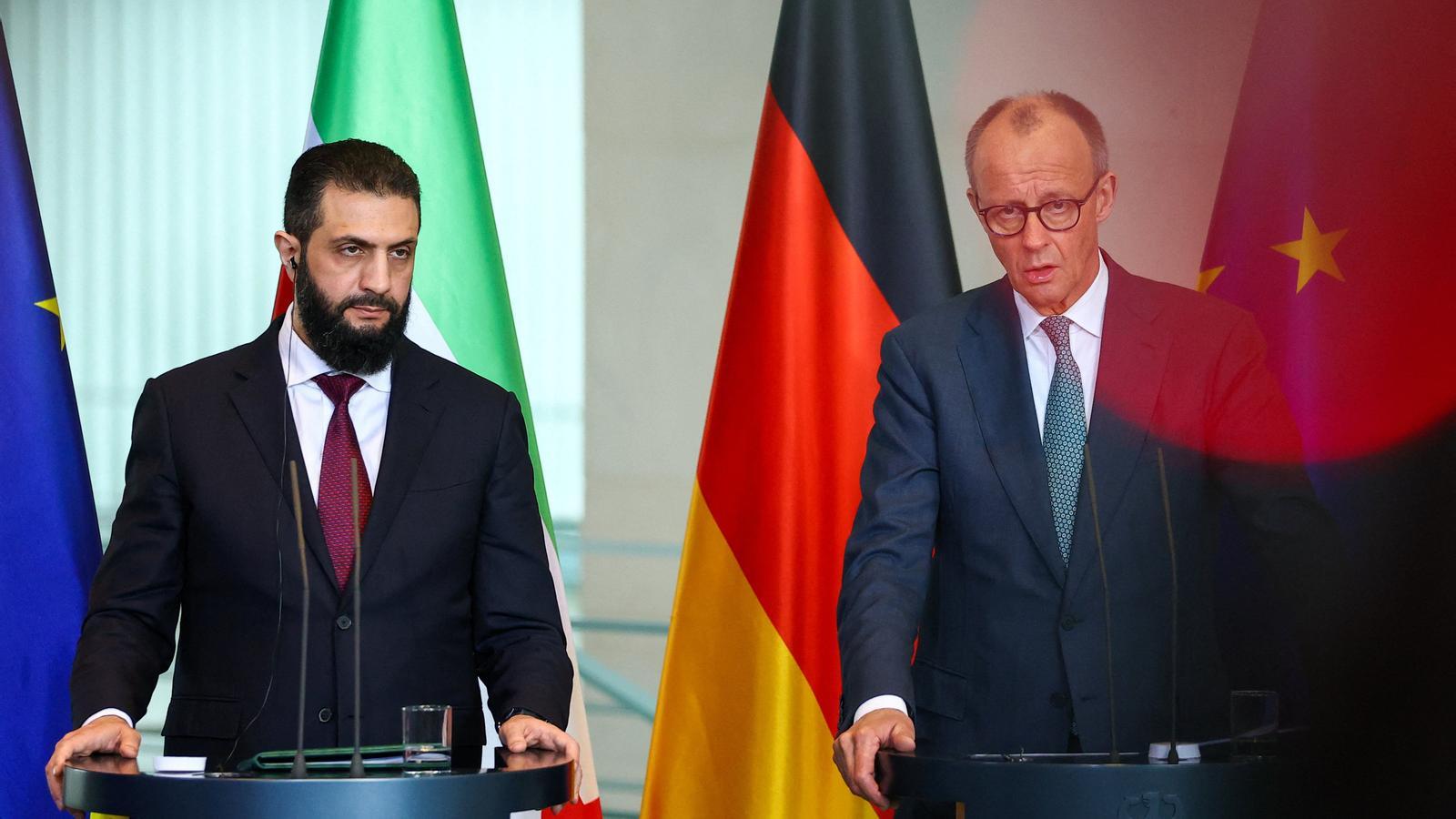
BerlinThe German government rolled out the red carpet in Berlin this Monday to receive the controversial Syrian president, Ahmed al-Sharaa, one year and three months after the fall of Bashar al-Assad's regime at the end of 2024. While Al-Sharaa sought to attract German investments and greater international political recognition with this visit, German Chancellor Friedrich Merz wanted to use the meeting to pressure Damascus to facilitate the accelerated repatriation of Syrian refugees living in Germany. And Merz got straight to the point with his wishes: the chancellor has asked that 80% of the more than 900,000 Syrians currently living in Germany return to their country of origin within three years, a decade after the 2015 migration crisis.
“One year after the end of the war, the general conditions in Syria have fundamentally improved”, the chancellor stated at a joint press conference with Al-Sharaa at the Chancellery. Merz's wishes contradict the German Ministry of Foreign Affairs, which has described the security situation in Syria as “instable”, an assessment shared by various international organizations.
Merz has announced the launch of “a joint working group” to promote and coordinate the return of Syrian refugees. Berlin wants to promote voluntary return programs and facilitate deportations, for example, of criminals. The chancellor, on the other hand, has praised those Syrians who have integrated well into Germany, among whom he highlighted doctors and engineers. Regarding this program, Germany, and also the Damascus executive, are confident that repatriated Syrians, with the work experience gained in Germany, will play an important role in the reconstruction of Syria. With their command of German, they can also serve as a bridge between the two countries, the two leaders wished to emphasize.
The Syrian exodus to Germany remains a thorny issue in Berlin today. The decision by former conservative Chancellor Angela Merkel to open Germany's doors to 1.3 million Syrian refugees in the midst of the migration crisis divided the country and emboldened the far-right. The ultra party Alternative for Germany (AfD) was founded in 2013 as an anti-European populist party, but it saw a electoral vein in the migration issue and took advantage of it to gain votes. In 2025, the AfD had 3% voting intention; today it is the second most voted party in Germany and the main opposition party.
Despite being from the same political party, Merz has been highly critical of Merkel's open-door policy to Syrian refugees. The chancellor, who has led a coalition between conservatives and social democrats since May 2025, is aware that the migration issue concerns Germans and can be exploited by the far-right ahead of the regional elections in September.
Following Merz's “promise” of the return of 80% of Syrian refugees living in Germany to their country, far-right leader Alice Weidel demanded “an immediate moratorium on naturalization for Syrian citizens and the first deportation flights”. Many Syrian refugees have rebuilt their lives in Germany and have no intention of returning. Around 83,000 Syrian citizens obtained German nationality in 2024.
"Moral bankruptcy" of the chancellor
The Syrian president, who long ago swapped jihadist attire for a suit and tie, continues to be a controversial figure. In Berlin, he was met with demonstrations both for and against him. Part of the Syrian community received him as if he were a pop star at Berlin's Hotel Ritz, amidst shouts of Allah is the greatest (God is the greatest), while his visit was criticized by refugee organizations and the German left. The Kurdish community in Germany called the visit “in unacceptable”.
Cansu Özdemir, a deputy from the left-wing party Die Linke, spoke of a “moral failure” by the chancellor. By receiving Al-Sharaa, Merz “flirts with a regime that was built on the ruins of networks linked to Al-Qaeda” and “normalizes Islamists who massacre undesirable ethnic and religious groups, such as Christians, Alawites, Druze, and Kurds”, according to the deputy.
Merz is not the first international leader to honor Al-Sharaa, despite his terrorist past. The former jihadist fighter also met in 2025 with Emmanuel Macron and Donald Trump. The UN Security Council lifted the sanctions against Al-Sharaa, former leader of the Islamist group that overthrew Bashar al-Assad's government in December 2024, in November of last year.
