Two more years of excavations: the new Barcelona Court will have to wait until 2031
Under the future courts there is an enormous necropolis and the remains of the disappeared Ribera neighborhood
-
CAT -
CAST
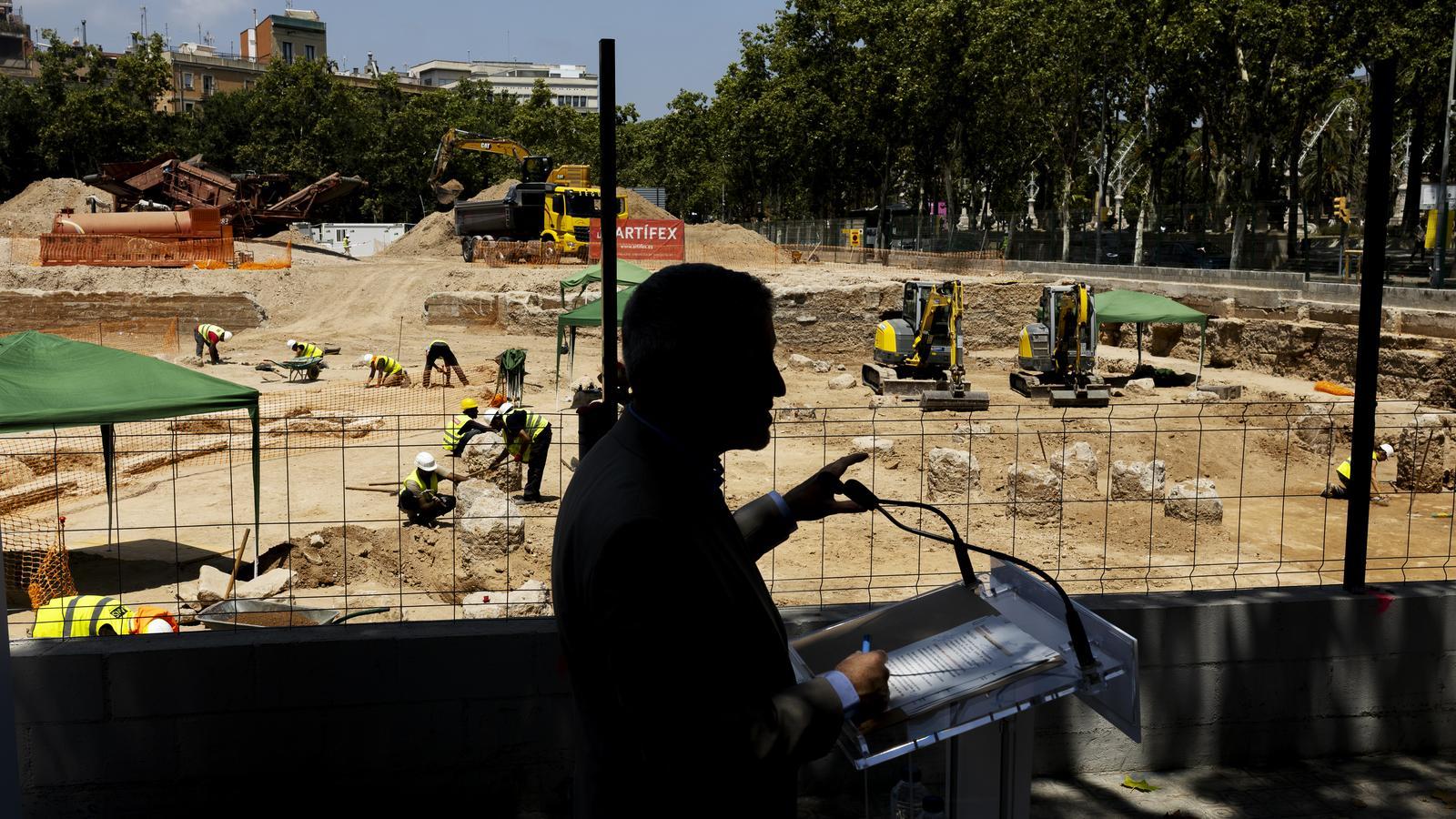
BarcelonaWhen the old municipal courts on Passeig de Lluís Companys were demolished, between 2018 and 2019, a large necropolis from the 9th and 10th centuries with 123 burials was discovered. At that time, no associated temple was found. Nevertheless, documentation from the 12th century indicates that the church of Santa Eulàlia del Camp could be found in this area of Barcelona, where some sources—although there is a great debate open—claim that the remains of the city's historical patron saint were originally buried. Those findings are just the first chapter. The excavations will continue for two more years. When archaeologists have unearthed and documented everything the site hides, at the beginning of 2028, the construction of the new headquarters of the Barcelona Court will begin. The new building will not be a reality until 2031. "We have to excavate about 6,000 square meters and, so far, we have done 2,000," explains the head of the excavations, Jordi Chorén. Josep Pujades, head of the Archaeology Service of Barcelona, highlights that the necropolis is much more extensive and, in fact, its limits are unknown.
The extramural cemetery, where the tombs were carefully planned, is only a part of the buried history. In the 14th century, the site where archaeologists are now working housed the Hort dels Tiradors. It was an agricultural area with gardens and irrigation canals fed by the proximity of the Rec Comtal. The space was part of the Ribera neighborhood, urbanized with streets like Fusina street. It gradually filled with artisan workshops, such as drapers and glove makers, and tobacco mills. All this activity disappeared suddenly with the War of Succession and the subsequent construction of the Ciutadella. Later, the site hosted the Palace of Fine Arts of the 1888 Universal Exposition, the remains of which are also currently being documented.
"The construction of the new headquarters of the Barcelona Court is a project that has been stalled for too long and this is a first step for the works to resume," assured the mayor of Barcelona, Jaume Collboni. It is a project that has suffered many setbacks since the public competition was held in 2009, which was won by the RCR Arquitectes firm. Two years of excavations will not completely halt the architectural project. According to the Minister of the Interior, Ramon Espadaler, work will be carried out in parallel on the design of the court interiors.
Will the archaeological remains be visible?
The project will involve an estimated investment of 98 million euros and will result in a building of approximately 57,000 square meters. In addition to the current sections of the Court, the complex will house the judicial library and the Civil Registry, which currently occupies a building of the Ministry of the Interior in Ciutat Vella that will become vacant. "The location where the building will be situated is a very unique point in Barcelona, on the border between Ciutat Vella and the Eixample grid — assures the architect Rafael Aranda—. The design is sensitive to this entire territory and adapts to it with different volumes." Aranda also states that, if important remains are found, they will have to be taken into account in the final project: "We will do it as we have done with other projects, such as the one in Malaga," he assures.
When the works are finished, Barcelona will have two judicial centers. On the Lluís Companys promenade, on one side, there will be the Provincial Court and, on the other, the Palace of Justice, which will continue to house the High Court of Justice of Catalonia (TSJC). The trial courts will be concentrated at the Ciutat de la Justícia. Whether visible or not, everything found will be documented and will serve to better understand the past of Barcelona. Analyses of human remains will be carried out, which will be able to explain more about how people ate, what diseases they suffered from, and what Barcelonians of that time died from. And, perhaps, the mystery of the church of Santa Eulàlia will be solved. With practically no documentary trace, it is also not descartable that this enormous cemetery was not associated with any temple. "My hypothesis is that those who were buried within the walls were the most important people, linked to the aristocracy or ecclesiastical elites. The rest of the population was buried at a certain distance from the city. During the 5th, 6th, and 7th centuries, the entire area that extended along the ancient Roman road — the Via Augusta — functioned as a burial area. It is, after all, the natural continuation of the Roman phenomenon of burying the dead outside the urban center," states Philip Banks, a historian specializing in medieval Barcelona.
