Pablo Heras-Casado: "There is no one who is above Wagner's music"
Orchestra conductor. He conducts the Bayreuth Festival Orchestra on a tour that begins at the Palau de la Música
-
CAT -
CAST
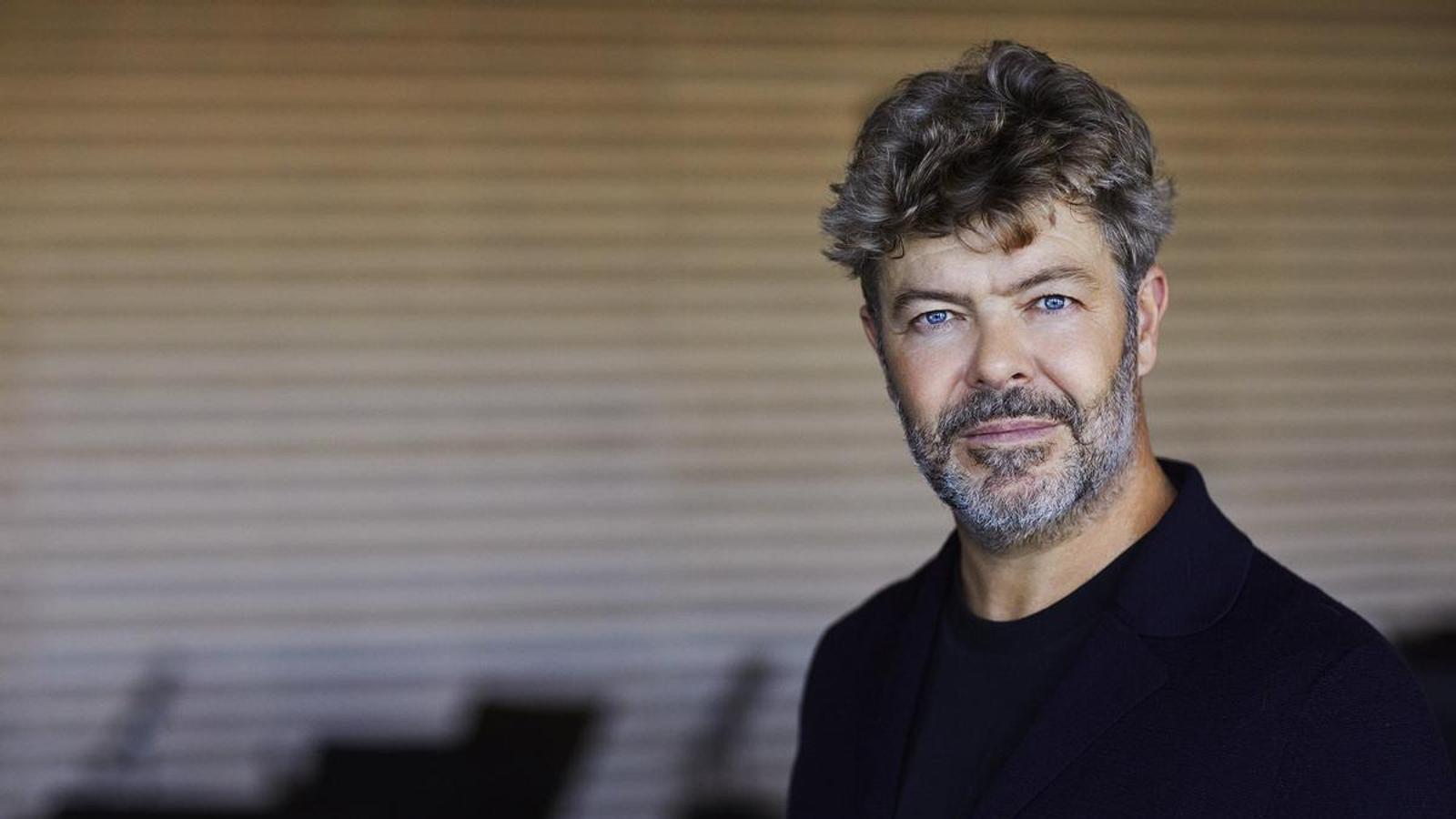
Barcelona"It is the first time that the Bayreuth Festival Orchestra has undertaken a tour like this, and it will not be easy for it to be repeated," said Katharina Wagner, great-granddaughter of Richard Wagner and director of the Wagnerian festival held every summer in Bavaria, a few weeks ago. The tour in question begins on August 29 at the Palau de la Música, to celebrate the 40th anniversary of the Peralada Festival, and will then go through Santander, Seville, Valencia, and Las Palmas de Gran Canaria. The baton will be held by Pablo Heras-Casado (Granada, 1977), who made his debut at the Bayreuth Festival in 2023 conducting Parsifal, and where in 2028 he will conduct the complete tetralogy of The Ring of the Nibelung. He is "one of the most recognized international batons currently," as Joan Oller, general director of the Palau de la Música, recalls. Heras-Casado, who retains Catalan from his years of training and work in Catalonia – which he speaks and writes fluently – speaks to ARA by phone during a break from the intense summer activity in Bayreuth.
What is more intimidating? Bayreuth, Richard Wagner, Katharina Wagner?
— Well, none of the three. Obviously, the respect is the greatest one can have, but my answer is based on four years of relationship with Bayreuth. I know what it means, and everyone who is here knows that it is the musical Olympus, but everyone is clear that what matters here is Richard Wagner. There is no one, not a conductor, not a musician, not a singer who is above his music. That's why I believe there is so much devotion and spirituality in this place, a place that we all feel as our own. When the festival ends, we count the months left until the next one begins. Yes, it is a very demanding festival that requires a lot of intensity, and it would not be possible if we didn't feel at home here. Thus, with Wagner, with the festival, and with Katharina Wagner, there is a wonderful relationship. It is a gift for me.
How does Katharina Wagner demonstrate trust in musicians?
— She simply demonstrates it by supporting us and being there. She has grown up with Wagner, she has grown up at the festival. Since she was little, she has experienced all editions alongside her father, and she is a person who has a surprisingly precise and intelligent criterion in all aspects: vocal, scenic, orchestral. It is very important that someone like her is present day by day in all aspects of artistic creation and organization. Obviously, she is a person with very clear ideas, and if she doesn't like something, she will say so too. But it's fantastic to have someone by your side with opinions you can trust.
Katharina Wagner says what she thinks about what she doesn't like, even about her great-grandfather's work. I remember the staging of Lohengrin that she directed at the Liceu in which she changed the story in such a way that it corrected the original libretto. If anyone could do it, it was her.
— Yes. In fact, I don't see it as any kind of sacrilege to give new perspectives to works from the past. This also helps you to see them with different eyes and to keep asking yourself questions. I myself directed a Carmen, by Bizet, with stage direction by Dmitri Tcherniakov at the Aix-en-Provence Festival, in which Don José was admitted to a clinic for couples therapy, and in which Carmen and Don José were a couple who already existed. These kinds of distortions, as long as they are respectful of the music and the essence of the work of art, I think they add value. They are new visions, and they are necessary.
Could 2026 be your most Wagnerian year?
— Absolutely, yes.
And in the autumn you will direct Götterdämmerung(The Twilight of the Gods) and Das Rheingold (The Rhinegold) in Paris, to complete the tetralogy of The Ring of the Nibelung with staging by Calixto Bieito.
— Yes. And at the Vienna opera I have also just conducted two complete Rings. And next year, in the spring, I will conduct Parsifal in Munich and The Flying Dutchman in Vienna. That is to say, these are two long years of conducting almost exclusively Wagner. It is an adventure I would never have imagined, because I have always been jumping from repertoire to repertoire, from Baroque to a world premiere, from Schumann to Shostakovich, from Stravinsky to whoever. To dedicate myself in depth to Wagner at this moment, and even more so coinciding with the 150th anniversary of the performance of The Ring in Bayreuth, is an impressive adventure.
Regarding the tour with the Bayreuth Orchestra, whose initiative was it?
— From Oriol Aguilà, the artistic director of the Peralada Festival, to celebrate the festival's 40th anniversary. He proposed it to Katharina and me. In principle, the idea was simply to go to Peralada and celebrate this anniversary, coinciding with the 150th anniversary of the inauguration of Bayreuth and the creation of The Ring. Then we added other partners and I myself was in charge of including Madrid, Santander, Seville, etc. A beautiful collaboration was created, and it has become a historic tour, because when the Bayreuth Festival ends, all the musicians return to their ensembles and their theaters. This time, however, they have extended their work with the Bayreuth Orchestra for more than a week, which in 150 years had never undertaken such an extensive tour as this year's. And before starting the tour at the Palau de la Música, we have a concert in Grafenegg, Austria, on August 28, but with a different program: a selection from Parsifal. And from there we will go directly to Barcelona. For me it is an honor to be the director of this tour, and even more so in my country. It is an enormous joy.
How will you work on the orchestra's sonority on the tour, considering that they are musicians who have been playing in Bayreuth, a place with a very peculiar sonority?
— The special sonority is that of Bayreuth, where the acoustics need to be adapted, and in other places it is a matter of returning to conditions that are, let's say, standard. We are all used to them. A few weeks ago I conducted the prelude to the inauguration of the Bayreuth Festival, which is an open-air concert in front of 12,000 people. We performed a comprehensive Wagner program, from all of Wagner's operas, and at times it was necessary to readjust the dynamics with which they are played in the pit: some attacks, some colors, etcetera. But the musicians are very flexible, and the readjustments are made immediately. For me, the prospect of being able to enjoy this repertoire with them, but in other conditions and adapt it to such special venues as the Palau de la Música in Barcelona, the Palau de les Arts in Valencia, the Teatro de la Maestranza in Seville, the Teatro Real in Madrid... will also be a very beautiful adventure.

The repertoire is about the tetralogy, right?
— Yes, on the occasion of the 150th anniversary of the premiere of The Ring of the Nibelung, it could not be anything other than a selection of fragments from the four operas of The Ring, both orchestral and vocal fragments, with a trio of exceptional voices: Klaus Florian Vogt, Catherine Foster, and Nicholas Brownlee, who is a very young American baritone, but who is also becoming a reference Wotan.
In fact, Brownlee will be Wotan in The Rhine Gold which will be presented next season at the Liceu, and a month ago he sang in the Simfonia del mil of Mahler, in the farewell concert of Josep Pons as musical director of the Liceu. You know Pons well enough, don't you?
— Above all, I met him when I was still in Granada as a student and he was the principal conductor of the Granada Orchestra. I had a lot of contact with him and learned a lot from him. He is a great musician and a great worker and trainer. He has a very deep musical foundation and he transmits this in rehearsals and it shows in the orchestras. I have witnessed many of his rehearsals and he has always been an inspiration. He is an orchestra builder and knows how to shape them. I remember that when he started at the Liceu, he had this purpose, to be able to redirect the orchestra at a difficult time. And it is clear that he has done so. Just as he did in Granada and Madrid. It is admirable.
Will we see you directing the Liceu in the next five years?
— In the next five years I see it difficult because everything is already quite organized. But I hope the moment will come when I can make my debut at the Liceu.
Aside from Wagner, is your big future challenge Richard Strauss?
— Yes. I have always been combining very diverse and very scattered repertoires because I was interested in everything. But in the last fifteen years, everything has been very gradual and very organic and very much about taking steps, building the repertoire since I started conducting – and I continue to conduct – Mozart and Beethoven. Then I also conducted a lot of Schubert, Schumann, Mendelssohn... I got into Bruckner later, like Wagner. And I consider that now I feel ready to continue in this vein after Wagner and delve into the Strauss repertoire. And yes, I have plans to do so.
