The UIA congress will include, from June 28 to July 2, more than 100 sessions, a large central exhibition of 4,000 m², and more than 70 itineraries through Barcelona and its surroundings, connecting the content with the territory and opening exceptional spaces for the occasion. The main venues will be the Barcelona International Convention Center (CCIB), the Disseny Hub Barcelona, and the Sant Adrià de Besòs Three Chimneys complex, while the Sagrada Familia will host the UIA Gold Medal and triennial awards ceremony.At the presentation of the program, held at the COAC headquarters, the mayor of Barcelona, Jaume Collboni, emphasized that the World Capital of Architecture 2026 “reconnects architecture with citizenship,” and that the Congress “will once again place Barcelona at the center of international debate.”The Minister of Territory, Housing, and Ecological Transition, Sílvia Paneque, vindicated the role of architecture in building a society “more just, more sustainable, more human,” thirty years after the first UIA congress in Barcelona. She defined architecture as “an act of transformation” that also shapes the framework for political action, and summarized the major challenges to be debated: architecture designed for humans and for ecological systems and biodiversity; building without destroying, prioritizing reuse and rehabilitation; linking transformations with the roots and identity of the territory; understanding public space as a humanist right; and analyzing the impact of permanent change – especially digitalization and artificial intelligence – on the urban fabric. Paneque also insisted on the “biographical interconnection” between the city and the people who inhabit it, concluding that “modernity and urbanity are the most human possibilities for coexistence in freedom for human beings.”Furthermore, the vice-president of the International Union of Architects and the Congress, Teresa Táboas, stressed that the congress “is open not only to architects, but to everyone,” because the transitions affecting the planet “do not respect the boundaries of any discipline.” She described the congress as a “polyphony of perspectives, geographies, and disciplines” seeking a common melody and vindicated the “miracle” of UIA congresses, capable of making architecture “stop talking to itself and become listening, an encounter, to create a symphony.” For Táboas, “the world is in transition; this is the only certainty,” and what is done with this transition – how it is thought, built, and inhabited – will also depend on what emerges from this congress in Barcelona in the summer of 2026.
The Barcelona World Architecture Congress in 10 emblematic works
The list of participants in the Barcelona event includes four Pritzker winners: Lacaton & Vassal, Shigeru Ban, Smiljan Radić, and Wang Shu

-
CAT -
CAST
BarcelonaThe UIA 2026 Barcelona World Architecture Congress will become, between June 28 and July 2, the global epicenter of architectural debate. The congress, titled Becoming. Architectures for a planet in transition, will bring together around 10,000 participants and 250 speakers in more than 100 sessions. Here are 10 emblematic works by some of its most anticipated architects and speakers.

Transformation of the Saint-Vincent-de-Paul Hospital in Paris into housing
By Lacaton & Vassal
French architects Anne Lacaton and Jean-Philippe Vassal have won the most important awards in the sector – the Pritzker and the Mies van der Rohe – with a philosophy based on a rigorous economy of means and the power of rehabilitation. In this case, they transform a 1950s hospital into 134 homes, 66 of which are for sale, 33 for social rent, and 35 for rent. To make this possible, they add up to four floors to the existing building. The project, which has the collaboration of their protégé Gaëtan Redelsperger, includes 2,600 m2 of commercial space, out of a total of 12,490 m2.

Blue Ocean Dome
By Shigeru Ban
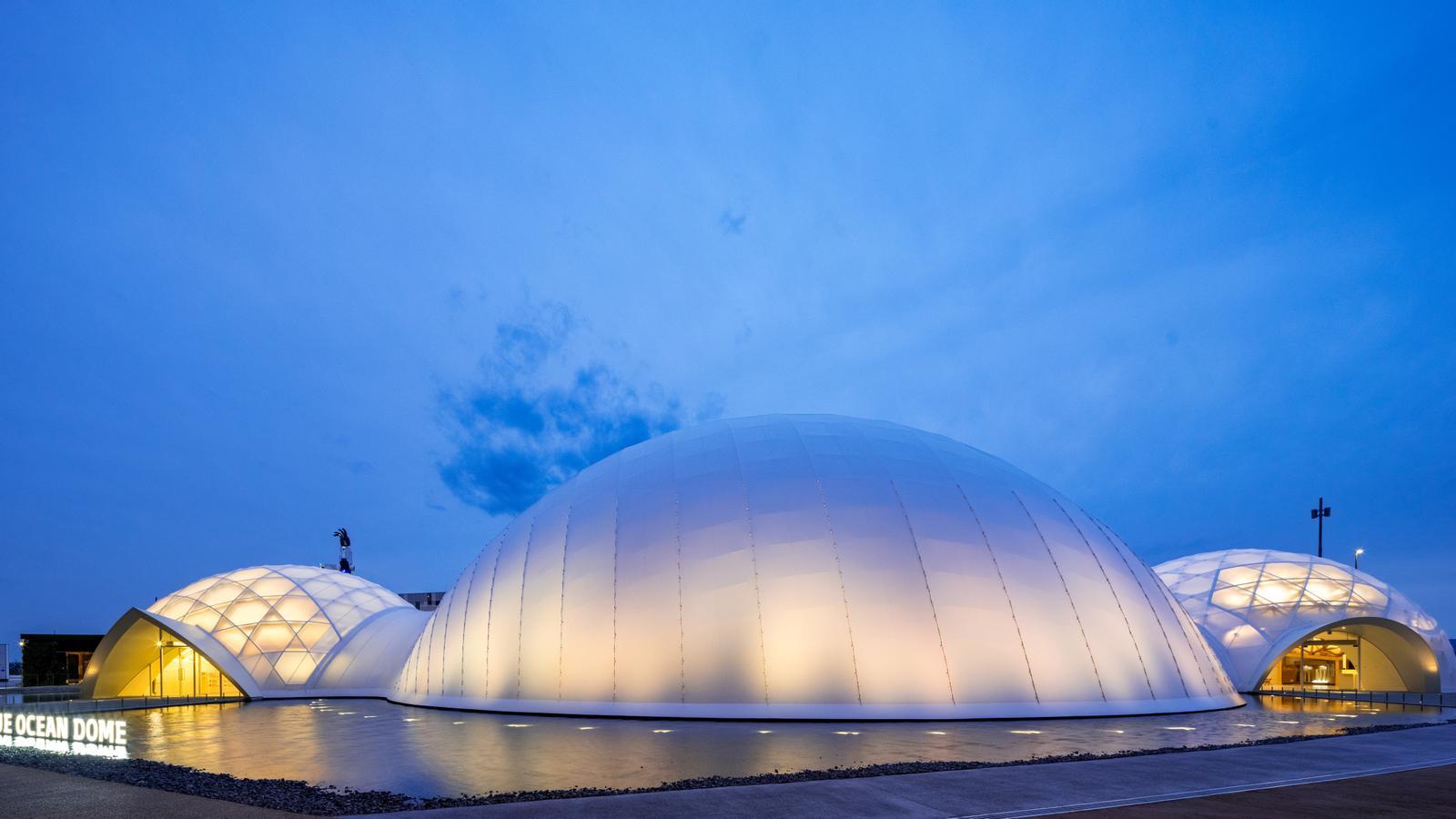
A new demonstration of the talent of the Japanese Shigeru Ban in innovation with materials and the desire to reduce their environmental impact. This work, built for the occasion of the Osaka Universal Exposition of 2025, consists of a complex of three domes built with paper tubes, laminated bamboo and, for the first time in a large structure, carbon fiber reinforced plastic (CFRP). "CFRP has been used in aircraft and car bodies, but not yet as a main structure in architecture. As the structure weighs less than the earth that would have to be excavated to make the foundations, we managed to eliminate the need for piles," explains Shigeru Ban. This made it possible to install the building on a site with low resistance and to relocate the building more easily. Shigeru Ban, who won the Pritzker Prize in 2014, is also known for emergency buildings in natural disaster contexts with these same materials.

Lin’an Museum of History
D'Amateur Architecture Studio
Amateur Architecture Studio is formed by architect Wang Shu, the only Chinese Pritzker Prize winner, and his wife and partner, Lu Wenyu. They are known for how, instead of being carried away by the wave of China's modernization based on the destruction of historical fabrics, they create contemporary, yet timeless and rooted architecture. One of the most extreme examples of their vision is the Ningbo Museum of History, built with the remains of existing buildings. They have maintained the same idea in one of their most recent works, the Lin'an Museum of History, where they integrated pieces of farmland from the village where it stands and fragmented the building into different volumes to resemble the houses of a village and not "a large container".

Limbo Museum
From the studio Limbo Accra
The Limbo Museum, in Accra (Ghana), is driven by the Limbo Accra studio, founded by Dominique Petit-Frère and Emil Grip. They are focused on "unlocking the potential of unfinished buildings in West Africa and beyond", experimenting with the repair and transformation of buildings that were left abandoned. The Limbo Museum is located within the skeleton of a brutalist building and has been operating since October 31, 2025, as a creative laboratory for architects, artists, and designers. "We adopt an intuitive and future-ready approach in relation to experience, material, and space", explain Dominique Petit-Frère and Emil Grip.
London Sky Bubble
By Smiljan Radic
The Chilean Smiljan Radic has won the Pritzker Prize 2026 for works that are "at the crossroads between uncertainty, material experimentation and cultural memory", as the jury said. "His buildings seem temporary, unstable or deliberately unfinished, almost on the verge of disappearing, and yet they offer a structured, optimistic and discreetly cheerful refuge that embraces vulnerability as an intrinsic condition of lived experience," the jury added. Among his most recent works is the London Sky Bubble, in Tobacco Dock, which in 2022 was the setting for the first fashion show of the Alexander McQueen brand after the covid pandemic: it is an inflatable cloud that recalls utopian architectures of the 60s and 70s. The generator that kept it running was powered by hydrotreated vegetable oil, a renewable alternative to diesel made from fats, food waste, and agricultural residues.

Zaishui Art Museum
By Junya Ishigami
In one of his most well-known statements, Japanese architect Junya Ishigami points out that he wants to create architecture that is like "a new nature." Ishigami is known for his bold vision: "The architecture we have is mainly based on history and past knowledge, even though we use the latest technologies. We must always rethink the meaning of architecture in our current time and its purpose. Anything can become architecture. Therefore, we must reconsider what architecture is today and temporarily forget the past to recreate new fundamental bases suitable for the present." In the case of the Zaishui Art Museum, in Rizhao (China), it is a kilometer-long walkway that crosses an artificial lake, with the aim of integrating the building into the landscape. In fact, water enters the building. In addition to exhibition halls, the space includes an information center and commercial areas and functions as the iconic entrance to a new district of the city.

Khudi Bari Modular Structures
By Marina Tabassum
Khudi Bari, "small house" in Bengali, is a modular solution to provide dignified housing for people in a situation of forced displacement, and it has been replicated in different parts of Bangladesh as self-built housing. The Khudi Bari is a structure made of bamboo and steel connectors. It is lightweight and, at the same time, resistant. It is designed so that three people can assemble it in just three days with simple tools and dismantle it in a few hours. Deep foundations are not necessary. The dwelling is divided into two levels: a ground floor for social and private spaces, and an upper floor that serves as a bedroom and shelter in case of floods. The roofs are made of corrugated sheet metal, which facilitates transport and maintenance, and the facades can be built with local materials, which strengthens the bond with the environment. For this work, the Bangladeshi Marina Tabassum won the Aga Khan Award for Architecture in 2025.

'The lost waves'
From Cooking Sections
Cooking Sections is a London-based studio formed by Spaniard Daniel Fernández Pascual and Israeli Alon Schwabe. They come from the world of architecture, but their distinctive feature is multidisciplinary environmental research often focused on food. This research allows them to reveal "practices of industrialization and extraction that are transforming the planet". Their work takes on diverse formats, such as the installation they presented at the Centro Botín in Santander last autumn, The Lost Waves. The disappearance of the Mundaka wave was the starting point for reflecting on the devastation of the marine environment. "There are many, many waves threatened with extinction, due to the construction of new ports, the dredging of new channels, and new fishing methods that increasingly alter the seabed. It is about becoming aware that the surface and the seabed are connected. And that steps must be taken to protect the waves," they warn.

Housing block in Illa Glòries
Of A Certain Study
The Barcelona-based firm Cierto Estudio, founded by Marta Benedicto, Ivet Gasol, Carlota de Gispert, Anna Llonch, Lucia Millet, and Clara Vidal, is known for some emblematic works in Barcelona in recent years, such as the green axis on Consell de Cent street, and above all for its work in housing, where a residential block in Illa Glòries stands out. The UIA has recognized it with the first UIA Young Architects award for its contribution to contemporary architectural practice. For the jury, Cierto Estudio embodies "a model of shared authorship that reinforces its commitment to inclusive processes and a practice based on common values." "The studio stands out for its commitment to architecture as a tool to improve the living conditions of the majority, with special attention to housing. In both public and private commissions, their work reflects a coherent design approach that seeks to improve living conditions while maintaining a careful balance between architectural quality and broader social impact," says the jury. Among those awarded by the UIA this year is the Fetdeterra studio.

Change Milestone
Andrés Jaque / Office for Political Innovation
The Madrid-born architect Andrés Jaque, founder of the Office for Political Innovation and dean of Columbia's architecture school, is one of the five finalists for the Shift Landmark competition, an urban laboratory for innovation and climate adaptation to be built in Rotterdam's new Waterkant neighborhood. It is a complex of up to 30,000 m² that will include an immersive experience of 10,000 m², a hotel, a conference center, and gastronomic spaces. The project starts in Rotterdam because 55% of Dutch territory is vulnerable to flooding and a large part of the city is below sea level, making it considered a global symbol of resilience. Jaque's project is titled Planetary landmark for the climate age (Planetary monument of the climate era), and is conceived as "an operational section of the planet of transformation," where there would be immersive experiences capable of activating "new social behaviors".

