The house where Macià prepared the liberation of Catalonia a hundred years ago opens as a cultural space
The new space is inaugurated this Sunday with Catalan ex-presidents and relatives of those who participated in the insurrection
-
CAT -
CAST
BarcelonaVilla Denise, a 240 m2 manor house in Prats de Molló (Vallespir), begins a new life this Sunday. The property where, in November 1926, a hundred years ago, Francesc Macià settled to lead the liberation of Catalonia in the midst of Primo de Rivera's dictatorship, opens its doors as Casa Macià, with a museum proposal and different spaces for cultural activities.
After decades of being closed, the house has been rehabilitated thanks to the combined efforts of many volunteers and public aid. Former Minister of Culture Lluís Puig, who has just returned from exile, is one of the main leaders of a project that began six years ago. "For the four long years that I lived in Brussels, I began to take a great interest in Ventura Gassol, who was falsely accused of having induced the assassination of the Bishop of Barcelona, Manuel Irurita," explains Puig. The Franco regime used this accusation to request his extradition when Gassol, Macià's right-hand man and Minister of Culture between 1932 and 1936, was exiled in France. "Gassol led me to Macià. There have been many Catalan exiles... When I was in Northern Catalonia I felt less exiled, even though during those years I could not return to my home, in Terrassa," explains Puig.
A good part of the building's rehabilitation was carried out with the selfless work of volunteers from the Casa Francesc Macià Foundation. "Without the work of the volunteers, we would not be inaugurating it: we have cut down trees, we have painted, we have restored dry stone walls and the floors of the house. All this was done by the volunteers," says Puig.
A living space for research
The new Casa Macià does not intend to be just a museum, but a space for cultural revitalization. On the ground floor, the building preserves the room that the future president of the Generalitat used to hold operational meetings, and where on November 4, 1926, the French Gendarmerie entered to arrest him.
The project is born in alliance with the University of Perpignan, and plans to deploy on-demand visits, temporary exhibitions, and an outdoor stage for open-air cinema and performances. "Furthermore, we have already announced the first historical research grant, focused on recovering the biography of three key and overlooked women from Estat Català during the interwar period and the Civil War," explains Puig, who adds that much research remains to be done regarding Prats de Molló.
The insurrection led by Macià, which was aborted on November 4, 1926, cannot be separated from the political context of the era: the dictatorship of Primo de Rivera (1923-1930), which repressed Catalanism by outlawing entities and dismantling the Mancomunitat, a fact that precipitated the exile of many political leaders, among them Francesc Macià himself. Exiled in France since September 1923, Macià wanted to create an army to liberate Catalonia.

As explained by the historian and head of the Espai Macià, in Les Borges Blanques, Marc Macià, the former colonel of the Spanish army had reacted against the dictatorship of Primo de Rivera: "Macià transformed politically over the years; he made a turn towards republicanism, the left, and independence, closely mirrored in the Irish process and armed struggle. After founding Estat Català in 1922 –the second pro-independence party in Europe after Sinn Féin–, Macià sought funding for the armed cause, but did not obtain enough resources. He even traveled to Moscow to ask for the support of the USSR and incorporated dozens of Italian anti-fascists to add men with combat experience from the First World War".
A military failure and a media success
Lluís Puig highlights the complexity of the preparation: "It was a very well-prepared military operation by a person who had been a high-ranking military officer. Everything was planned, everything was mapped, from Andorra to the sea, with all the farmhouses where people could be housed, the Civil Guard barracks, the logistics of transport to regroup the groups, how to treat the wounded, or how to act in case of being arrested..." However, neither enough men nor enough money were obtained. For Puig, bringing the names of collaborators and militants identified in the network out of oblivion is "a historical duty." At this week's event, with the presence of former presidents such as Jordi Pujol and Carles Puigdemont, according to the organization, more than twenty relatives of those who participated in the 1926 plot are expected to attend.
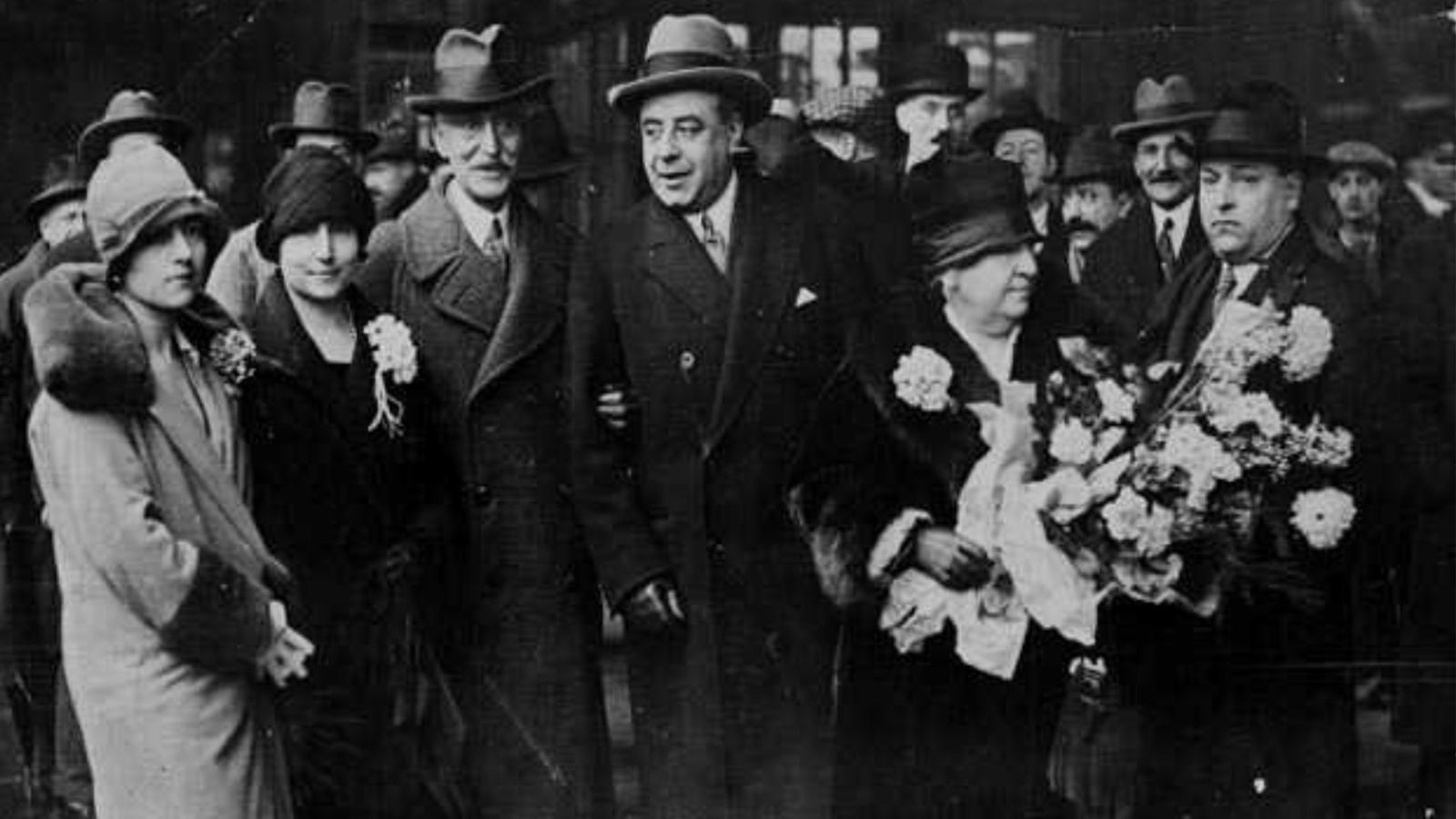
Although the Gendarmerie aborted the march before the volunteers crossed the Coll d'Ares towards Olot, the trial held in Paris in January 1927 turned the military defeat into an international political triumph. With unusual communication skills, the old colonel seduced the European press: "During the trial, he started talking about justice, freedom, and the hundreds of Catalans who had fought with the French in the First World War; he charmed the French public," says Marc Macià.
Puig agrees that the hearing in the French capital placed the Catalan conflict on the front pages of the world press: "Macià assumed full responsibility and said that all the people arrested were not criminals, thieves, or murderers, but soldiers who fought under his orders for the freedom of Catalonia. There it was understood that Catalonia had a conflict with Spain that went back centuries." Sentenced to only two months in prison and expelled to Belgium, Francesc Macià undertook a tour of America in 1928 that would consecrate him as "l'Avi" [the Grandfather]. "From 1926 to 1931, he carried out many projects; he was the only political leader who tried to bring down the dictatorship and merged different sectors that had been separated into ERC," explains Marc Macià.
The informant of Prats de Molló
One hundred years after that attempt to bring down the dictatorship of Primo de Rivera, new investigations continue to come to light. A few months ago, historian Joan Esculies published Estat Català, 1922-1931. De Prats de Molló a la Generalitat (Josep Irla Foundation), where he revealed the identity of the person who had betrayed Macià to the French General Directorate of Security in November 1926: the Italian Angelo Savorelli.
Savorelli, a native of Mezzano, joined the group of anti-fascist Italians recruited for Macià's cause, and he was assigned the role of telegrapher for the separatist army. However, from mid-October 1926, Savorelli passed first-hand information to Commissioner Marius Balmadier, head of the operation for the General Control of the General Directorate of Security.
Esculies' research also presents detailed data on the 101 Catalans and 28 Italians who participated in the incursion from France. The average age of the Catalans was 25, and 30% were deserters or had fled to France to avoid military service and the draft for the Morocco War. According to Esculies' investigation, most of the weapons used—which had been used during the First World War—were acquired through antique dealers at the Paris Flea Market.
