The Grec begins with a call to theatre for the people
Marta Pazos directs 'The Threepenny Opera' in a reivindicative opening of the festival, which celebrates fifty years
-
CAT -
CAST
BarcelonaPerhaps because it's our anniversary, the Teatre Grec Gardens are buzzing with people and activity, even though it's just past seven in the evening. It's one of the summer's big events and everyone wants to enjoy it and talk about it. The heat doesn't make it easy (shadows are highly sought after, hats and fans, at full speed), but the collective enthusiasm overcomes everything. The ducks quack contentedly – and will do so even more during the night – from the pond that welcomes one of Barcelona's most emblematic spaces. "At least they're in the water," says a woman to the man accompanying her, who follows her carrying two glasses full to the brim.
In a coincidence that is not entirely accidental, but largely the result of social and political circumstances, the Grec Festival was born in 1976 and so was the Teatre Lliure. The current directors of each –Leticia Martín and Julio Manrique, respectively – have joined forces to stage a large-scale production of Bertolt Brecht's The Threepenny Opera that lives up to the anniversary. The project was commissioned to the Galician director Marta Pazos, who has teamed up with Dani Espasa as musical director. After three performances at the Grec, it will move to the Lliure in the autumn. "It's a show with a strong essence of mischievousness and a very sharp critical sense that needs to be listened to carefully," says the director of the Grec.
Everyone who reaches the top of the garden steps is hot. Actor Carlos Cuevas is among the first to appear. Soon, the theater world conquers the gardens. Pere Arquillué, Lluís Homar, Sergi Belbel, Josep Maria Miró, Josep Maria Pou, Àngel Llàcer, and Joan Pera, among many others, stroll through them. The director of the Teatre Lliure, Julio Manrique, also joins, with his wife, actress and director Cristina Genebat; the director of the CCCB, Judit Carrera, television presenter Marc Giró, and the director of Temporada Alta, Narcís Puig. Hugs and kisses all around.
Among the institutional and political presence are the President of the Generalitat, Salvador Illa; the Minister of Culture, Sònia Hernández; the Mayor of Barcelona, Jaume Collboni, and the Councillor for Culture, Xavier Marcé. A few minutes before the show begins, and from the audience, some are betting on how many people will arrive an hour late, accustomed to the fact that the inauguration of the Grec often starts at ten at night. The last ones to open the festival just before sunset were La Perla 29's people in 2018 with The Epic of Gilgamesh, King of Uruk. As on that occasion, the length of the assembly –The Threepenny Opera lasts three hours – and the fact that it opens on a weekday have led the director of the Grec to move the performance to nine o'clock. Some celebrate it, others argue that it makes things more difficult for the company in the face of a challenge that is already risky: all eyes in the sector are on the opening of the festival and, sometimes, there is no room for compassion.

A flock of pigeons among the audience
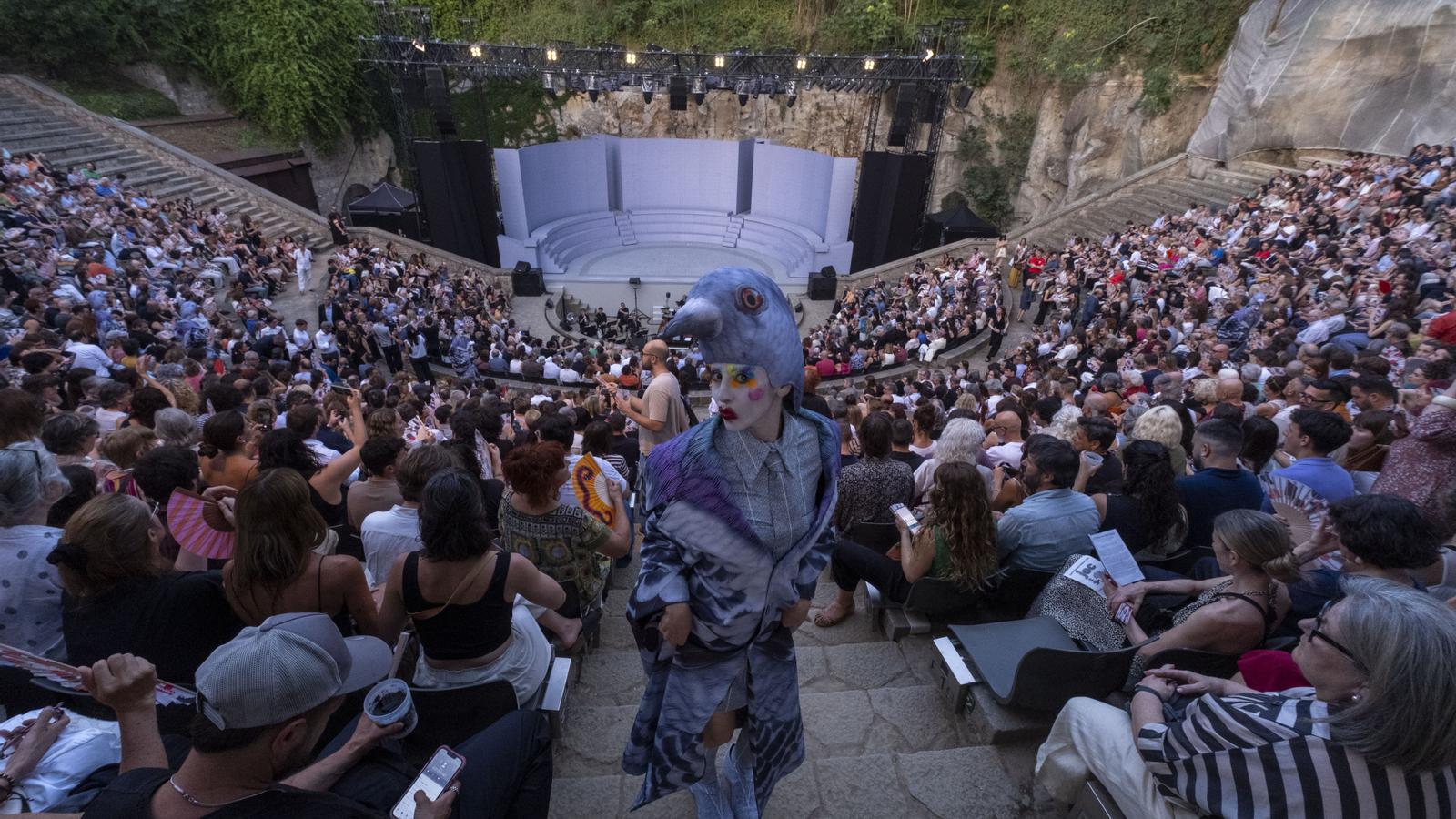
While some are still looking for their seats, a flock of human-sized pigeons unfolds among the spectators. "Come on, let's go, it's for today!", one of the birds barks at a couple slowly descending the theatre stands. They surely haven't noticed that the show has already begun and that the pigeons will be omnipresent until the play ends. Bertolt Brecht and composer Kurt Weill were inspired by German cabarets to shape this story, starring Mackie the Knife (Nao Albet) and Polly Pychum (Miriam Moukhles) in the London underworld. Pazos plays the cabaret card from the start, when he brings out his "alter ego embodied by an expansive Marta Bernal, with a striking blue mane and a loud yellow tracksuit.
"Do you know who I am? I am the Liceu's cake. You've seen it, haven't you?", says this fake Marta Pazos, addressing Collboni and Illa. "You haven't seen it? Come on! Then you'll say!", she scolds them. The imposter recalls that the 1976 Grec "was born from a group of hippies united in assembly" and vindicates that moment "of culture and democracy in which everyone did everything". Since having politicians in the stalls happens on rare occasions, the director takes advantage of it and shoots: "Collboni, El Molino returns to the stars", he demands of the mayor, a petition that receives a fervent applause. Before going up on stage, thealter ego by Marta Pazos states: "What you will see will not be an opera, nor did it cost pennies." But she promises that "the money is well spent" because she is "the queen of the colorinxis" and leaves it "very neat".
With colors, however, this time few will be displayed. The scenography – signed by Pazos herself – is a gray stand with white stripes that extends along half the circumference. The orchestra, of ten musicians and led by Dani Espasa, occupies the theater pit, opened for the first time after a long time. On stage, the characters wear the same pattern as the stands, and only in the makeup of their faces do the colors that break with the monochrome shine. In this uniform landscape, we will see a Miriam Moukhles in a state of grace and a powerful Nao Albet with the air of a Joker. Arnau Boces, Pablo Capuz, Joan Esteve, Eduard Farelo, Marc Domingo, Clara Mingueza, Biel Rossell and Júlia Truyol complete the cast of a story that rails against capitalism and inequalities, problems that the years pass and have no expiration date. The heat announced it and the inauguration of the Grec has made it official: summer has begun.
