Arnau Fernández Pasalodos: "The evidence that there was more cruelty against women is found in the same graves"
Historian
-
CAT -
CAST
BarcelonaIn the Spanish state there are still thousands of people searching for their relatives buried in mass graves. The historian Arnau Fernández Pasalodos (Barcelona, 1995) has interviewed great-grandchildren of those murdered and explains his own story and his complaint to the Huesca courts in the book Did your great-grandfather kill mine? How the trauma of the Civil War and Francoism has spanned four generations (Crítica). Because the trauma of the war reaches the fourth generation.
How did your research begin? What was the trigger?
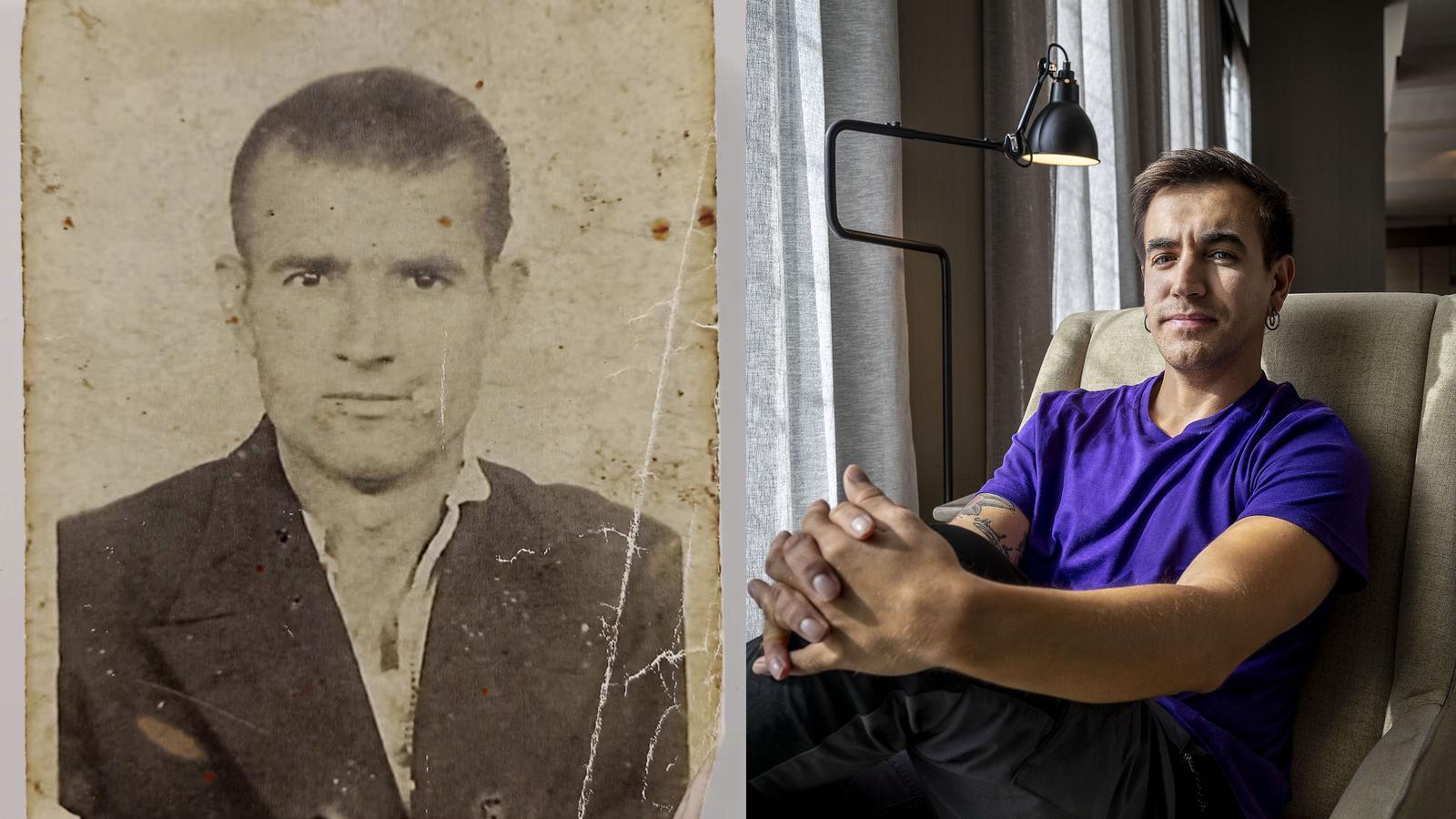
— It all starts with a conversation with my grandmother, a photo, the silence... When I was little, I was very shocked that my grandmother said: "My father was killed." She told a story that seemed quite implausible to me, especially when I was a teenager. She told me that her father was at home, that he had been reported by a right-wing brother, that the police showed up to search the house, that they fought with him and shot him. When I started my history degree, I saw that the story didn't add up. I went to the archives and started finding documentation about my grandfather, Manuel Sesé, and I discovered that in 1948 he was a victim of the "law of flight." They killed him because he was providing arms and ammunition to the anti-Franco guerrillas in Huesca, and he was a militant of the CNT. They made a custom report to cover up the murder.
You combine the family's oral history, which turns out not to be entirely true, with research in the archives. Has access to the archives been easy?
— The Ministry of Defense has opened many funds. Another matter is the archives of the Ministry of the Interior, which remain very restrictive. This is problematic because it does not allow us to consult many fundamental documents to investigate the Francoist repression. And regarding contrasting oral memory with the document, it is a fascinating topic. At home, we receive partial or modified information. Then the need to know arises. And when you go to the archive, you see the traps that the family itself has set to hide what happened during the Civil War. Francoism forced many grandparents and parents to be silent and never talk about politics. In my family, for example, nobody knew that my great-grandfather was an anarchist. It is a pity that a person's political militancy is erased by the silence imposed by the dictatorship.
You speak of emotional connection and feeling the pain. How does this connection with a great-grandfather you never met come about?
— The connecting link is the grandparents. When you are a child or a teenager and you ask your grandmother about her childhood, you see that her face suddenly changes and she speaks in a low voice. This is where you connect with the pain. I remember very well the case of Lucía Expósito, a colleague from Seville. She told me: "Arnau, when I went to university my grandmother told me: «Be careful with that business of going to university and learning»". Why? Because this woman's mother was executed by firing squad in Fuentes de León because she knew how to read and write, because she went to the People's House and read aloud to illiterate people. Furthermore, she was linked to the Socialist Party. Her daughter related throughout her life the fact of being a woman and having culture with violence.
There is also a sense of injustice and helplessness.
— Injustice, powerlessness and rage are words that constantly come up. Many of the great-grandchildren have not recovered their great-grandparents' bodies. Or if they have been found, it was when the grandparents had already died. You find the body, but you can no longer say to your grandfather: "Here is your father, now we can have a proper period of mourning and a dignified funeral." This is explained by Francisco Javier, a colleague from the Huelva mountains. When he found his great-grandfather and other neighbors executed on the same day and thrown into the same mass grave, he organized a funeral in the village. All the elderly people who were still alive went there to offer their condolences for the deaths of the year 36. There, a process of restitution and dignity took place, a way of lifting a weight off their shoulders.
Has enough been done in memory policies?
— They are completely insufficient. Furthermore, we have a serious problem depending on the autonomous community. In Andalusia and Aragon, with the PP and Vox governments, the regional laws called "reconciliation" laws have allowed for the elimination of funding allocations to open mass graves. Exhumations are paralyzed, and associations or families have to take charge of them. International law obliges states to guarantee investigation, justice, reparation, and guarantees of non-repetition. These regional policies go against international law.
In the book you also address the specific violence against women, like the case of Blanca and her great-grandmother, who was killed while pregnant and they boasted about it. Was there more cruelty against women?
— Without a doubt. And it is not just talk: the material evidence that there was more cruelty against women is found in the graves themselves. In my research on how the Civil Guard repressed the anti-Francoist guerrilla in the 40s and 50s, this is clearly observed. Since they could not catch the guerrillas in the mountains, their target was the women who maintained the support networks in the farmhouses.
You decided to take your great-grandfather's murder to court. How was that process?
— It started when I went to the Huesca cemetery. My family never knew where Manuel was buried. In an archive, I found the death certificate, which indicated the exact burial site. I went there with the cemetery caretaker, and he pointed out the place: on top of the grave, they had built a block of concrete niches. Seeing that my great-grandfather's grave was buried was a moment of humiliation and deep pain. Months later, I had a meeting with Dolores Delgado, the prosecutor for historical memory. Upon explaining the case to her and showing her the documentation, she told me: "Given all this, you are a victim and this can be investigated as a crime against humanity." Crimes against humanity do not expire. I have the names of the civil guards who went to the house –Agustín Serrano Arroyo and Martino García Gracia– and the autopsy report signed by the forensic experts, where it is specified that my great-grandfather had a single gunshot wound to the head, fired at close range. He was on his knees and handcuffed. It was a clear extrajudicial execution. That was how I testified before the Prosecutor's Office. For me, it was an act of dignification, as if I could speak on behalf of my grandmother. Now the judge will have to decide what to do. The killers are already dead and will not go to prison, but the justice system can officially declare that Manuel was a victim of a crime against humanity and identify those materially responsible.
Why is it so important to focus on the perpetrators and not just the victims?
— Because historiography has studied victims a lot, but perpetrators very little. When we take high school students to see the opening of a mass grave, the emotional impact is enormous. They cry, they understand what happened, and they realize that the grave does not appear by spontaneous combustion: there are men with names and surnames who dug the grave, fired, and delivered the coup de grâce. The graves are the most powerful tool we have today to educate new generations against fascism, revisionism, and neo-Francoism.
