The eternal life of Iny starts at the Egyptian Museum of Barcelona
An immersive exhibition discovers the history of this high official who served three pharaohs during the Old Kingdom
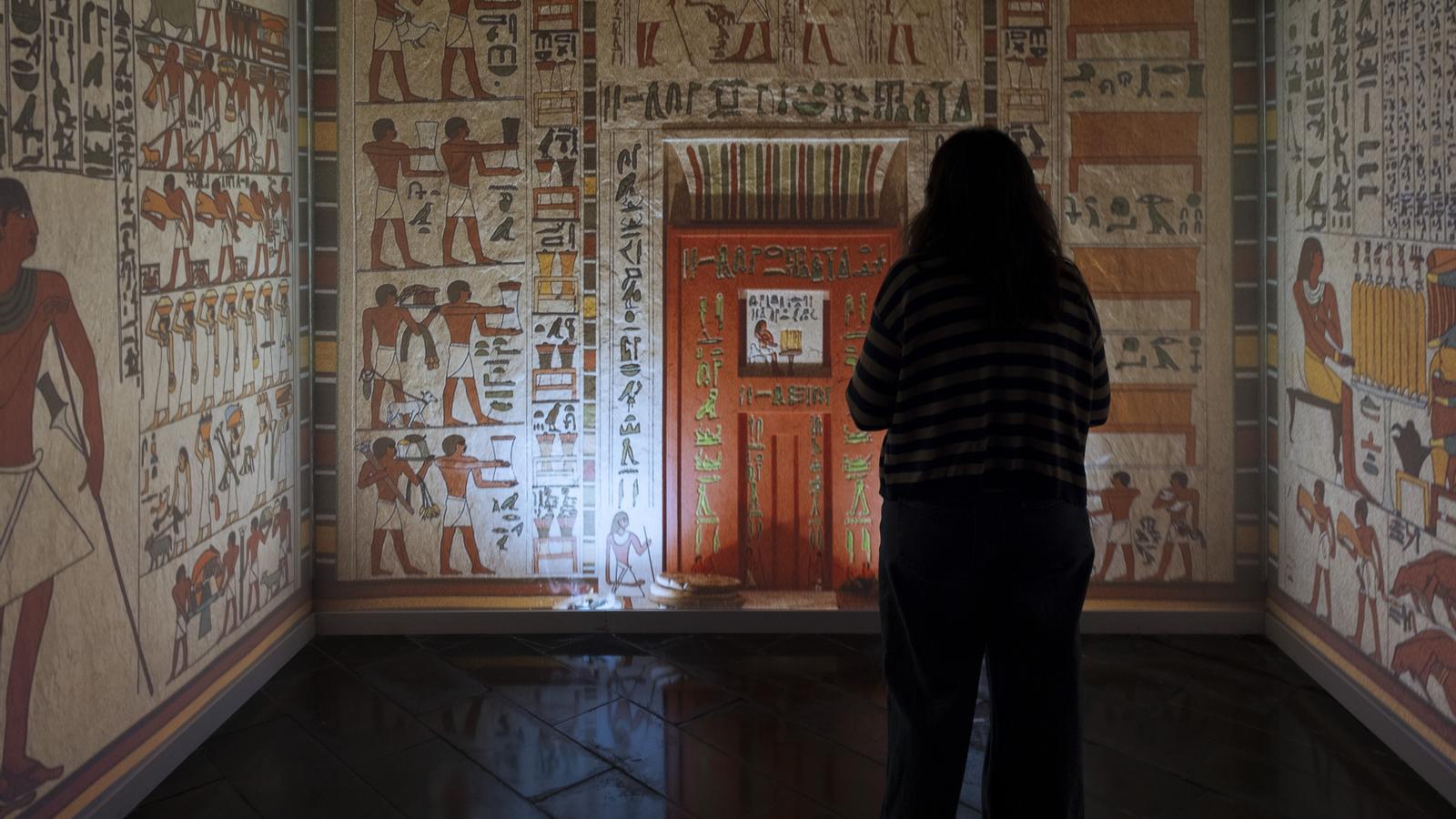
Barcelona"Now Barcelona is my home. Thanks to this museum, I will continue to live eternally. Speak my name, Iny; only then will I be able to continue living eternally. Bring me bread, beer, even geese, if you find any". The one who speaks like this is no fictional character, but Iny, an Egyptian of humble origin who climbed to the core of power during the reigns of Pepi I, Merenre I, and Pepi II. Now, four millennia later, it is he who takes the visitor by the hand to guide them to the Egypt of the 6th Dynasty in the first immersive venture of the Egyptian Museum of Barcelona: Iny, the pharaoh's explorer.
Where this high official was buried is still a mystery. Despite the looting, some pieces of his chapel survived and traveled to Europe and Asia. They are fragments that explain, for example, that he led six expeditions to unknown lands to supply the pharaohs with lapis lazuli, cedar, perfumes, oils, and lead. Jordi Clos, president of the museum, followed Iny's trail in different cities around the world. "I bought the first piece of his tomb in London in 1991, when the Egyptian Museum didn't even exist yet. I was fascinated by its aesthetics and its function: a false door that connects the world of the living and the dead", he recalls. For thirty years, the collector has been completing this puzzle with six original pieces. Some parts of Iny's chapel are kept at the Tokyo National Museum: "Since we couldn't get them to loan them to us, we have made reproductions", he admits.
Iny's rise
Iny died in 2222 BC after an exceptionally long life in which he served three pharaohs. The inscriptions in his chapel reveal that he accumulated religious, administrative, and military responsibilities. Among his titles were Sole Friend, leader of strong men, lector priest, or leader of scouts. He also received the necklace of flies, a distinction reserved, for all that the insect symbolizes, for the most persistent. Until this October, the Egyptian Museum had always told the story of this ancient civilization based on the more than 1,359 pieces that Clos has been buying over the years. "We have taken a great leap that until now we did not have in mind," says the hotel businessman. The museum's old library has now been transformed into a room where seventy pieces from the Sixth Dynasty dialogue to put the life of the protagonist of the immersive projection into context.

"Iny is a fascinating character because he had been completely erased from history, and he didn't deserve it given everything he lived through," remarks Clos. This explorer was a witness to the twilight of the Old Kingdom, when the centralized power of the pharaohs was blurring in favor of local rulers. "Nothing is invented; everything responds to the real life of Ancient Egypt," emphasizes Clos. The projection starts in Saqqara – the largest necropolis in Egypt where the first stepped pyramid of Djoser stands – from where Iny flies eleven kilometers to Memphis, the capital of unified Egypt. Known as "the city of the white wall," the digital reconstruction prefers not to speculate on the material of the wall because no remains of it have been found and, therefore, archaeology does not know it. "The project, which has required two years of interdisciplinary work, puts high technology at the service of research and heritage," remarks the director of the Egyptian Museum, Maria Àngels Taulé. "We wanted to be very rigorous."
Memphis from 4,000 years ago
Iny brings the spectator into the pharaoh's palace. As no trace of it remains, the reconstruction is inspired by other palaces of high-ranking officials. Large silos and slaughterhouses are the antechamber before entering the building, where Iny is received by the pharaoh. There are musicians, scribes... The one who places the necklace on him is a woman who broke many molds, Nebet. In the midst of the Old Kingdom, the pharaoh Pepi I appointed her vizier, the highest administrative and legal authority in the country, only below the king himself. Her selection was no coincidence: Nebet was the mother-in-law of Pepi I and one of the most influential figures at court. This appointment made her one of the first documented women in Egyptian history to assume a position reserved almost exclusively for men. The immersive projection is full of small details: the rooftops of the houses, some with looms, are based on the engravings in the tomb of Meketra; the shipyards, where the vessels were built; the market; the unreachable Nile; the small boats where fishermen fish with small baskets; the lush vegetation from which they extracted papyrus...
The rigor of the reconstruction has even contributed academic findings. Such is the case with the design of ships that went out to the high seas. "We thought that the raised stern in the boat engravings was a matter of artistic perspective. But when comparing it with the vessels of the 5th Dynasty, we discovered it was a real technological innovation: the helmsmen would climb to the highest part of the stern to better command the ship and the sails," explains Taulé. The exhibition opens this Wednesday and can be seen for a full year. Afterwards, the museum will begin a new immersive project.
