Silvio Rodríguez: The Cuban process would have been very different if they had not flogged and distorted it so much
Musician. Performs on September 1st at the Gran Teatre del Liceu
-
CAT -
CAST
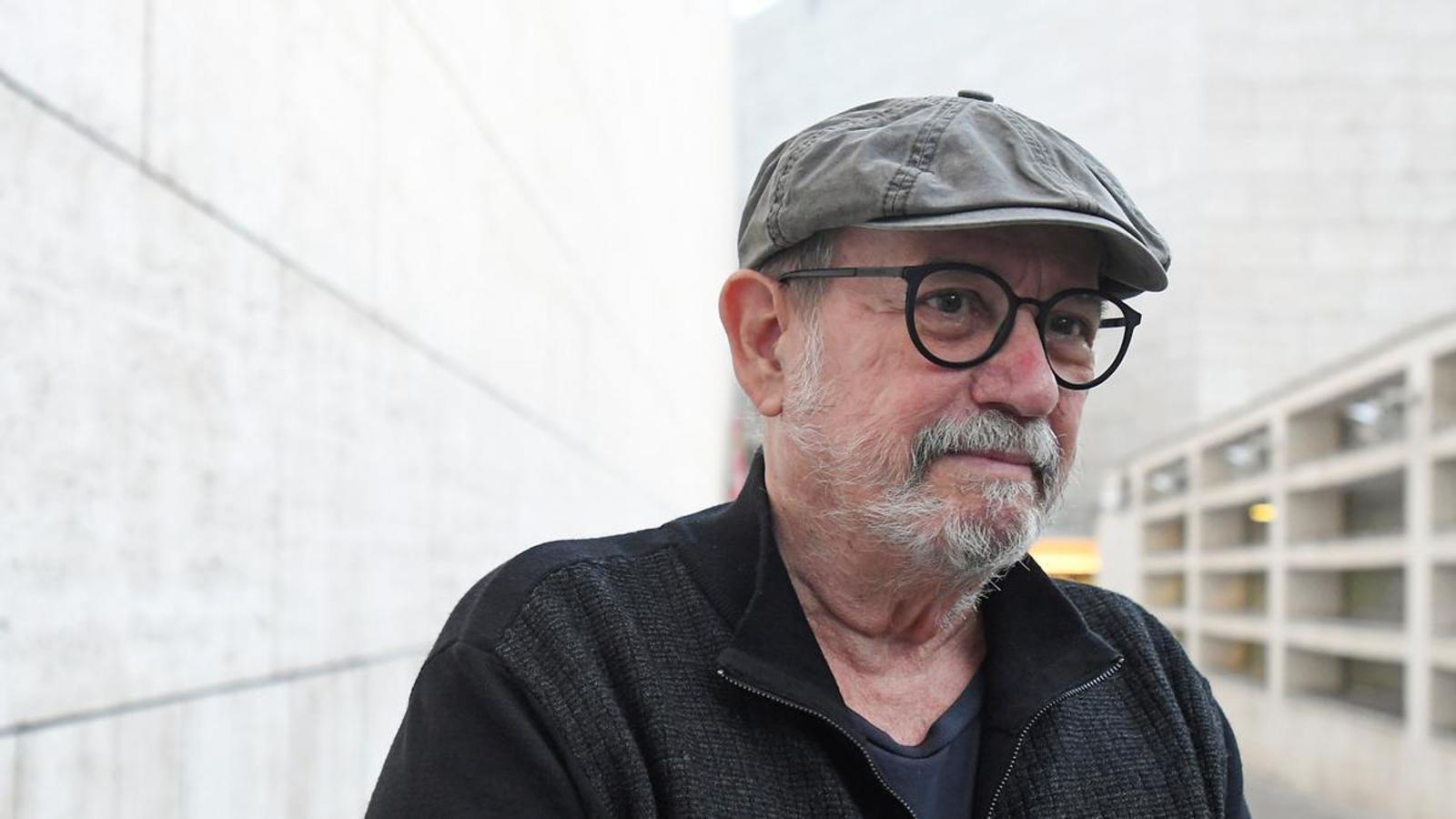
HavanaFounding figure of the Nueva Trova Cubana and one of the most influential voices of Latin American singer-songwriter music, Silvio Rodríguez (San Antonio de los Baños, 1946) is preparing a tour that will stop by the Gran Teatre del Liceu on September 1st, where he hopes to reconnect with "old and very dear brothers and friends" and will share the bill with Joan Isaac and Sílvia Comes, and on the 16th at the Roig Arena in Valencia. About to turn 80 and with nearly half a century of albums behind him, the singer-songwriter responds to the interview in a dark Havana, hit by power outages and the tightening of the US blockade. We meet on the ship Astral, anchored in the port of Havana, which has brought photovoltaic materials from Barcelona across the Atlantic. The singer, who wanted to personally welcome the crew and all the volunteers of the "Rumb a Cuba" mission, talks to ARA about doctors operating with mobile phone light, music schools closing early, the legacy of Che and Fidel Castro on the centenary of their birth, his well-known request for an AKM rifle to defend the island and, also, about his blog, photography and a trova that resists. "It is almost a miracle that Cuba exists," he assures.
One of his latest songs with the Argentine Milo J. is titled Luciérnagas. Although its content has no relation to it, these days Havana at night has seemed to us a city of fireflies: small points of light here and there. How do you experience the current tightening of blockade measures?
— Luciérnagas is not my topic, but that of the young and very talented Argentine singer-songwriter Milo J. I only lent a little bit of my voice. We live waiting for fuel to appear so we can start the electric plant of our Ojalá Foundation and continue working; looking for medicines for the sick; trying to help those who have the least. The doctors, who are our daily heroes for their constant dedication, have had to finish operations with the light of phones. There are tens of thousands of patients waiting to be operated on, including several thousand children. This is our daily life.
Regarding Cuban music specifically, what is its situation? Do the lyceums, music schools, orchestras still function...? And how have the latest migratory waves affected Cuban talent on the island?
— Due to the power outages caused by the oil blockade, this year the country's schools had to close earlier than usual. It is not yet known how the start of the school year will be faced. The University of the Arts had to send its scholarship students to their respective provinces. The start of the next academic year is also not entirely clear. There are orchestras that continue to work with great sacrifice; public transport is scarce due to the lack of fuel and has been resolved with tricycles, by popular initiative. I have no elements to comment on the national incidence of migration on music, even though two of my regular musicians live outside of Cuba. Right now we are about to get together to prepare for the tour. This is how we work. In other crises, when conditions have improved, musicians and orchestras return. We will see if the same happens later. What I can guarantee is the joy, the special feeling that any cultural activity generates, especially musical ones. From a symphonic concert in the Havana cathedral, through another of songs on the university steps, to the charming performance of a small children's choir at the Casa Vitier-García Marruz, a feeling of spiritual cohesion spreads that is felt, that embraces and accompanies people in their very hard daily lives.
And at what point is the Cuban trova today?
— I know that a television program is maintained and that some clubs survive. The poet and filmmaker Víctor Casaus, under the current difficult conditions, is trying to revive the Pablo de la Torriente Brau Cultural Center, where for three decades the production and recording of trova concerts was systematized, in addition to stimulating plastic arts and book publishing. Let's hope he succeeds.
In the song Sea señora, from the album Segunda cita (2010), it said: "To disenchantment, oppose desire. / Overcome the 'r' of revolution. / Restore what I see as decrepit, / but leave me Maceo's arm / and, to lead it, his reason". And on that same album, in Bendita (yo fui una vez), you sing: "To the patroness I will ask in the hermitage / that she free us from the blockade and the troglodytes". Who is she pointing to as troglodytes? What would need to be restored in today's Cuba without renouncing the reason of General Antonio Maceo (1845-1896)?
— I was referring to the restoration of the pristine sense of the Revolution, that is: a revolution of the people, by the people, and for the people, not for an omnipotent and mechanical bureaucracy. That's why I end up saying: "When wings turn into hardware / it is time to make the journey again / to the seed of José Martí".
In the Tonada del albedrío, also from Segunda cita, it says: "Guevara the human said / that no intellectual / should be salaried / by official thought". This year marks the 65th anniversary of Palabras a los intelectuales, the speech in which Fidel maintained that Cuba would not have an official art – as socialist realism was in the USSR – and distinguished between revolutionary, counter-revolutionary, and non-revolutionary artists, the latter to whom maximum freedom of creation should be granted. What assessment is made of this cultural policy? What is the role of intellectuals in Cuba today?
— In the early years, some leading sectors dreamed of implementing Stalin's conceptions in Cuba from the USSR. Fortunately, Che and Fidel were revolutionary intellectuals and did not believe in the so-called socialist realism. Nevertheless, our cultural policy has been refined over time. In the early 70s there was a special moment of extremism that Ambrosio Fornet described as the Grey Quinquennium, and so it is known. Fortunately, the Ministry of Culture was later created, with Armando Hart at its head. Another good moment was Abel Prieto's first term as Minister of Culture. Both periods had great support from Fidel, who was interested in the problems of the cultural world down to the last detail. Most of the intellectuals I know (people from the arts, but also from economics, sciences, and thought) tend to be people with their own ideas, with contradictions with reality, and at the same time, with high patriotic feelings. Many have managed to present their ideas and, whether they are heard or not, they defend them consequently. If we live in a society where we all have to participate and can do so, I believe this is what is expected of us.

The album Quería saber (2024) opens with América, which ends with these verses: "May the light keep me / from America's embrace, / from its gaze, / from its love spell. / At dawn / America's cry is heard / and it resembles pain". They refer us to the current situation: did you write them thinking about it?
— When I finished this song, several people asked me if America was imperialism. And I think they thought so because of the moment when the protagonist ties himself to the mast of the ship so as not to be dragged away by irresistible beauty (an allusion to Odysseus when he approaches the sirens). But it turns out that this song is dedicated to a neighbor of mine from decades ago, to a beautiful and desired girl who was called that: América. And everything I explain there happened to suitors who went crazy with her beauty. From my window, near hers, I heard her cry at night. It was then that I realized that beauty, sometimes, could seem like a solitary light bulb, surrounded by bugs attracted to the light.
Maintain a harsh but always constructive criticism. To Para no botar el sofá sing: "To pronounce the we, / to complete the unity, / we will have to count on the other, / the lights and the darkness". How do you value the latest measures of the Cuban government to liberalize the economy?
— We come into a world, a reality built by many others over a process of millennia. The least we can do is express what we think. That's why my songs are the way they are. Sometimes, even describing a landscape is critical. Criticism and self-criticism are present in family relationships and friendships: how could they not be in social matters? It's the most natural thing in the world. The Cuban government's measures were eagerly awaited by practically the entire country. Many things people already did spontaneously, out of survival. I had been waiting for these changes for more than three decades. I believe that laws still need to be reviewed, even the Constitution. In the early 90s, I wrote some songs about our shortcomings. Such as Hacia el porvenir: "Hacia el porvenir partieron sombras. / Cuando no alcance, solo podré alertar. / Si alguien me oye allí, no se olvide pues / de iluminar".
Your position has been firm in two recent statements: a video, viral on social networks, in which you state: "I believed in the heart of Fidel and in the heart of Che". What assessment do you make of the Revolution and the figure of Fidel on the centenary of his birth? And your already famous request for a rifle to defend Cuba from an eventual American intervention, was it expected to go around the world?
— The Cuban experience appeared alongside the most arrogant and cruel empire in human history; so much so, that it has managed to make the world order itself and behave according to its interests. Those who do not do so are slandered, invaded, assassinated, and dispossessed of their natural resources. It is almost a miracle that Cuba exists. For this reason, the Revolution always had a great need for self-defense. This, in a certain sense, strengthens, but also conditions and can even create a habit. I believe that the Cuban process would have been very different (in a better sense) if they had not harassed and distorted it so much. I said this about the heart of Fidel and Che ten years ago, when I was about to turn 70. Asking for a rifle to defend the sovereignty of my homeland is much older: it is part of my molecular configuration, of my atomic consistency. Cuba has always had to fight for its freedom, being a noble people who only want to work in peace and prosper.
His musical output is very extensive: practically one album every two or three years since 1975. What balance does he make of this long career, now approaching 80 years old? Does he have new projects ahead?
— I have been writing songs with a certain regularity for 65 years. I made good use of the first 30 years in particular. It was as if I knew that life gets complicated and distances us from what we love most. I have just finished Cualquiera que nace en Cuba, which I hope to show soon, and I have a few other things in preparation…
Next September he/she will visit Catalonia. What message would you like to send to your Catalan followers?
— To begin, in Catalonia I have a Catalan son and a Catalan-Vietnamese grandson. So you see. Right in beautiful Barcelona we will begin our tour, at the Gran Teatre del Liceu, where I will meet again with old and much-loved brothers and friends.
There are two tasks to which he seems to dedicate daily constancy. On the one hand, the blog, which he updates very often and which generates quite a few controversies inside and outside of Cuba. On the other, one that goes more unnoticed but is no less interesting: he is always accompanied by a camera. What value does he give to photography and how does he relate to it?
— As explains the first page of my blog, Second date, I started by seeing what a blog was. It quickly filled up with people and it was like that for about twelve years, until I couldn't take it anymore and had to do without the "red bee". The last four years what I do is upload interesting things I find in my readings and some of my own. I clarify that I do not agree 100% with everything I publish from others. Even sometimes I disagree with almost everything. But I like thought to circulate. My childhood took place in the 1950s. That's when news and "evidence" of visitors from other worlds, flying saucers and other herbs began to appear. That's how I learned that a camera had to accompany me everywhere (no UFO would escape me) and, as soon as I could, I got a very rudimentary one. Working in the press from a very young age, knowing photographers, darkrooms, projectors and chemicals made my desire grow. Photography and visual arts fascinate me.

