The best nights of classical music at the foot of Montgrí
Núria Moliner, Xavier Antich, Rosa Maria Calaf, Eudald Carbonell, Sira Abenoza and Xavier Albertí recommend to ARA six concerts of the 46th edition of the Torroella de Montgrí Festival
-
CAT -
CAST
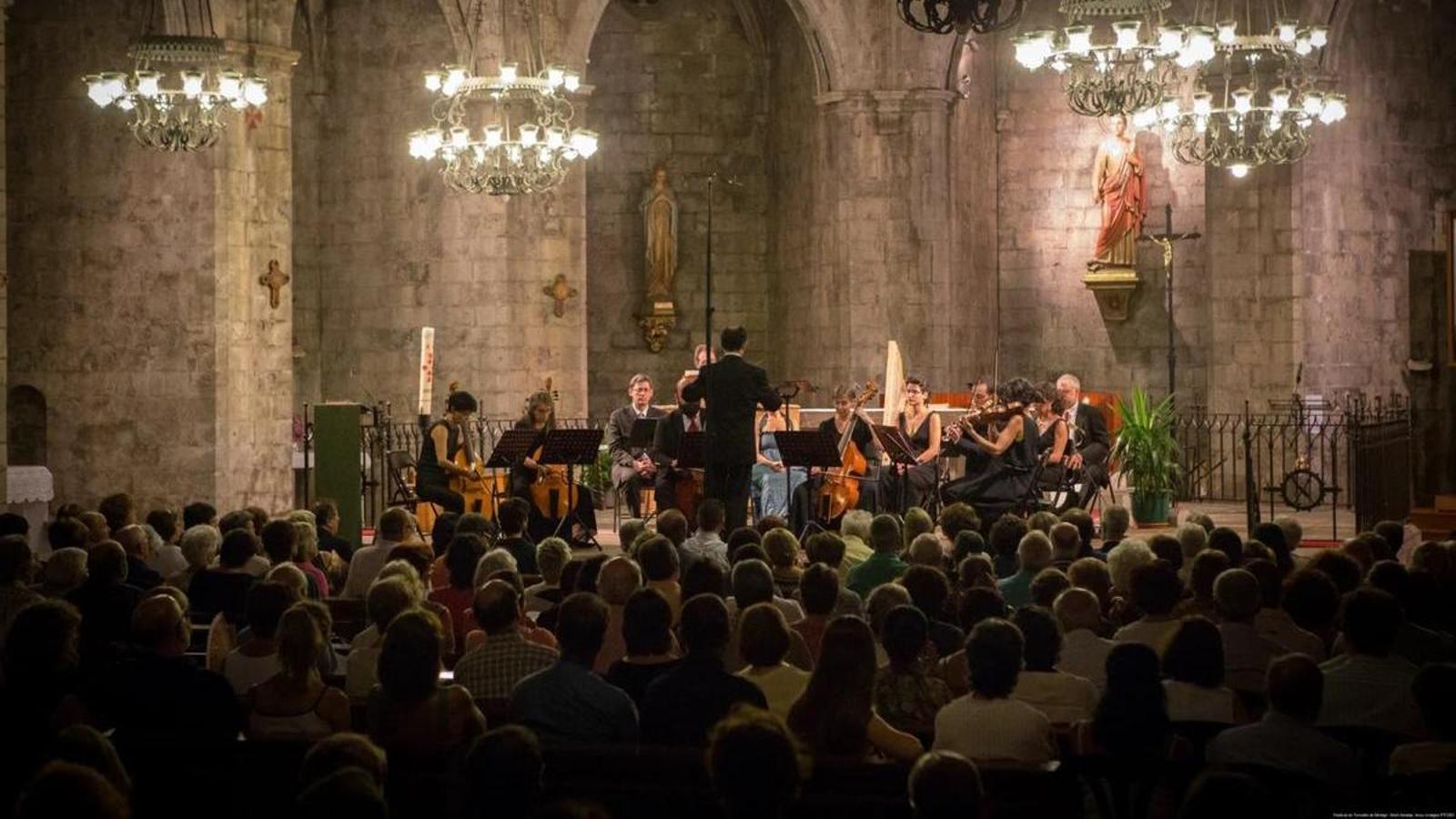
GironaLike every summer, for a month, from the end of July to the end of August, Torroella de Montgrí once again becomes the musical capital of Baix Empordà. During the tourist season of major festivals on the Costa Brava, filled with media names and magnificent stars, the Torroella event, at the foot of the Montgrí massif, keeps its identity alive with 16 classical music concerts, from Baroque to contemporary proposals, very interesting and of a high level. Of the entire program of this 46th edition, which is presented under the slogan Love also leaves a trace, ARA recommends, with the help of renowned personalities from the world of culture, six unmissable concerts for summer nights.

The Torroella Festival is always a guarantee of the best chamber ensembles, and the Diotima Quartet, a string quartet specializing in contemporary music, is an excellent example. Accustomed to interpreting the most modern language and premiering works by 21st-century authors, the four musicians of the ensemble at Espai Ter will offer, in addition to pieces by Ravel and Debussy, a new piece by the composer from Reus, Joan Magrané, in a neat and refined style. The philosopher from Igualada, Sira Abenoza, strongly recommends it: "It is a great opportunity to hear, for the first time in Torroella, one of the great current chamber ensembles, which will premiere a work by the magnificent Catalan composer Joan Magrané, written at the request of the Festival." Furthermore, regarding the ensemble's name, the thinker adds: "I have always been fascinated that a quartet of four men bears the name Diotima, the woman whom Plato first and later Hölderlin present as the great teacher of love".
The second recommendation is for another string formation, in this case a trio of violin, viola, and cello. They are The Rest Project, a very open-minded ensemble that usually combines music from composers of different eras with interdisciplinary proposals. And the Torroella concert is no exception. They will alternate pieces by György Kurtág, a contemporary composer heavily indebted to the classical masters, with works by Johann Sebastian Bach. This is why their proposal has caught the attention of architect and communicator Núria Moliner: "It's a good way to get to know this Hungarian composer, who in 2026 will celebrate 100 years, and, moreover, they will do so by linking him with arrangements of the Goldberg Variations, a classic, a very accessible and beautiful piece that it's always good to reconnect with," she argues. True to their experimental spirit, the concert will also intersperse poems by Joan Margarit recited in recordings made by the poet himself, who died in 2021. "I find it very beautiful because Margarit is one of my favorite poets. He was, in fact, an architect and structural engineer. I have all his books and his poems are beautiful," concludes Moliner.
The Lloret native Xavier Albertí, a man of theatre and culture, never misses a concert by the prestigious pianist Elisabeth Leonskaja when she performs in Barcelona. He is an unconditional admirer. Nor will he miss the opportunity now that she is coming to Torroella as the soloist for Mozart's Piano Concerto No. 12. She will perform accompanied by the English Chamber Orchestra, under the baton of the Polish conductor Marzena Diakun, in a program centered around the great First School of Vienna, which will be completed with Haydn's Funeral Symphony, and Schubert's Symphony No. 5. "I am an absolute fan of Leonskaja. Every time I go to see her, I leave gratified. She is the last representative, at 80 years old, of a deep school of performers that unifies the best of the great Jewish, Russian, and Viennese tradition," says Albertí. And he concludes: "She is a woman who achieves things that no one else gets from the piano: colors and instrumentation so polyphonic that it sounds like you are listening to an entire orchestra. Don't miss it."
The ensemble The Tallis Scholars, directed by Peter Phillips, has been an undisputed world reference in the performance of Renaissance choral polyphony for over fifty years. On their second visit to Torroella, they will offer a journey through two of the most influential composers of the 16th century: the Italian Giovanni Pierluigi da Palestrina and the Franco-Flemish Roland de Lassus. "Choral polyphony is the musical miracle that allows the conjunction of several voices, sounding simultaneously, with independent melodies but harmonically related in all their richness, without renouncing any nuance and enriching themselves with all differences. A revolutionary model that forever changed European music until it became an aesthetic paradigm and, above all, still today, an ideal of sociality. If we can sing like this, why can't we live like this?", reflects Xavier Antich, a philosopher specializing in aesthetics and president of Òmnium Cultural. All the vocal soloists of The Tallis Scholars sing a cappella, without accompanying instruments. "This makes this Renaissance music subtle and almost abstract, so bare: the heart and soul laid bare, without mediation. Few, like The Tallis Scholars and Peter Phillips, can boast of having made ancient music our most modern music. Music that today, fortunately, is still essential", he certifies.
The day after the Assumption of Mary, one of the great events of the season arrives in Torroella thanks to the Freiburger Barockorchester, which will present a very diverse program entirely dedicated to Wolfgang Amadeus Mozart at the Espai Ter. The historicist orchestra will perform three concertos for solo wind instruments, operatic excerpts with the magnificent Caribbean soprano Jeanine De Bique and, as the centerpiece, the mythical Mozartian symphony number 41, known as Jupiter. "Mozart has accompanied me my whole life. From the age of 15 and 16 I have studied and worked listening to him. Also the work of Bach. They are my two favorite composers", says archaeologist Eudald Carbonell, a great lover of classical music. The cadence of Mozart's writing, always so elegant and brilliant, brings back many memories for Carbonell: "It transports me to my youth in Santa Maria de Besora, when I spent long hours searching for fossils and discovering the secrets of the past with my group of friends. I also remember my grandmother Pepita, who used to play classical music for me on a gramophone. It was she who transmitted to me this taste for listening to and enjoying great composers. In Santa Maria de Besora, sharing time and experiences with her, not only was my interest in music born, but also my fascination with fossils and research", recounts the archaeologist.
The journalist Rosa Maria Calaf, recently named National Journalism Award winner, has spent a good part of her life traveling as RTVE correspondent to try to understand the world. Curiosity and the desire to discover unknown territories have been travel companions that have always accompanied her. For this reason, in this latest musical prescription for the Torroella Festival, she recommends the show by Le Poème Harmonique: a great and very unique baroque festival, with ensemble, vocal soloists, acrobats, actors and mimes, inspired by Carnival, the commedia dell’arte and folklore. "A concert-show like this invites us to look back to better understand the present. Its music opens a door to another time, not to dwell in nostalgia, but to remember that great human emotions hardly change. Love, absence, joy, despair... find different languages, but they beat with the same intensity. Scenarios or centuries change, but we continue to recognize ourselves in them," argues Calaf. The journalist also appeals to the expression of this year's theme, Love also leaves a trace, to beautifully describe the experience of a classical music concert: "There are invisible traces that survive those who left them. One of them is music: it crosses generations, overcomes time and continues to move people who will never share the same era, but who do share the same sensitivity. Music is one of the few spaces where borders disappear. It is the language that best reminds us that, beyond differences, we share the same human condition. That is why I want to undertake, with Le Poème Harmonique, one of those journeys that do not appear on any map, but which remain for a long time in memory," concludes Calaf.
