Sant Jordi 1976: a euphoric festival that ended with scrambles
Political books triumphed, the streets were filled with flags and the demonstrations ended with injured people
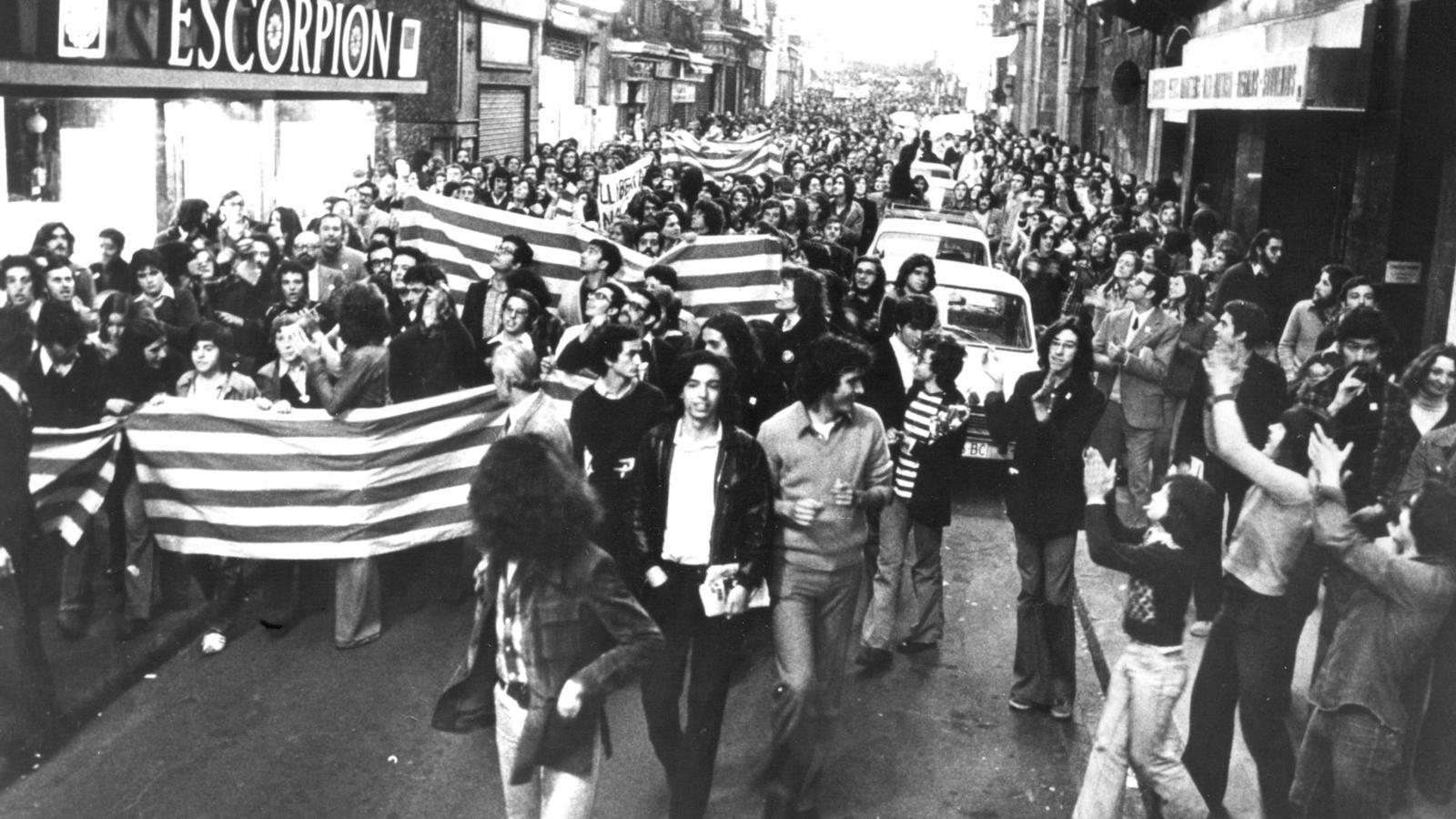
BarcelonaAfter the death of Franco in November 1975, Catalan culture experienced an urgent need to reclaim public space. And on Sant Jordi's Day in 1976, this became very clear. That year, the festival was experienced with great euphoria, even though the shadow of the dictatorship also made itself felt. “It seemed like a great day, that April 23rd. I come from the Civil Registry, where a friend will soon be able to change a Castilianized name for its native form; I see Catalan flags, Catalan books overflowing the stalls, the bust of Prat de la Riba returning to occupy a place at the corner of the Pati dels Tarongers of the Generalitat and, to top it all off, a new novelty, a Catalan newspaper, the first in 37 years, after an order erased our press from the map, along with the Statute and so many other things,” wrote the writer Manuel de Pedrolo, who also signed copies of his book Procés de contradicció suficient, published by Edicions 62.
Pedrolo stated, in this article published in Avui, that Sant Jordi's Day was not enough because there were too many dragons to slay. The writer concluded the chronicle by arguing that Catalonia should be "a place where we feel that nothing is ours but everyone's." As Pedrolo explained, that year Avui was published, with a print run of 123,066 copies which sold out before nine in the morning. A reader, in the newspaper of April 24th, called for the return of the images of Sant Jordi. “Due to the events that began on July 19, 1936, an image of Sant Jordi disappeared from the Barcelona Cathedral. It was in the place where there is currently a reproduction of the Mare de Déu del Pilar.” The article in La Vanguardia also conveyed the euphoria experienced in the streets: “A clear affirmation of love for books, for culture, and for Catalonia.”
The success of political books
It was not easy to organize a Sant Jordi festival at that time. Cultura en ruta, a campaign by Òmnium Cultural launched in 1970 that traveled the Catalan territory with a bookmobile selling books and records in Catalan, was looking for a large enough venue in Barcelona shortly before Sant Jordi to receive books from publishers and distribute them. It had a team of twenty people working for three months, organized 182 stalls, and achieved a sales volume of 3,907,214 pesetas. On Sant Jordi itself, La Vanguardia spoke of how political and sociological books had displaced pure literature. There was also an abundance of titles on sexual themes, which the journalist did not particularly like, and he encouraged the purchase of The Art of Loving, by Erich Fromm, because it had a more Christian inspiration. That year, quite a few copies of Nacida inocente. El drama de los reformatorios juveniles (Ediciones Martínez Roca), by Gerald Di Pego; Tots els barris de Barcelona (Edicions 62), by Jaume Fabre and Josep M. Huertas Claveria; La caiguda de l'imperi sodomita i altres històries herètiques (Edicions 62), by Terenci Moix; Cuáles son los partidos políticos de Catalunya (La Gaya Ciencia), by Josep Maria Castellet and Lluís Maria Bonet; Diari de presó. L’espectacle obsessiu (Laie), by Lluís Maria Xirinacs, and
Dona de pres (Edicions 62), by Teresa Pàmies.
Publicacions Abadia de Montserrat released many titles on the history and legends of Catalonia. Many Catalan children's and youth publications and magazines were sold out, and El zoo a casa (La Galera), by Joaquim Carbó, was very successful. Among many other books, Retrats paral·lels (Publicacions Abadia de Montserrat), by Montserrat Roig; Un regne per a mi, by Pau Faner, winner of the Sant Jordi prize 1975 (Aymà), and
Crònica d’Isambard (Aymà), by Toni Turull, finalist for the Pla prize 1976, could be seen at the stalls.
The Diario de Barcelona published some statements from the editor of Planeta, José Manuel Lara, who explained that he had received an offer of 250 million pesetas for the publishing rights of Franco's memoirs in English. The publication date, according to Lara, depended on the dictator's daughter. The memoirs were written in notebooks, "like the ones boys used to carry when they went to school," he explained, and argued that the dictator had not wanted to publish the memoirs during his lifetime because he said that many would look bad. Lara, he explained, had tried to convince him by arguing that the younger generations needed to know the problems Spain had experienced. In all world polls, according to Lara, Franco won Mao's memoirs.
The clashes with the police
In his diary, Epifani de Fortuny i Salazar, Baron of Esponellà, collected congratulations from different entities, including Òmnium Cultural, with an illustration ofThe Scream (1975) by Grau Garriga and another with verses by Clementina Arderiu: “Tend your roses! Finish your blooming for Sir Saint George is already here”. The one that deserves a comment, however, is from the general secretary of the Royal Academy of Fine Arts of Sant Jordi, Joan Bassegoda Nonell: “It is the first time I have been congratulated on my saint's day without it being my saint's day…”, he wrote ironically. The Baron of Esponellà assured that Bassegoda was aware that it was not his saint's day but that he wanted to make it public that "the academy was devoted to Saint George".
It was not all festive and cheerful. Various organizations, such as the Assemblea de Catalunya, called for protest mobilizations. An enormous banner was hung on Diagonal Avenue, demanding a Catalan government. In Plaça Sant Jaume, coinciding with the sardana dance, dozens of Catalan flags, and some republican ones, were unfurled, and leaflets were thrown. Freedom, amnesty, and the Statute of Autonomy were demanded, "The people united will never be defeated" was shouted, the resignation of the mayor Joaquim Viola was requested, andEls segadors andL’estaca by Lluís Llach were sung. At the demonstration on La Rambla, the police appeared with rubber bullets and tear gas bombs, and there were injuries. According to the Diario de Barcelona, there were also "countercultural demonstrations", with young people exhibiting the magazine Ajoblanco. "They shouted political slogans with incoherent motives", assured the journalist, who also explained that they simulated a robbery and urinated on the facade of the Gran Teatre del Liceu.
The medal for Martín Villa
At the Palau de la Generalitat, which that year had not yet recovered its name and was the seat of the Provincial Council of Barcelona, the official mass and the blessing of the roses were held. Mayor Viola explained that he had been able to buy the book, but not the newspaper Avui: “It had sold out in all the kiosks before nine o’clock”, he assured. Among those present was also the Minister of Union Relations and former civil governor of Barcelona, Rodolfo Martín Villa, to whom the Gold Medal was presented. "Thanks to the political talent of Martín Villa, today the Catalan flag can fly on the pinnacle of this palace and on the flagpoles of the town halls", assured at that moment the president of the Provincial Council of Barcelona, Joan Antoni Samaranch. Villa is currently held responsible for the direct repression of citizens who participated in the democratic social movements of the time, and is considered responsible for the persecutions, mistreatment, torture, and vexations that the police carried out during the dictatorship. That Sant Jordi began as a great citizen festival, with many Catalan flags in the street, and ended with scrambles. In the street, both day and night, it was noticeable that there was a great desire for change.
