Robert Llimós dies, the artist outside of labels who portrayed aliens
Plastic Arts Award of the Generalitat de Catalunya, was linked to the new figuration and conceptual art

-
CAT -
CAST
BarcelonaThe painter and sculptor Robert Llimós died on Monday at the age of 83, as confirmed to ARA by family sources. Son of the painter Camil Llimós, Robert Llimós studied at the Massana School and the Sant Jordi Higher School of Fine Arts in Barcelona. During the sixties, he began in the new figuration movement, along with recognized artists such as Eduard Arranz-Bravo, Rafael Bartolozzi, and Gerard Sala. Later on, between 1969 and 1973, he experimented with conceptual art, abstract forms, and artistic actions. In fact, the Can Framis museum of the Vila Casas Foundation will inaugurate an exhibition on November 10th of this stage of his career, the one most represented in museums, such as the MACBA and the Reina Sofia Museum. "Robert Llimós has been a fundamental artist, who played a decisive role in the seventies in introducing and consolidating conceptual currents from the practice of painting and action. He opened visionary paths that today are a reference for the new generations, who have adopted and reinterpreted practices similar to those he had already explored back then," says the artistic director of the Vila Casas Foundation, Bernat Puigdollers. "Throughout his career, he has always been an indefatigable artist," says Puigdollers, "who wanted to experiment with a multiplicity of techniques and let himself be influenced by the latest artistic trends with the constant purpose of opening new paths." "As Blanca Arias demonstrates in the exhibition we will inaugurate at the Can Framis Museum, this was his main concern: to search for and find a new image," adds Puigdollers.
On the other hand, Puigdollers regrets that Llimós and other artists of his generation have not had more institutional recognition: "Now the last survivors of a generation are leaving us, who, claiming the joie de vivre, knew how to open paths amidst the darkness of Francoism: Arranz-Bravo, Bartolozzi, Gerard Sala, Gonçal Sobrer, Artigau, Serra de Rivera, Miquel Vilà... A generation to which we have not yet done justice."
Llimós defined himself as an artist outside of any label and in constant evolution. "A painter should never do what people expect of him. His work must constantly startle and surprise when observing its evolution," he asserted. One of the constants of his trajectory is social criticism, as can be seen in works from the 60s like Can Carreté and Figuera. In the 70s, Llimós returned to figuration and conveyed denunciation through a violent use of color, as can be seen in Sitting Bull, a critique of the disappearance of indigenous communities. His committed character did not abandon him, and in the 90s Llimós painted Fragment ruandès, in which innocent goats witness the genocide in Rwanda. The artist returned to social criticism in the monumental triptych Metamorfosi, with which he denounced the use of weapons of mass destruction and the anxieties generated after the 9/11 attacks in New York. In 1994, he received the Plastic Arts Award from the Generalitat de Catalunya
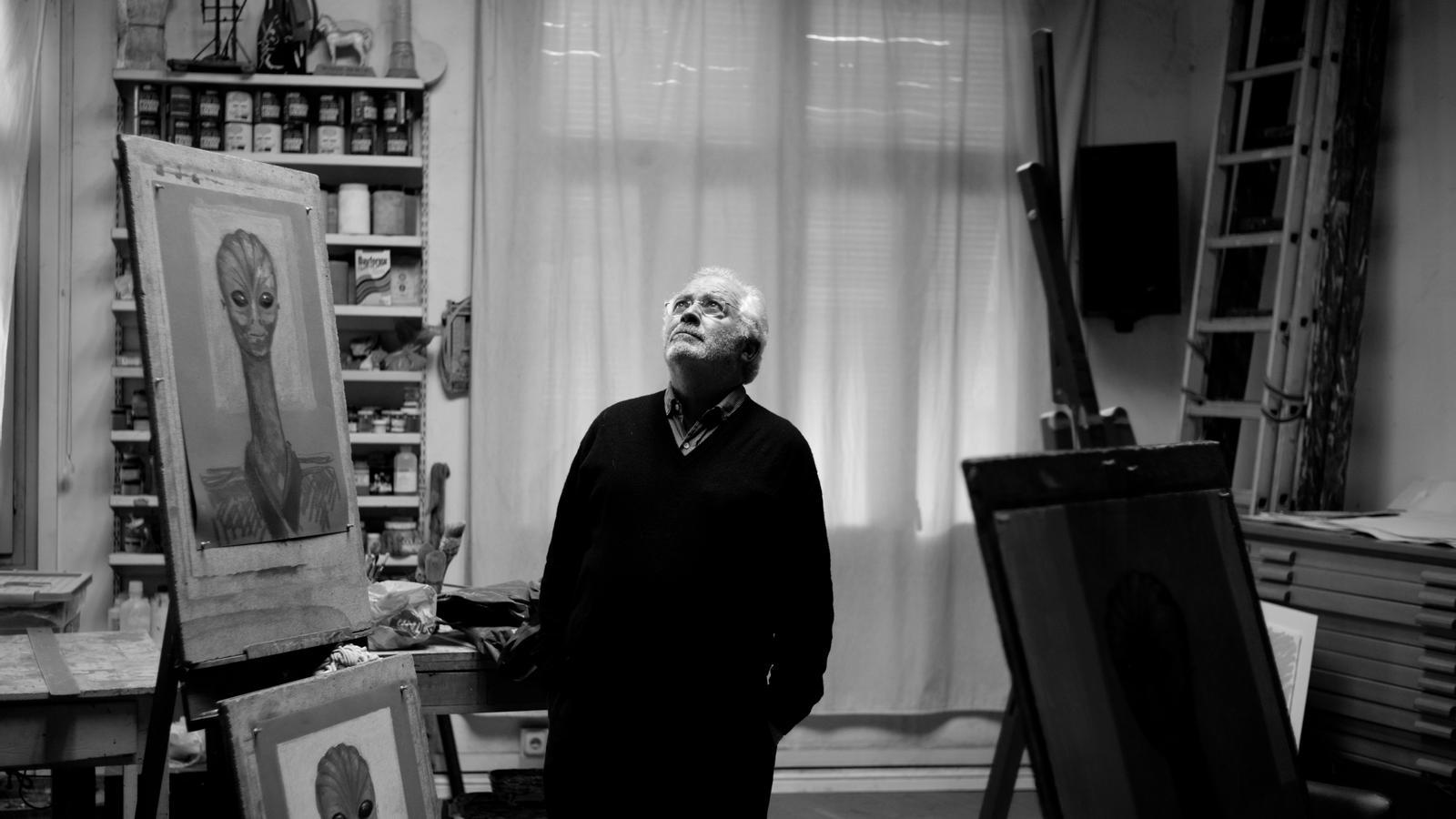
Between 1975 and 1983 Llimós lived in New York, and between 1987 and 1988 he settled in Miami. Another moment in his trajectory is the series Globulins, developed between 2004 and 2008, in which spherical shapes float in undefined color spaces. The last 17 years of his career were marked by the fact that he claimed to have come into contact with extraterrestrials, to whom he dedicated numerous portraits that did not have a commercial outlet but which he exhibited, for example, at La Fortalesa, the old military fortification in Sant Julià de Ramis. Llimós explained that he had spotted a spaceship and some aliens on the beach of Fortaleza, in Brazil. Some critics pointed out that the sighting could have to do with the death of his son, a theory that the artist dismissed.
The aspect of public sculptor
Llimós created several public sculptures in the city of Barcelona: Miraestels (2010), two sculptures at the Port Vell; Marc (1997), at the Vila Olímpica, a tribute to his son who died a year earlier, and Ones (1987), at the Bosch i Alsina pier, at the port of Barcelona. He also participated in events such as the São Paulo Biennial (1967 and 1969), Documenta 5 (Kassel, Germany, 1970) and the Encuentros de Pamplona of 1972, and in numerous collective exhibitions in centers such as the Museo del Barrio (New York, 1976), the Joan Miró Foundation (Barcelona, 1979 and 1983), the FRAC - Maison de Gascogne (Auch, France, 1986) and the Museum of Contemporary Art of Barcelona (1997), among others. More recently, he exhibited at the Fondazione Pastificio Cerere e Spazio Cerere (Rome, 2016) and at the DOR Museum in Sant Julià de Ramis.
