The Catalan Tolkien

-
CAT -
CAST
BarcelonaThis summer, which many of us have seen fires ravage our forests and where we don't know for sure if what we are experiencing is nature becoming unbalanced or, on the contrary, doing its best to rebalance itself; this summer Editorial Barcino has published a new edition of Liliana, by Apel·les Mestres (Barcelona, 1854-1936), and has given us the opportunity to re-evaluate a writer whom we should all know better. Personally, I would swear I had never read anything by him, although I had seen illustrations by him at the MNAC. I delved into his life a few months ago, when I was preparing the script for a podcast about classic authors that I present, La contracoberta. And since then I have been amazed not only by his pen, but also by everything he knew how to do well: drawing, painting, writing poetry, theatre, prose and music, translating and giving graphic illustration the artistic category it deserves.
Mestres was a total artist who, moreover, was passionate about nature, botany and gardening. I could tell you how fascinated I was by the texts of La casa vella (1912), the book in which he recounts his childhood in a Barcelona that was just beginning to expand beyond its walls. He, a sensitive and imaginative child born in Plaça Felip Neri, began to let his imagination fly with the monsters of the cathedral: “I went in and out of the cathedral at all hours. Corridors and spiral staircases, crypt and tombs, chapels and galleries, rooftops and bell towers, I knew everything stone by stone and I became so familiar with that mysterious grandeur, that solemn stillness, those dragons that watched me from capitals and gargoyles, that, frequently, I held real conversations with them, and I am sure that more than one of the ballads I wrote twenty years later were told to me by those monsters, those devils, those bells”.
Liliana (1907) is a beautiful and very lyrical narrative poem that speaks to us, precisely, about the fragility of the integrity of our world and about the inevitability of dualities; that there is no good without evil, love without hate or beauty without pain, and that nature lives in balance as long as all these human-like sentiments do not disturb it.
The first thing that fascinated me about Liliana was the amount of elements it had in common with The Lord of the Rings, by J.R.R. Tolkien. In this column we value Tolkien as a first-class author, capable of creating his own worlds and languages, removing man from the center of the world and speaking to us of a nature with its own voice, powerful, full, fighting and suffering. Apel·les Mestres (1854-1936) and Tolkien (1892-1973) have in common that they resort to fantasy to reflect on basic philosophical themes, such as the clash between good and evil. And not only do they do it wonderfully, but they also draw on a romanticism that leads them to share the same type of characters and treatment of folklore and nature, which makes their works seem like a fable or an ancient legend.
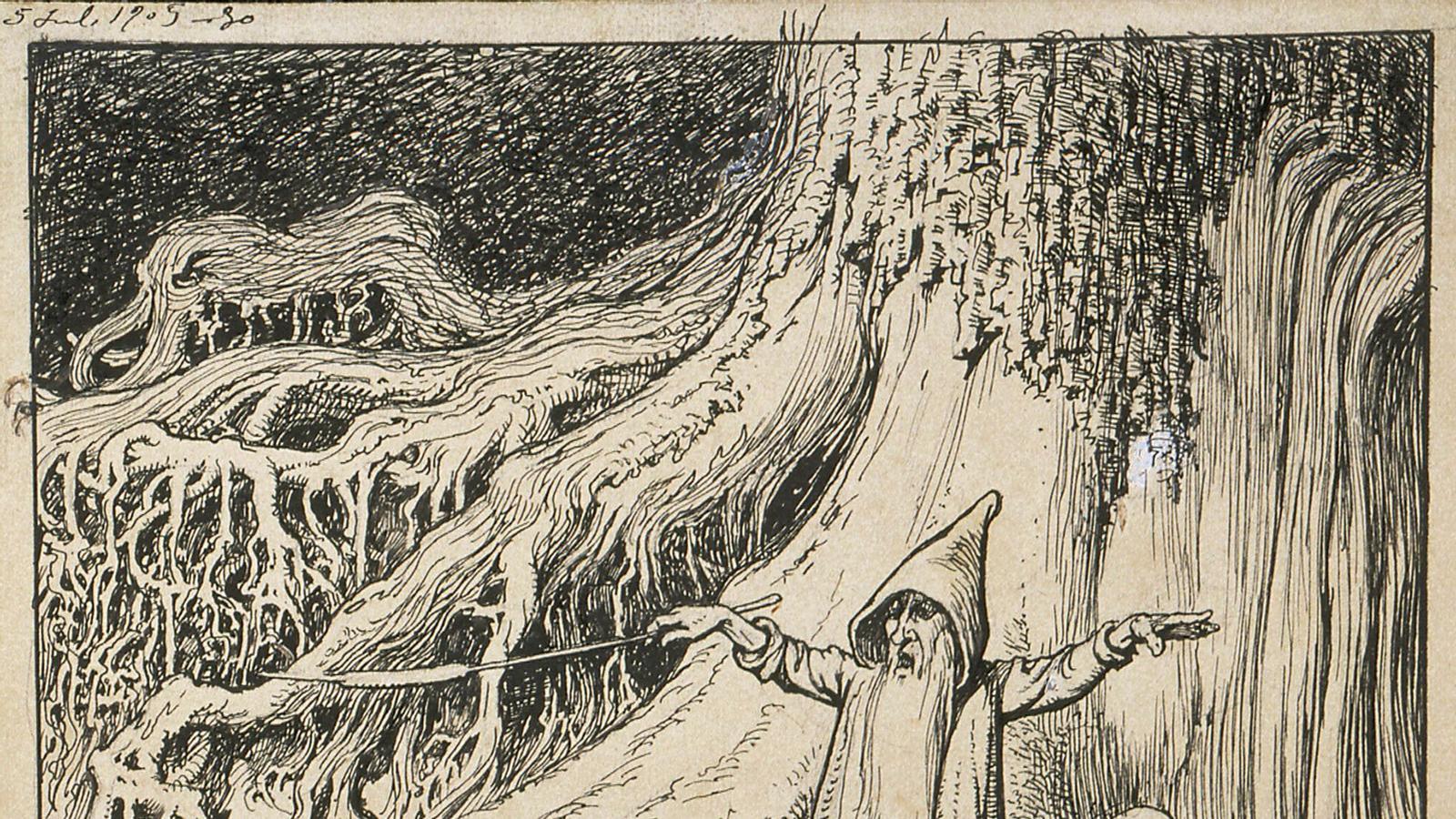
Thus, Liliana begins with the first abuse that a man inflicted on a tree: asking for its help to create an axe and then using it to harm it. In this prologue (the work is structured in songs, not chapters), the trees lift their roots from the ground and begin to walk. If this already has an exact parallel with The Lord of the Rings, you should know that, in addition, the Barcino edition includes Mestres' original illustrations, and that these directly recall the ents from the film. In Liliana, the main protagonists are the dwarves, who, like in Tolkien, were miners: “Active and good workers, they did not take long / to enlarge the burrows more and more and delve deeper and deeper / and they worked so hard within the heart of the Earth / that they became, without thinking, miners,” recounts the Catalan.
Dwarves who lose their way
Although if Flok, Mik, and Puk, the three gnomes protagonists of Mestres' work, were characters from The Lord of the Rings, they would be innocent, wise, tender hobbits, but also brave and adventurous, and willing to risk themselves: “The most prudent Flok, Mik, the intrepid leader / and Puk, tender Puk, exquisite dreamer, / always together and in agreement (three spirits, three bodies) / seemed to form just one body and one spirit”. The spider is also a character shared by both authors, and which the Barcelonian uses to talk about the paradox of causing harm when trying to do good.
Tolkien and Apel·les share archetypes, although each builds different stories. Liliana is a work that feels short and that we wish Mestres hadn't resolved so quickly. And in the midst of the work, of course, there is Liliana, a nymph who personifies purity (“What is fearing? / Believing in evil? I don't believe in it… The Earth is beautiful; / and what is beautiful, is it not what is good?”) and who makes the gnomes lose their way and rethink their lives from top to bottom: “We thought / we knew everything, as you say; that's what we thought… / Today we see very clearly that we were mistaken. / Today… we know nothing; today… we would believe / that you are the one who knows everything, and we would swear it”. But beauty is ephemeral and generates a painful disappointment in the little protagonists, who only win when they have to mobilize for the homeland, the forest, threatened once again by humans. But I can't go on much longer, and about Liliana we could talk for hours. This summer, buy the book and enjoy this great creator of our culture.
