Pepe Serra: “The profane paintings will arrive in Sixena without any alteration”
The director of the MNAC recalls the steps of the move at the presentation of the sound installation 'The reverse journey'
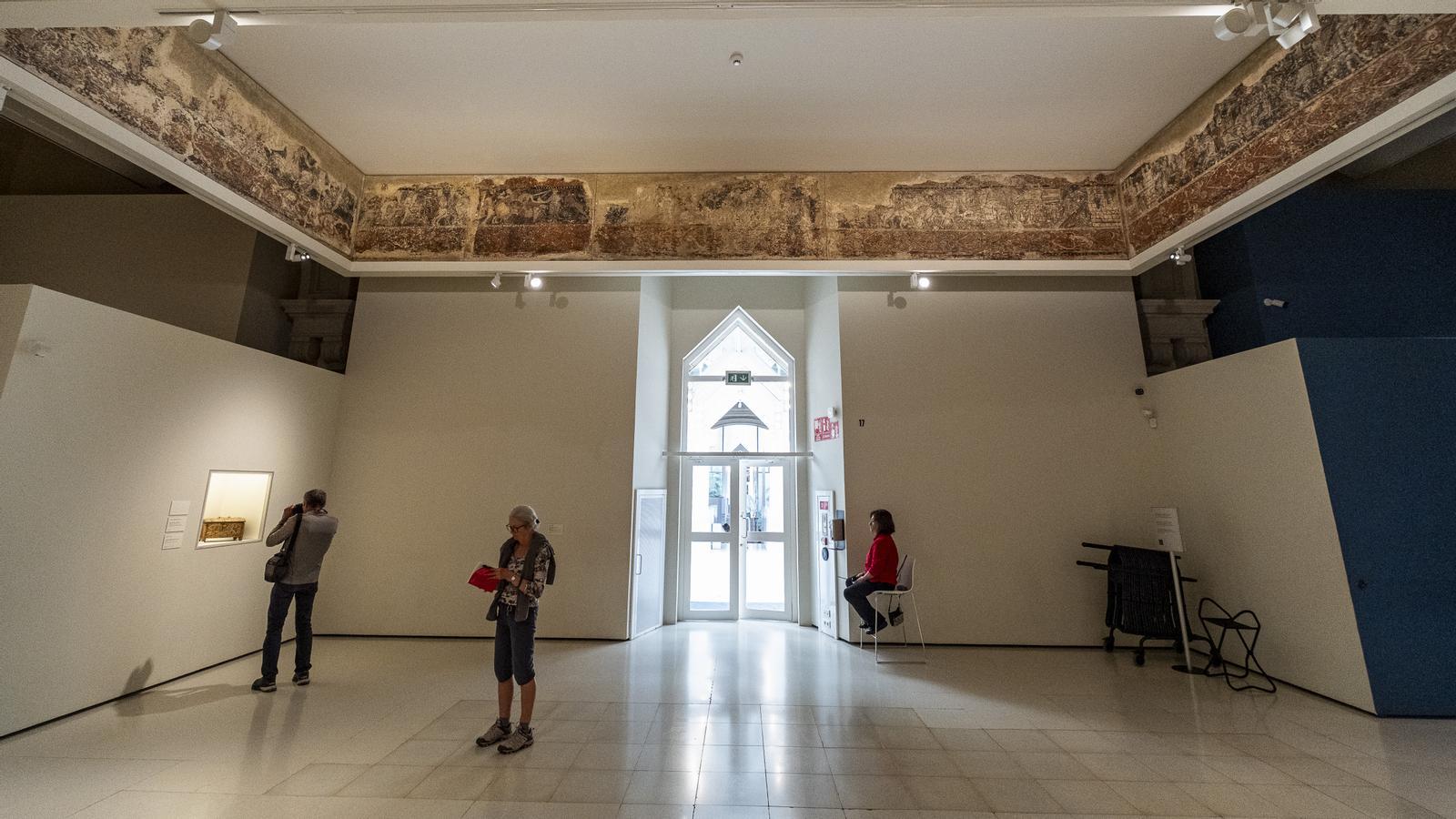

BarcelonaThe day when the dismantling of the profane paintings of Sixena at the Museu Nacional d’Art de Catalunya (MNAC) begins is getting closer. It will be Tuesday, November 17, and the operation is expected to last about four weeks. However, the museum faces the operation with calm and confidence in the ability of its technical teams to ensure that the works arrive at their destination without any alteration. “The profane paintings will arrive in the exact state in which they are now, without a single alteration,” states the museum director, Pepe Serra, in statements to the media. During the dismantling process, it will be necessary to carry out “some interventions and some technical protection mechanisms,” of consolidation and packaging for transport. The forecast is that the work will be finished on December 2.
During the dismantling, the room will be closed to the public. It will be like an “operating room,” says Serra, who also reminded once again that these paintings were removed from Sixena in the 60s under the protection of the General Directorate of Fine Arts. Once the profane paintings leave the room, they will not put any reproduction there, nor any element that reminds of them. For Serra, the Romanesque collection of the MNAC is “unbeatable” and he trusts that the Sixena monastery will enjoy the same conditions of conservation and dissemination that they have in Barcelona.
The profane paintings are mounted on eight panels, so it will not be necessary to modify their sizes to move them, whereas those of the chapter house would have to be cut. The Aragonese side pointed out that they would have to be cut into more than 70 fragments. “Here, nothing has to be sawn, nor do the sizes or the composition have to be altered. The museum defends that it can technically do this and it will do it,” asserts Serra. On the other hand, they have identified “risks in the transfer of the murals of the chapter house.” “All the reports we have received, including that of the world's highest authority, which is ICCROM, support the museum. The museum has already said it does not have the capacity nor does it recommend doing so, because the risks of destruction of a large part of the work are extremely high, and we still have no one saying that this can be done, not saying it in the media, but believing technically that it can be done.”
Current events of the Romanesque
Serra made these statements coinciding with the presentation of The Inverse Journey. A Sonic Fresco of the Romanesque (The Inverse Journey. A Sonic Fresco of the Romanesque), a sound installation by researcher and artist Ona Balló. She also took the opportunity to highlight the contemporaneity of the Romanesque, which is “the heart” of the museum and the extension.
The Inverse Journey can be defined as the sound layer, created with sounds recorded in the places of origin, of the paintings from the apses of a series of Romanesque churches: Santa Maria d'Àneu, Sant Pere del Burgal, Sant Pau i Sant Pere d'Esterri de Cardós, Santa Maria de Ginestarre, Santa Maria de Taüll, and Santa Eulàlia d'Estaon. “Each church is like a music box tuned to its own tone,” states Balló.
The title refers to the removal of the mural paintings from the Pyrenean churches a century ago and their transfer to Barcelona. “At the origin of this exhibition, there is an intuition and a question: when the paintings were moved here, what did they leave behind along the way? What happens to all the sound that surrounded them?” says Balló. Thus, the goal of incorporating the sound, which includes that of a flock of sheep, rain on a roof, and the belling of a stag, is for the public to look at the murals again and find details they had not noticed before. “These sounds have great depth and a powerful narrative capacity,” explains Balló. “I always imagine them as strata: we have some that are very current, but also others that, all of a sudden, overlap or are heard in the background, which are very ancient, even pre-Romanesque, like the sound of a river or the pitter-patter of rain on a roof.” “They are also very daily sounds that the people of the villages have preserved,” adds the artist.

For Balló, the valleys from which the murals originate are like a “great off-screen” of the museum. “When I went to the valleys to record these sounds, I wanted to walk the route between the churches, to rediscover the real distances that we don’t have in the museum. That is why I propose a sound journey that we do by walking, because the ambition is for us to realize that the museum has traditionally not been a space for listening,” says the artist. “This route makes us consider a question where the current museum and the future one meet, which is that the sound allows you to walk. Often, audiovisuals invite you to stop, and I believe that precisely the freedom of a museum visitor, unlike in cinema, is that one can move freely and, in this case, go looking for the sound,” explains Ona Balló.
