Jordi Oriol plays with the uncertainty principle in 'The Last Atom'
Joan Carreras and Mia Esteve star in a show at the Goya Theatre about a couple suffering the disappearance of their daughter

-
CAT -
CAST
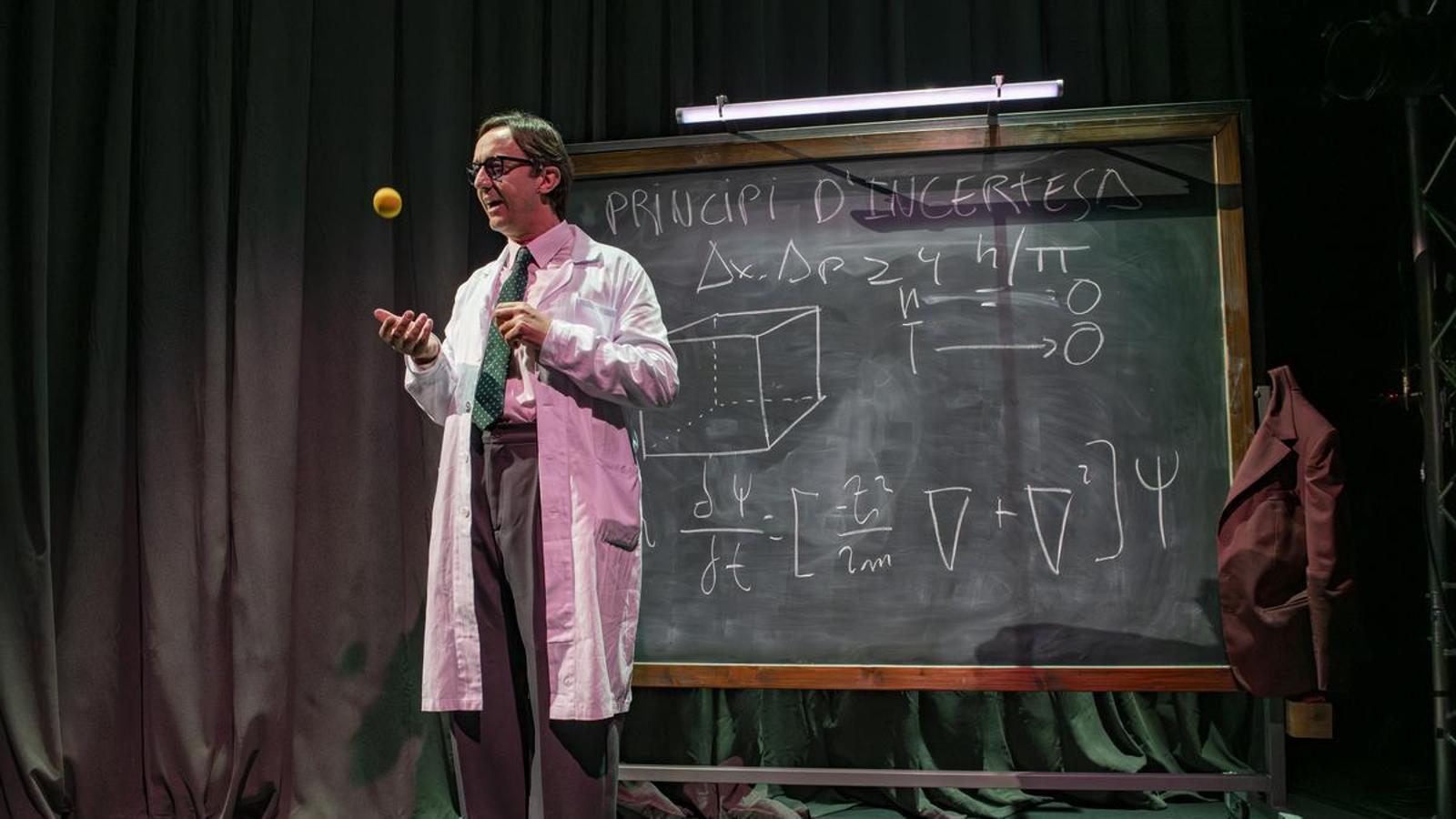
BarcelonaWhat do science and language have in common today? Playwright and director Jordi Oriol has no doubt: the uncertainty principle. "Scientists have reached a point where they need to know more, but they can't. Science has begun to speak in metaphors, mathematics is about statistics and probabilities. We have gone from Shakespearean to be or not to be to to be and not to be at the same time," says Oriol. Faced with this reality, the creator has built a show that unites the two worlds to make their connections evident. Titled The Last Atom (which can also be read as "L'ultimàtum", in one of the creator's fun linguistic winks), the production stars Joan Carreras and Mia Esteve and will be performed from May 29 to June 21 at the Teatre Goya.
The protagonists of this story are two professors with a shared tragedy. He is a scientist, a specialist in quantum physics, and she teaches linguistics at the university. Separated for some time, the show begins just as it is ten years since the disappearance of their daughter, a teenage girl who one day did not return home. "Throughout the play, we speculate on how one character and the other experience grief, how they try to overcome this absence. They had a reality, a future, that has disappeared from them. Now they face a future they had not planned for," points out Oriol. The cast is completed by Carme Milán, Lara Segur, and Carles Pedragosa, who also performs live music. Together they bring to life about fifteen characters, from a group of students preparing musical capsules about Oedipus to an intimate friend of the couple and an actress who has appeared in the story.
Despite the pain of the main couple, the show presents their story through play and comedy, in line with other productions by the producer Indi Gest such as La caiguda d'Amlet (2007), Europa Bull (2018) and La mala dicció (2021). "The audience sees and experiences the tragedy and at the same time, from a distance, can have fun with the situation. Life can be macabre and at the same time a Wes Anderson comedy, if we look at it from this playful perspective," emphasizes Oriol. In this regard, Joan Carreras highlights the company's way of working, avoiding rigidity and theatrical conventions. "The drive that makes you decide to be an actor, here it multiplies exponentially. Everything is possible, anything can happen, even during performances," stresses the actor. "We are used to starting rehearsals with an open ending. It's a real obstacle course," adds Pedragosa.
To be or not to be on stage
Behind the story of the two professors, Oriol has placed a deep reflection on uncertainty in the present and the role of theater. "I have the feeling that we have lost the fundamental narratives that have created us as a Western society. Religion, science, and democracy have collapsed. We live in times when we don't know where to turn, when we are lost. We don't know what can happen tomorrow: whether we can afford our rent or not, whether we will have to lock ourselves at home due to a pandemic, whether there will be a blackout, or whether there will be no more oil tomorrow," says the playwright. Faced with this reality and the fact that "in the scientific world, the same thing happens as with humanity," Oriol argues that the world of theater has been playing with being and not being simultaneously for millennia: "Schrödinger's cat is alive and dead at the same time. Just like an actor on a stage, who can play a character who dies and, at the same time, be alive."
