"It was a spoliation": La Bonne reclaims its headquarters from the Diputació de Barcelona
The feminist association demands the nullity of the 1941 cession and denounces institutional mobbing
-
CAT -
CAST
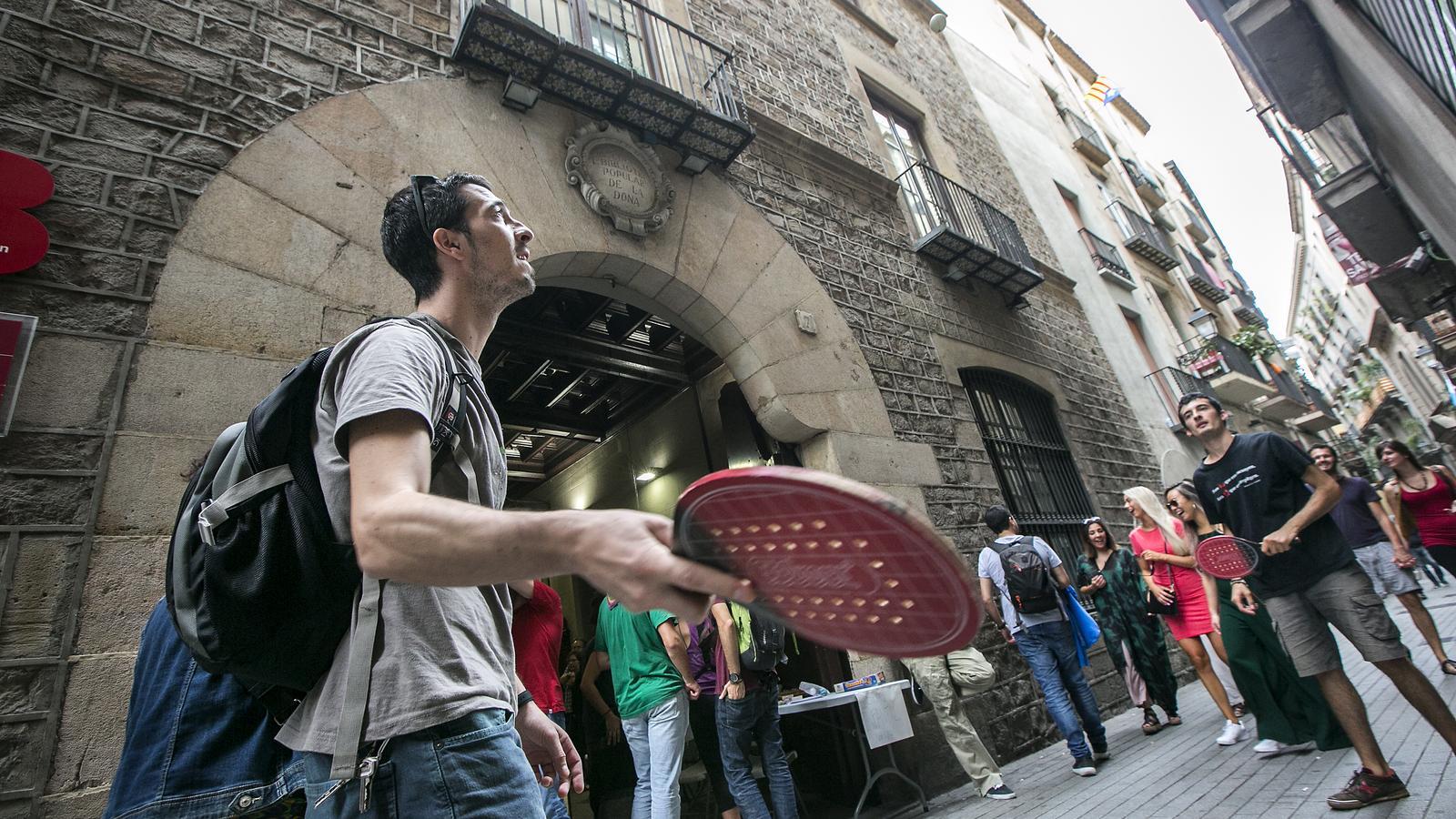
BarcelonaThe Association for the Promotion of the Francesca Bonnemaison Women's Cultural Centre (la Bonne), a meeting, exchange, and creation space for feminist cultural projects that brings together more than a hundred women's collectives, has been fighting with the Diputació de Barcelona for over ten years to continue in the Francesca Bonnemaison building, on Sant Pere Més Baix street in Barcelona. The latest step has been to formally request the reversal of the property from the president of the Diputació, Lluïsa Moret, based on the democratic memory law. The argument is that in 1941, in the midst of the post-war context, a deed of assignment was signed to the Diputació which the association calls a "true spoliation". it has been more than ten years that it has been battling with the Barcelona Provincial CouncilFrancesca Bonnemaison (1872-1949) was a right-wing, Catholic woman from a good family who did something very audacious that still endures today: she created Europe's first women's library, the Popular Library for Women, in 1909. She offered women a place to train, and at that time it was so exceptional that, when the Institute of Culture and Popular Library for Women opened on Sant Pere Més Baix street, the police had to go there because the men, unaccustomed to the presence of women in public spaces, were becoming agitated. The Popular Library for Women was born in the upper cloisters of Santa Anna and was inaugurated on March 28, 1909. Since Bonnemaison had very good relations and knew the Barcelona oligarchy, she secured enough funding to move, in 1910, to number 12 Elisabets street, and in 1920 she acquired a larger premises in Sant Pere Més Baix. From 1922 onwards, the Institute of Culture and Popular Library for Women was located there. Even today, the institution occupies this space, which is the old Casa Cordellas mansion.
The association's director, Marta Vergonyós, maintains that her claim stems from a "moral legitimacy that has a legal basis." According to Vergonyós, the current project is the direct heir of the institute founded in 1909 and that "it is more alive than ever." "We continue with Francesca's original project; we are an interclassist space that welcomes from Sindillar, which has regularized hundreds of undocumented women, to the filmmakers of the Dones Visuals collective. Last year, 13,316 women passed through La Bonne for training, artistic residencies, and legal or psychological support. We are more alive than ever," assures Vergonyós.
The spoliation of 1941 and the role of the Falange
The jurist Eugènia Canal considers that the legitimacy of the association is fully accredited by the documents preserved in the National Archive of Catalonia, which certify that the original institute was an entity with its own legal personality, directed and represented exclusively by women from the beginning of the 20th century. There was a board of directors and a consultative body. On June 16, 1940, the extraordinary general meeting was held where the transfer of the institute to the Diputació of Barcelona was proposed. An opposing group expressed its rejection of it being absorbed by a public institution and, above all, of it falling into the hands of the Falange. Furthermore, many members were absent, including the project's initiator, Francesca Bonnemaison, who was in exile.
Despite everything, in 1941 the deed of transfer was signed before a notary, not only of the property but also of everything inside: from furniture to tableware, including books. "The Diputació paid nothing," says Canal. "This is an entity born from the will of women. The legitimacy of the current feminist movement as heir to that legacy was already recognized in the first agreement with the Diputació in 2003. Why does the Diputació not question its own legitimacy over the building and yet question ours?", asks the jurist.
Canal describes the 1941 operation as null and void. According to the jurist, there was no real economic precariousness that justified the transfer of the building to the Diputació; it was all a legal construct in the context of a city occupied by an army. "The 1941 legal operation is covering up an expropriation. It was done without the most relevant person, Francesca Bonnemaison, who was in exile in Switzerland. Without the coup d'état, this transfer would never have happened; it was, in practice, a confiscation," explains Canal. Where did the assets come from? Canal recalls that Francesca Bonnemaison even mortgaged two houses she owned on Villarroel street to finance the center. "It is a mystery how the Diputació ended up keeping those houses as well," she assures.
The relationship between La Bonne and the Diputació is getting worse and worse, and currently the association is in a critical situation. "We are in the worst situation: we have no agreement and we are operating outside the law," denounces the association's director. "It's textbook mobbing," she adds. "First they start withdrawing money, they go from ten-year agreements to four-year ones, and now we find ourselves being asked for impossible technical requirements such as the Declaration of Public Utility, a process in Madrid that has been denied to us despite the support of the Generalitat and the City Council. We will apply again now," she says. The Diputació's latest measure has been to inform the entity that they must pay to use the spaces, something that Vergonyós calls "unprecedented."
Vergonyós is particularly critical of the Diputació's management of the building, and assures that "the integral project has been distorted." "The Diputació re-rents the spaces to whoever pays, without any ethical criteria. They have rented the theater to the PP, to Ciutadans, and even to Desokupa. It is outrageous that women in situations of violence or who are migrants find themselves with a Desokupa event in their own headquarters." Furthermore, she denounces the institution's intention to empty the center of content to turn it into offices. "They are already asking us for the third floor for technicians' offices. The Diputació has empty spaces; this is a cultural center, and putting administration offices there seems like an absolute waste and negligence," reiterates Vergonyós.
Sources from the Diputació de Barcelona have expressed their "surprise and disappointment" at La Bonne's initiative, which for the moment has been limited to registering a letter addressed to Moret but does not rule out legal action. The Diputació has insisted that different formulas are being studied so that La Bonne can continue to use the space. On the other hand, it has assured that since 2002 it has been working to make the Francesca Bonnemaison Center a benchmark for feminist policies and social transformation from a gender perspective.
