From the dignified poverty of Dorothea Lange to the poetics of banality of Txema Salvans
The Xavier Miserachs Photography Biennial also dedicates exhibitions to Sergio Larrain, Gabriel Cualladó and the collection of the Banc Sabadell Foundation

-
CAT -
CAST
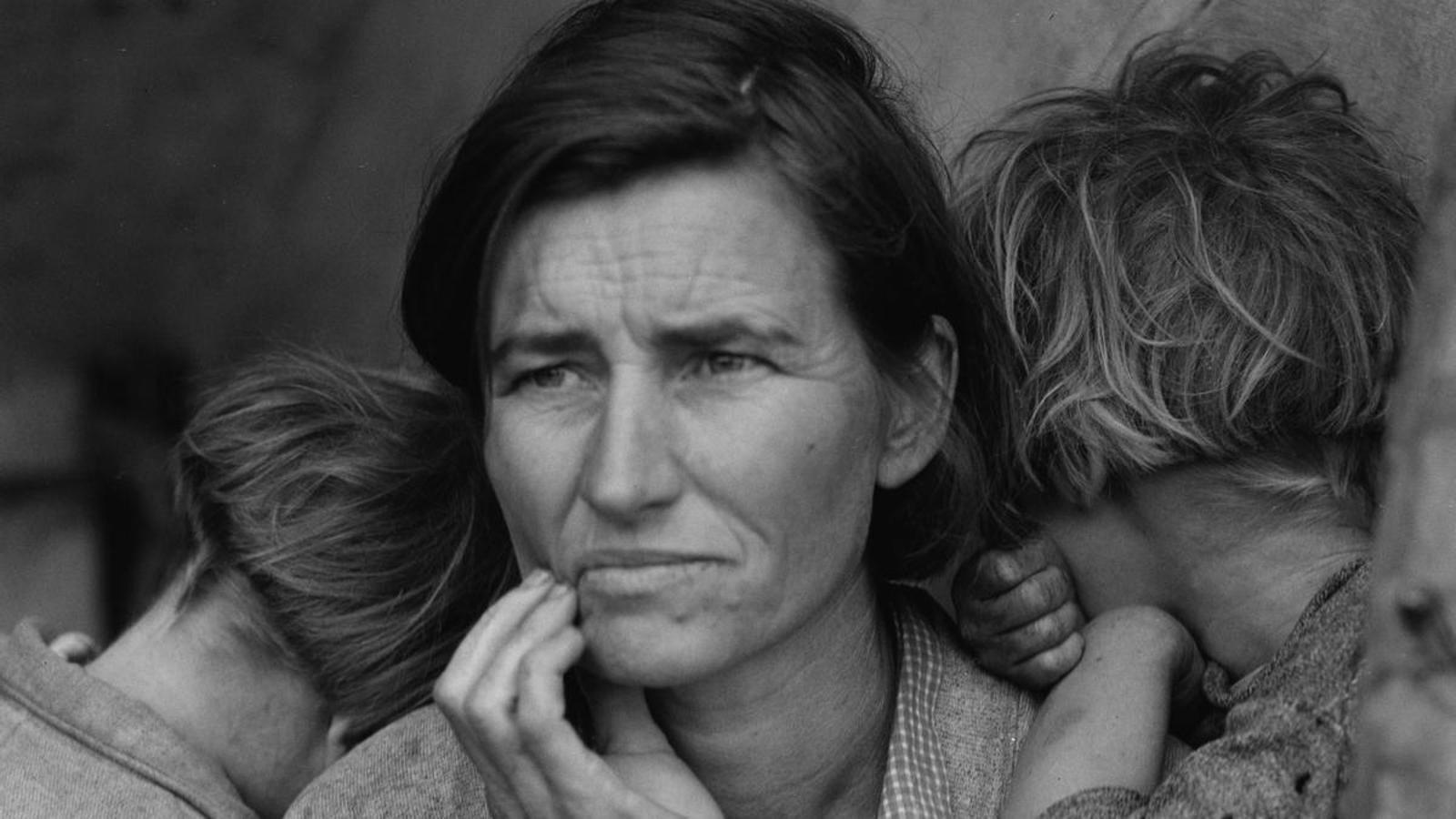
"I saw her and approached the hungry and desperate mother, as if drawn by a magnet. I don't remember how I explained my presence or my camera, but I do remember that she didn't ask me any questions." The photographer Dorothea Lange recalled in these words how she took her most famous photograph and one of the most iconic of the 20th century; Migrant Mother, a portrait of Florence Owens Thompson and three of her seven children. As can be seen in the exhibition dedicated to her by the XIV Xavier Miserachs Photography Biennial at the Bòbila Cultural Space in Palafrugell from this Sunday until October 18, this photograph is the culmination of how Lange progressively approached this woman, who was struggling to survive in a camp in Nipomo (California), while her husband and one of her children had gone to the city to have the car's radiator repaired so they could continue their journey. "There have been many women photographers, but unfortunately they are much less known than men. Dorothea Lange is an essential photographer in the history of photography," affirms the director of the Biennial, Maria Planas. "She worked with a Graflex camera, which was very heavy. She had polio when she was seven years old and managed to take all these photographs despite having mobility problems, which she concealed very well," says Planas.
A distinctive feature of this exhibition is that the texts accompanying Lange's images are quotes from the great literary chronicle of the Great Depression and the Dust Bowl, The Grapes of Wrath, by John Steinbeck. The exhibition is titled Dorothea Lange. A Long Journey and focuses on the work that the artist did in the thirties and forties on behalf of the governmental agency Farm Security to document the ravages of the Great Depression on American farming families. The images are current copies of photographs preserved in the Library of Congress of the United States.
In this edition, at La Bòbila there is another exhibition, also striking, Local is global. Banc Sabadell Art Collection. Documentary photography, curated by the Photographic Social Visions Foundation. Between the collapse of the 2008 crisis and the post-covid world, the photographs exhibited represent major contemporary issues such as migratory movements, climate change and wars, and others more personal like the dictatorship of beauty. Among the works exhibited is the Pietà of Yemen, the photograph with which Samuel Aranda won the World Press Photo Award for the best photograph of the year in 2011. Likewise, from an intimate perspective, one of the portraits that Darcy Padilla took of Julia Braid can be seen, when she was a young nineteen-year-old mother who had just discovered she was HIV positive. And in a more ironic register there is the portrait that photographer Zed Nelson took of a Brazilian plastic surgeon named Ox and his wife Angela.

The other great international name of this edition of the Biennial is the Chilean Sergio Larrain (1931-2012), of whom a retrospective can be seen at the Museu del Suro, complementary to the exhibition that the Fundació Foto Colectania dedicated to him in January, organized by the Magnum Agency and curated by Agnès Sire. As the exhibitions coordinator of the Magnum agency, Christiana Vieira, recalls, Larrain worked as a "silent observer", and also remembers that some of his images, taken during his journey through countries such as Chile, Bolivia, Peru, France, and Italy, are the result of a "state of mind", or an "awakening" that allowed him to capture the world.
Cualladó's minimalism
Each edition of the Biennial also includes an exhibition by a photographer from the Miserachs generation, and this year the chosen one is the Valencian Gabriel Cualladó (1925-2003). The exhibition, titled Poetics of Simplicity, can be seen at the Museu Can Mario of the Vila Casas Foundation, and one leaves wanting more. A self-taught photographer, Cualladó is known for a body of work with "a soft and melancholic poetry, and a minimalist language," says his son, also named Gabriel. Many of the characters portrayed are relatives and close people. "He managed to capture the personality of the sitter," Cualladó Jr. insists. "He really liked photographing children – he adds – he had the ability to treat them as people." Cualladó is also known for the freedom of his framing and some portraits in which the protagonist's face can be left in shadow or even hidden. Mystery over immediacy. "The debate arose as to whether he was a neorealist photographer, but he never liked that label, he preferred to give his photographs a timeless setting, rather than portraying an era," says the artist's son.

What do Txema Salvans and Josep Pla share?
After Toni Catany, the Josep Pla Foundation is once again hosting an exhibition by a contemporary photographer, in this case Txema Salvans. "What we aim for is that the aesthetic relationship and the results are natural, that it is a confluence," states the director of the Josep Pla Foundation, Francesc Montero. During the exhibition's creation process, they realized that it was not necessary to look for specific texts by Pla to make them dialogue with Salvans' images, but rather to base it on "the background or the atmosphere, and on the creative act," Montero also says. "We realized that Txema and Pla work from some common parameters – adds the director –: a very precise observation of reality, the ability to capture specific moments, to almost stop time. It is about a time that seems suspended, stopped, with people whose actions we don't always quite know, but who are there. Both Txema and Pla manage to capture time, and Pla adds the adjective to it".
Furthermore, for Montero, Pla and Salvans are twinned by the revealing nature of their works and by "the poetics of banality". "Pla also ends up expressing a certain emptiness and a certain disillusionment, that is, he is capable of seeing a beautiful scene and finding the expressive capacity to reveal what is disillusionment in it," says the director. "Both Pla and I work with our territory and everyday life," adds Salvans, known for the unusual scenes, between ironic and desolate, or both at the same time, that he finds on roads, suburbs, or industrial estates throughout the Iberian Peninsula. "I don't look for the news. I am interested in the spaces we frequent because for me that is where the true dystopia lies," concludes the artist.

The Casanovas photographers dynasty
In line with the Biennial's aim to delve into the local world, curator Enric Bruguera has once again struck gold from the legacy of the Palafrugell photography dynasty, the Casanovas. As their shop, where they kept the archive, burned down in 1998, Bruguera contacted numerous families who had lived in the town for at least two or three generations to reconstruct the Casanova family's trajectory. The result is a journey through the life of Palafrugell from the 1880s, with family portraits, images of gatherings, meetings of libertarian athenaeums and other Esperantists, and later images of Carnival celebrations before they were banned during Primo de Rivera's dictatorship.
There is a section dedicated to female portraiture, which allows us to see the evolution of fashion and hairstyles, and the influence of Hollywood cinema. On the other hand, the colored photographs recall the work of Aura Casanovas, which was not recognized at the time. And among the curiosities is the image of Manel Bisbe's baptism as Gitano de la Costa Brava at the old bowling alley in Llafranc by Carmen Amaya in 1958.
In addition to these exhibitions, you can also see the project An Invisible Landscape, by Wayra Ficapal, at the Torre de Guaita in Sant Sebastià de la Guarda, and a small-format project at the No Llegiu bookstore in Palafrugell, with some photographs that have been used for book covers. Regarding practical information, the Biennial pass costs 10 euros and grants access to a single visit to each of the paid exhibitions from the start of the Biennial until its closing.
