Historic strike in libraries: the reasons for the protest of the most valued service
The workers denounce a serious lack of staff and the neglect of the administrations while they are on the front line
-
CAT -
CAST
BarcelonaThere has always been talk with pride about the library service, especially if we look at the data: 95.9% of the population has a public library service in their municipality. In 2024, the centers received 22.6 million visits, registered 14.9 million loans, and there are already more than 3.3 million citizens with library cards. The other good news has to do with language: there has been a notable increase in the percentage of Catalan loans, which went from 38% in 2021 to 52% in 2024.
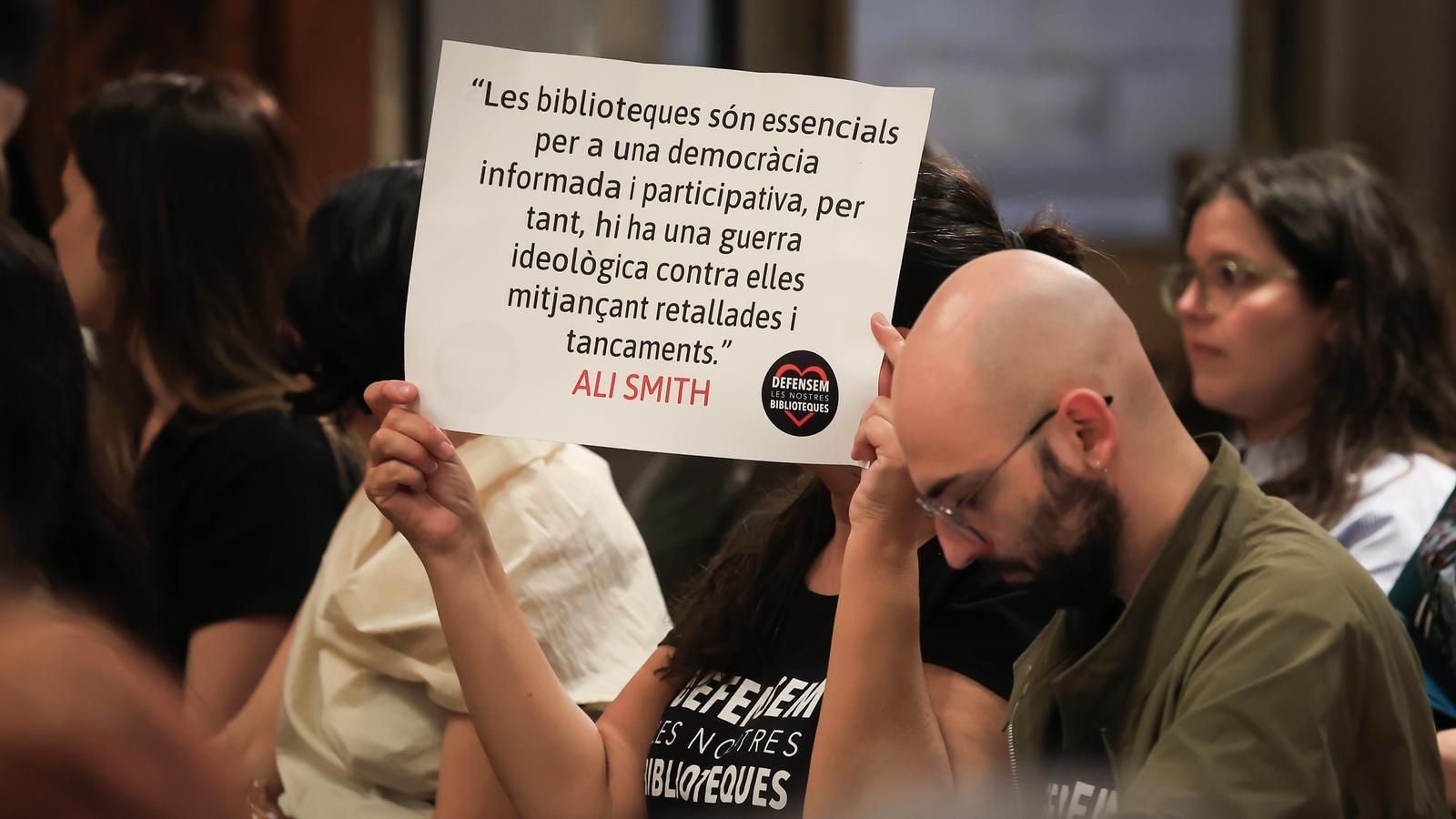
They are a frontline service, but as early as 2023 librarians complained that there was a lot of demand and not enough resources.They are a front-line service, but already in 2023 librarians complained that a lot was being asked of them and there were not enough resources.Tension had been building, and finally in April the conflict erupted and the strikes began. On June 5, a hundred libraries in the province of Barcelona closed. It is a rather historic event because until now librarians had never decided to close their doors so massively as a sign of protest. On Tuesday, the meeting at the Library Consortium ended without agreement, and the works council will request mediation from the Department of Labor. "We had never demonstrated before, and this is the first time that the entire sector has coordinated and appealed to the Diputació, the city councils, and the Generalitat," assures Laura Solà, a librarian at the Volpelleres Library in Sant Cugat del Vallès, and a spokesperson for CGT.
the job of a librarian is very vocationalAt the negotiation table, which public administrations participate in, there is Decree 124/1999 of May 4, a regulation they consider obsolete for responding to today's needs. There are significant discrepancies on which staff should be incorporated. "We have specific regulations and a strong level of library and documentation specificity and technicality that comes from the Mancomunitat. For many reasons, there are not the vocations we would like. Ours is an exceptional success model, but we do not have professionals because they have not been cared for," laments the president of the Official College of Librarians-Documentalists of Catalonia (COBDC), Francesc Xavier González. "There is an absolute lack of recognition from all contracting administrations. They have not been valued, and there are the salaries and hours that there are," he adds. For the director of COBDC, "the work of a librarian is very vocational" and "a service of culture and of the country": "The work done throughout the territory and in places where only one person is working is impressive," he assures.
Given the staff shortage, the decree change opens the door to graduates from other fields through a 90-credit master's degree at the University of Barcelona. González is critical of this: "The law stated that you could only be a librarian with a degree in library and information science (a 240-credit degree since 1998). Now a loophole is opening for higher education graduates, especially from the humanities, to take this 90-credit master's degree from the Faculty of Information and Audiovisual Media and be able to work in a public library. Things are being fixed in an emergency, but you are not solving the fundamental issue of a disregarded profession: you will do the master's degree, but you will continue to be a mid-level technician," he says. "Archivists are senior technicians, while librarians are the Cinderella of the documentary world. We have had years of meetings with political parties, but it's always 'it's not time yet'... and that's why you have the problems you have in filling positions," he adds.
Other professional profiles
Virgínia Cierco is the director of the Sant Pau - Santa Creu Library, in the Raval neighborhood of Barcelona, a facility that must serve users with very diverse realities. "We are a space open to everyone and here come people with very diverse and opposing needs, from people who want to study in silence to others who live on the street or who ask us for help to apply for scholarships for their children. To address such complexity, we need not so much to incorporate librarians as staff with different profiles, such as educators," she argues. For Cierco, many "beautiful" things have been written about what libraries should be like, but they haven't been put into practice. There is even debate about what a library should be. "Society is complex and there are conflicts, and if we are a good library, all of that is also within us; therefore, it's about changing things to be able to address it." For Cierco, it's about knowing how to respond and network with other services.
Library staff is a highly feminized collective that denounces historical grievances compared to other public administration employees. The staff asks for their work to be valued and for reconciliation measures to be applied. "The Provincial Council and the city councils exclude library staff because they say the schedule is tied to service needs. We are not given teleworking, we are excluded from it, and we ask for teleworking hours for projects and for administrative roles to be defined," details Solà. The staff now demands real negotiation spaces where, from the vocation of public service, "all involved administrations work jointly and coordinatedly to adapt and not pass the buck to each other," says Solà.
On the other side of the negotiating table, the heads of the service, led by the Barcelona Libraries Consortium, argue that their constructive proposal lays the groundwork for a historic improvement in the network's working conditions. The administration maintains that the dialogue tables remain open and active with the main objective of adhering the entire staff to the Barcelona City Council's regulatory agreement. The management also highlights the fundamental change that the professionalization of the entire staff will entail. On the other hand, the Generalitat assures that it is advancing a new plan for the operation of libraries. To achieve this, according to the Government, it is working with the rest of the administrations and the professional associations and colleges of the sector, with a special focus on rural areas to ensure that small municipalities have the same right of access to reading and library services.
