Emotion to the point of tears with what Judit Nedderman and the Trio Fortuny do
The project 'Vora' brings the traditional songbook to chamber music and Arnau Tordera covers the habanera at the Fira Mediterrània in Manresa
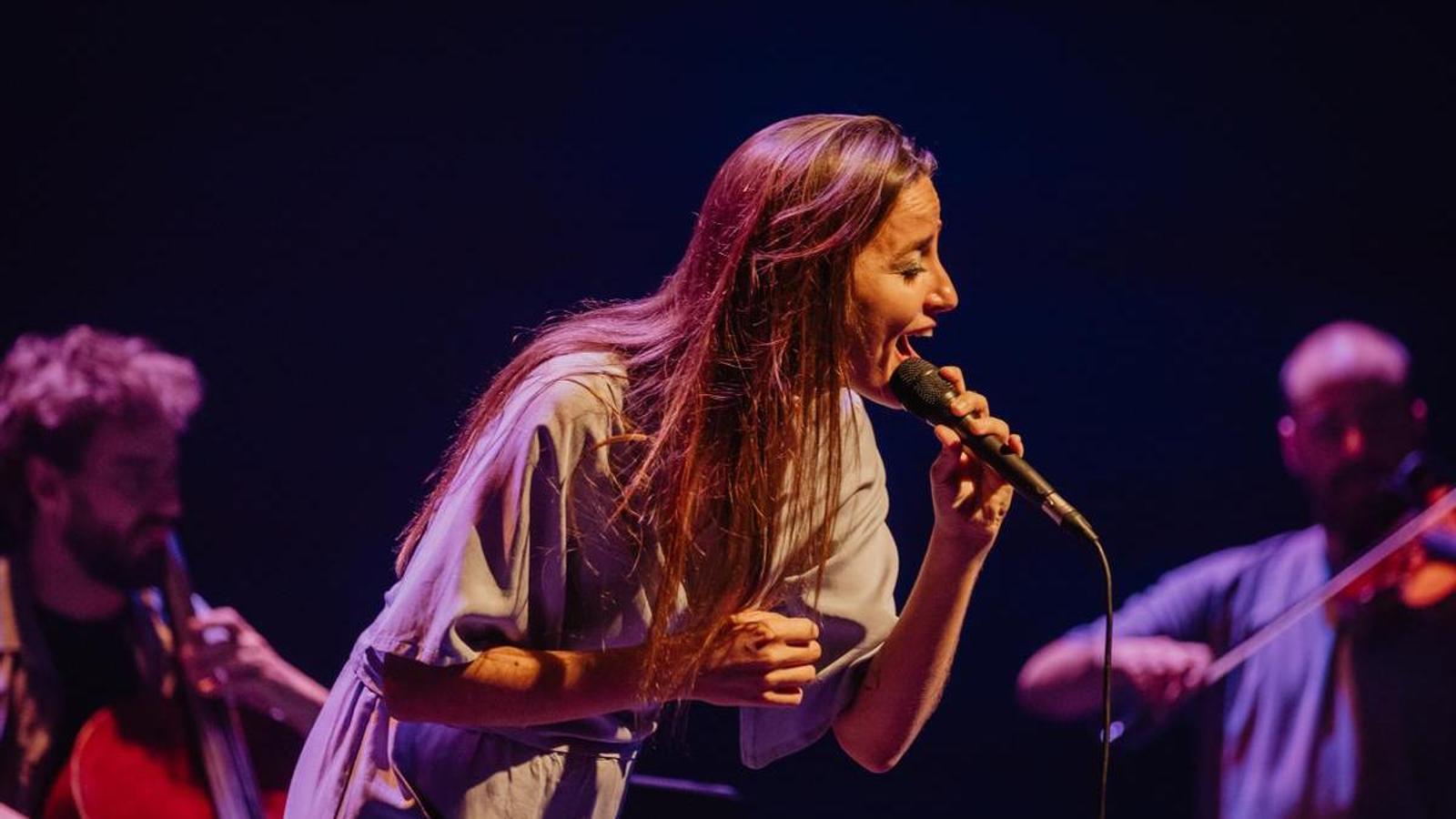

Manresa"If these songs have reached today, it is because they are great themes," stated Marc Heredia, composer and pianist of the Trio Fortuny. Agreed, they are great themes. But what the chamber trio has done with the voice of Judit Nedderman is the eighth wonder: they have recovered the songs that move us most in the world, the traditional songs our mother or grandmother used to sing to us as children —the stories of L’Hereu Riera and La filadora, the Muntanyes regalades and El mariner, compositions they have gleaned from the Càntut archive— and have reinterpreted them from the perspective of chamber music, with new arrangements and recompositions. The result is Vora, a jewel that will take the form of an album next year, but which is already a beautiful and moving show, delicate yet powerful, premiered on Saturday evening at the Kursaal, in one of the climaxes of the Fira Mediterrània de Manresa, which supported them as co-producers through its Obrador d’Arrel.
The gesture they make with Vora is like taking a tapestry —a simple, practical fabric, handmade and with a specific weave in each place where it is traditional—, taking what belongs to the people and hanging it like a museum piece, exalting the quality of these compositions that have traversed time and generations. The exceptional Trio Fortuny (Joel Bardolet, Pau Codina, Marc Heredia) play with the strings when the grandmother goes to the fountain to fetch a small pitcher of water and meets the miller's son, ride wildly through a tambourine song from La Palma d’Ebre, tuck us in with tenderness in La mare, and turn the ballad of El mariner into an epic saga that (La)Horde could dance to. As Nedderman said at the concert, referring to the Canigó that her grandmother pointed out to her from Molló, without a doubt "singing makes us love things more".
One of the songs they sang is La barca xica, a habanera that an hour earlier we had heard at the Teatre del Conservatori with a different register and voice, that of Arnau Tordera. His new show, Sirènia, performs a similar exercise: the musician from Osona has put a new coat on a repertoire of habaneras, has written new arrangements —with his trademark harmonies—, highlighting the romantic power of the lyrics and the refinement of the melodies. "All these elements generated an irrepressible attraction in me," the musician told us before the premiere.

Adorned with a striped shirt, barretina, and espadrilles, Tordera sings and plays the guitar, accompanied by the voices of Clara Renom and Glòria Figuerola. The selection of songs ranges from classics by Ortega Monasterio, the Pérez Cruz duo, and even to the Inland sailor by Josep Bastons. And he also includes his own songs: the oldest one is Like salt at sea by Obeses, a composition from fourteen years ago, and the spark that originated this show, which is titled A small white boat. Tordera, with its theatrical demeanor and marine scenography, offers the public an unexpected and militant approach to the 'havanera' —neither Festa Major classics, nor a modernizing bet: the common thread is "beauty, there is no testosterone-filled universe", he summarized— which ends with the apotheosic Seagull by Frederic Sirés.
Not claiming: enjoying
Both the musicians of Vora and Arnau Tordera assure that the intention of their new projects does not stem from a desire to reclaim Catalan heritage but from pure fascination for this music, often far removed from their usual genres. "More than the fact that it shouldn't be lost, it's that it inspires me to sing this repertoire and, in turn, we keep the tradition alive," explained Nedderman. And in turn, it will also mean that mothers will sing them to their children again. For them, the project combined musical challenge and emotional connection. "After all, traditional music is linked to all other music: chamber music is music of proximity. And within classical music, there is a tradition of rearranging these songs; Frederic Mompou himself did it," said Codina and Heredia. "We have a heritage that is artistically valuable. And for this legacy to be heard live, to be reinterpreted from a contemporary perspective, and to continue moving people, is implicitly a political gesture," affirmed Arnau Tordera.
