To coincide with the 150th anniversary of Pau Casals' birth, the Pau Casals Foundation has loaned the Liceu the Goffriller cello that Casals played for over sixty years. It will now be played in the ten performances of the opera 'Werther' by Òscar Alabau, principal cellist of the Liceu Orchestra. The cello, built by the Venetian luthier Matteo Goffriller in 1733, was acquired by Pau Casals in 1908.
Christof Loy stages the tragic "school of love" from 'Werther' at the Liceu
The Basque tenor Xabier Anduaga performs for the first time the leading role in Massenet's opera
16/04/2026 - 11:43 h

-
CAT -
CAST
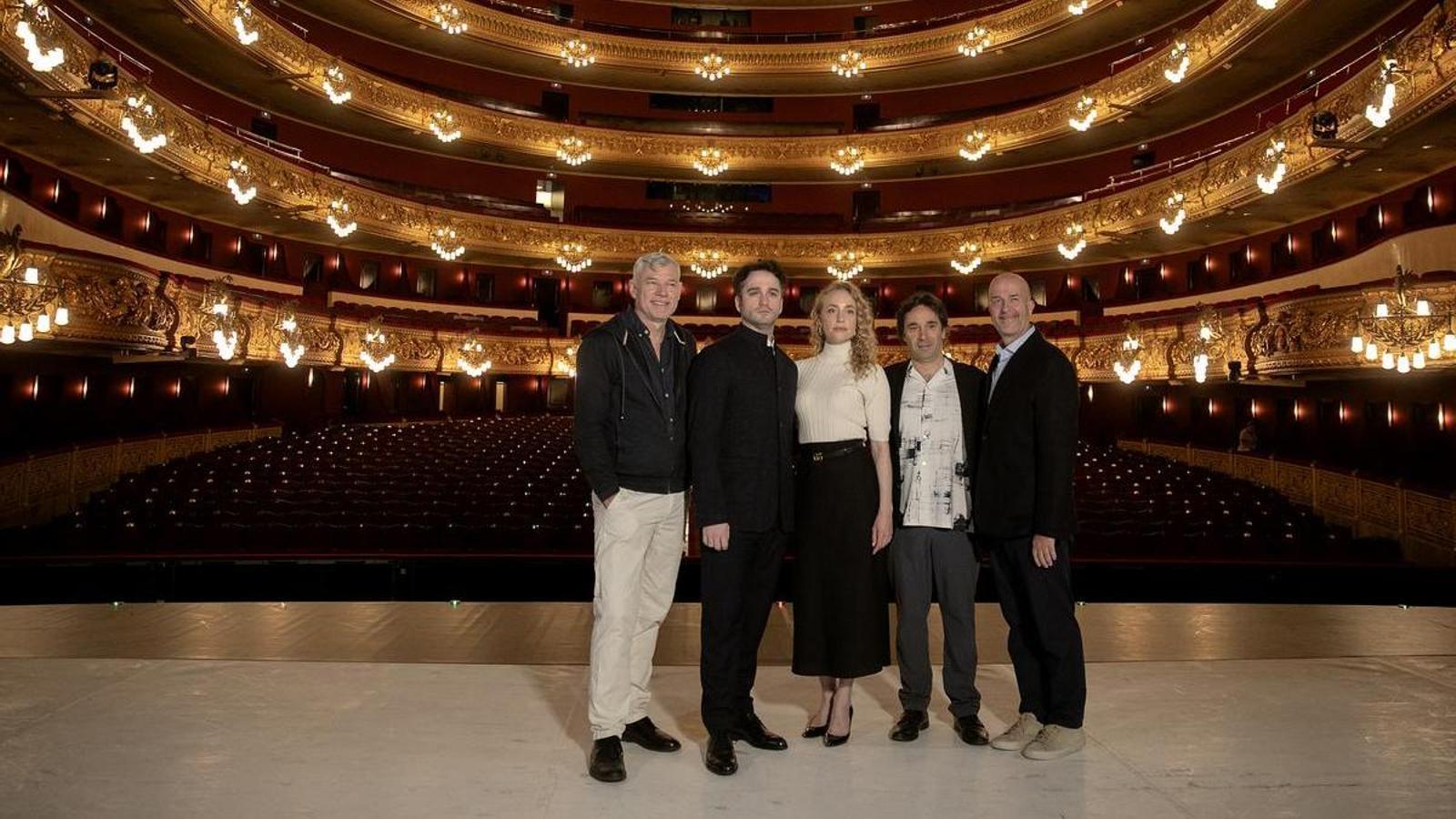
BarcelonaThe German director Christof Loy closed last season at the Liceu with a brilliant production of Rusalka, by Antonín Dvořák, with Piotr Beczala and Asmik Grigorian in the leading roles, both in a state of grace. Loy had the indispensable accomplice of set designer Johannes Leiacker, another master of clear lines and contained emotion, with whom he also worked on the staging of Jules Massenet's opera Werther, ten performances of which will be given at the Liceu from May 2 to 17, with a double cast. In the first (on the 4th, 7th, 9th, 14th and 17th), two singers debuting in the roles: Basque tenor Xabier Anduaga as Werther and German mezzo-soprano Kristina Stanek as Charlotte; two roles that in the second cast (on the 2nd, 5th, 8th, 11th and 16th) are sung by American Matthew Polenzani and AzerbaijaniElmina Hasan.
Although this Werther according to Loy has already been seen at La Scala in Milan in 2024 and at the Champs-Élysées theatre in Paris in 2025, the director approaches it as if he were creating "something new because there are two practically new casts". "It's as if they were two different stories. In the first, Xabier and Kristina, as in Massenet's score, are two young people who have to discover love and heartbreak in this school of life and love. On the other hand, in the second cast, there is an age difference between Werther, who is older, and Charlotte, who is younger. Therefore, they will be two productions of Werther." Only afterwards will it be possible to assess whether the nuance is as relevant as Loy claims when conveying this tragic story of impossible love between a poet who does not fit into a utilitarian morality and a woman trapped in a marriage resulting from a commitment made to her mother.
"I want to thank the Liceu for their trust, especially for debuting in such an iconic role as Werther in a theatre that is my home," states Xavier Anduaga, who first appeared at the Rambla theatre playing Ernesto in Don Pasquale, by Donizetti, in 2022. He returned in 2025 as the protagonist of La sonnambula, by Bellini, alongside the American soprano Nadine Sierra. "I am excited and feel the responsibility to perform Werther, a role that the best have sung," says the Basque tenor. In fact, the last time Massenet's opera was performed at the Liceu was in 2017 with a protagonist duo that amazed: the Polish Piotr Beczala and the Italian Anna Caterina Antonacci (and with the elegant stage sobriety of the German Willy Decker). "The most important thing is to maintain the balance between the vocal and acting parts," informs Anduga with the relative calm of knowing that it comes at a good time in his career. "I have gone through Rossini's opera buffa and bel canto, and I have always had Werther on the horizon," he adds. Kristina Stanek has the same feeling, aware of the importance of vocal and acting experience when tackling a role like Charlotte's, almost forced to "control her emotions" while at the same time conveying what a character feels who "seeks another way to feel love".
The cast of
Werther at the Liceu is completed by Sofia Esparza and Leonor Bonilla as Sofia, David Oller and Carlos Daza as Albert, Stefano Palatchi (the mayor), Josep Fadó (Schmid), Cristofol Romaguera (Bruhlmann), Marta Esteban (Kathchen), and Enric Martínez-Castignani (Johann), the only singer in the cast who has participated in this production, specifically when it was performed at La Scala.

The lovers' expectations
Werther, inspired by Goethe's drama The Sorrows of Young Werther (1774), is a "wonderful opera", as Stanek assures, which Massenet premiered in Vienna in 1892. "It is a rarity in French operatic tradition. It is a work without a chorus, without ballet, it has nothing to do with the grand French opera of the time", explains Loy. Massenet focuses on the intimacy of characters who plunge into an emotional upheaval, and the staging "tries to give the necessary warmth" so that this tragic "intimacy" can be shown, says the stage director, who takes the work to the fifties of the 20th century, an era that facilitates the commitment to a clear-line aesthetic. On stage, Loy creates a double stage space, with a kind of "wall with a door in the center behind which we can imagine Charlotte's world that Werther wants to achieve". In front of the wall there is "an empty space where the lovers meet with different expectations".
The Hungarian Henrik Nánási, who will conduct the Liceu Orchestra for the ten performances, perfectly describes the emotional progression of the relationship between Werther and Charlotte. "In the first two duets they don't sing together, because true love has not yet arrived. And in the third and fourth duets the voices are already together because love has been consolidated", explains Nánási, a director well known at the Liceu, where since 2016 he has directed The Magic Flute, by Mozart; Tosca, by Puccini and the diptych Cavalleria rusticana / Pagliacci, by Mascagni and Leoncavallo. Nánási praises Massenet's score, "one of the best composers in terms of balance", and highlights details such as the influence of Wagner's Tristan chord (which the Hungarian conductor will extend to emphasize Massenet's wink) and the use of the saxophone, especially in the letter scene in the third act. "The saxophone brings a melancholic, sad color, similar to the clarinet but more nostalgic.
Pau Casals' Cello
