Catalonia disembarks in Venice with rhythm and historical memory
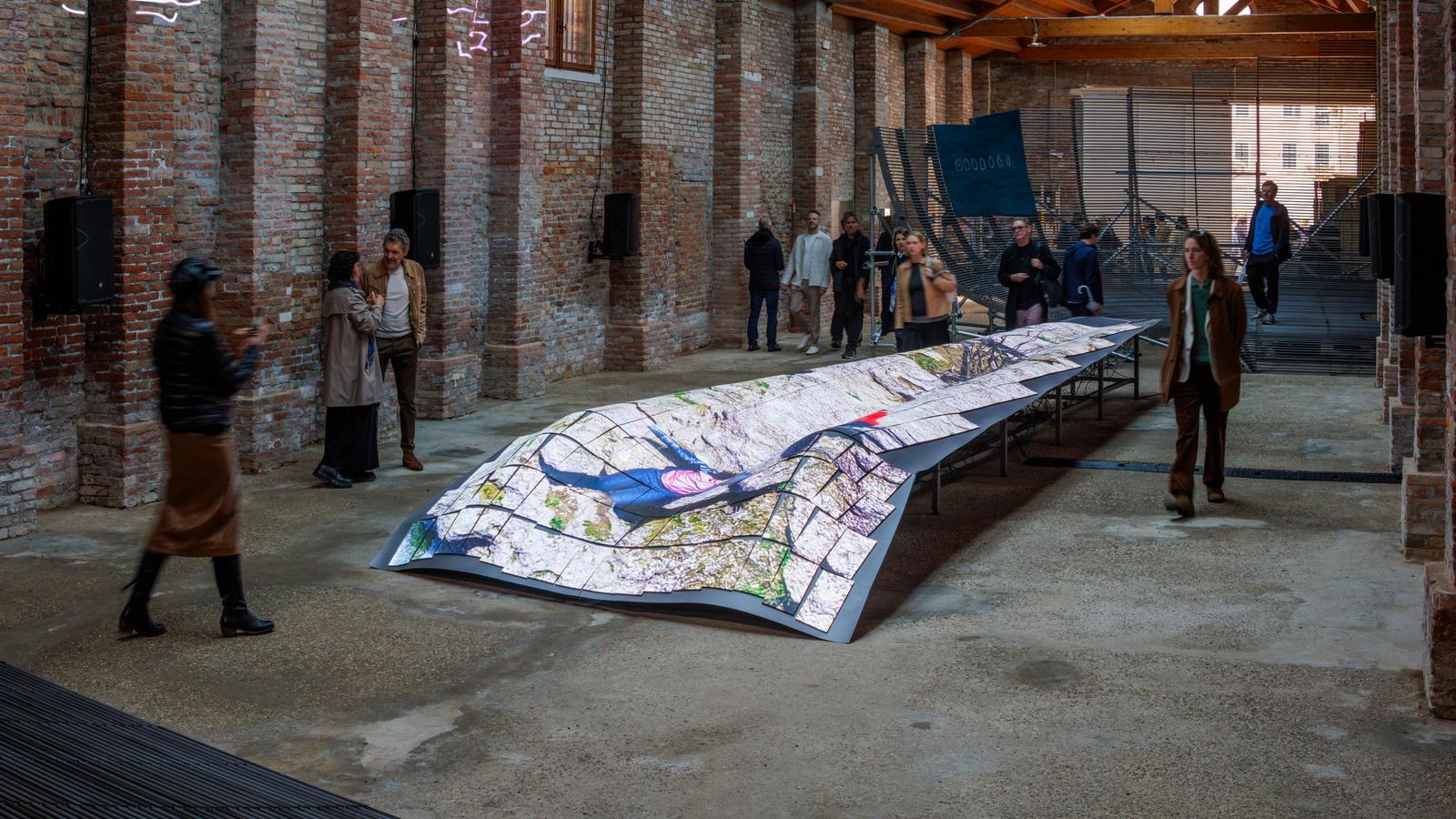
Claudia Pagès' macro-installation 'Paper tears' gains momentum with performance elements and a gigantic sculptural LED screen

-
CAT -
CAST
VeniceCatalonia and the Balearic Islands take center stage at the 61st Venice Art Biennale. The project by Claudia Pagès Paper tears [Paper tears] gains momentum with a poetic and political slam by Pagès herself and her collaborators that ranges from the most intimate to political and social critique, addressing the ravages of colonialism. The starting point for her discourses are a string of 15th-century watermarks found in the Museu Molí Paperer de Capellades. "Crowned heart. Crowned heart. Incel's dream. incel. 1486. Crowned love is not love. It is the Sacred Heart of Jesus. Little emperor, everyone loves you as long as you keep them alive! What strange references," says one of these texts.
"We are five people who speculate about the imaginary of the watermarks, which for them mean nothing. In the documents we find law, conflict, and you have to provide the language – explains Pagès. We play at making associations, and at the same time as we talk about ourselves, we explain different events, including the expulsion of Arabs and Jews, the colonization of the Americas... When you speculate about an image, you also speculate about yourself. It's a very autobiographical project, I'm from Capellades, I grew up in the Molí. The watermarks for me have been small objects that I've had around and that have always sparked my curiosity."
For the project's curator, Elise Lammer, Paper tears fits perfectly into this Biennale. "I think Claudia's project responds perfectly to what the director of this Biennale, Koyo Kouoh, invited us to do, which is to think about minor notes. And in Claudia's practice, there's this thing of transferring information in a more discreet way, from below. And also what is underground and water flows," says Lammer.
In another of the texts, Pagès and her collaborators go back to the beginning of the reign of the Catholic Monarchs and reach the present day: "Hand with a crown. Hand with a crown. Union. Expulsion. Delimited territory. Vassals and kings. Poor and millionaires. Musk, Bezos and the whole gang. 1475". All this in a audiovisual macro-installation that preserves the contagious rhythm of the artists' performances. "Claudia's project fits very well with this Biennial's theme, In minor keys. I think it's very nice how it has connected through these 15th-century filigrees, which are beautiful. Furthermore, I really like how she explains that it was a very turbulent time, and we are surely in the most turbulent Biennial right now. I think this other element is also very important," points out the director of the Institut Ramon Llull, Anna Guitart, in her first Venice Art Biennale at the head of the institution. For the Minister of Culture, Sònia Hernández Almodóvar, Claudia Pagès' project “connects heritage, memory, and critical reflection on systems of knowledge and power”. “It is an exhibition deeply linked to the industrial history of Catalonia through paper and water, an element that here, in Venice, acquires special symbolism”, she added.
Paper tears can be seen from this Saturday until November 22 at the usual venue of the Institut Ramon Llull in Venice, the Cantieri Navali, a former nautical warehouse. Throughout 2027 it can be seen in Barcelona, at the Fabra Centre d'Art Contemporani. The Cantieri Navali are not an easy exhibition space. Claudia Pagès has succeeded with a large, custom-made LED screen of about 10 meters. It has a sinuous shape, evocative of the Venetian canals. At one end and the other there are two bleachers made of corrugated material, designed by architects Miquel Mariné and Pol Esteve (GOIG). Watermarks appear projected by laser on the walls. "The exhibition is conceived as a kind of skater's half-pipe, or a place where you can enter, almost a dramaturgy or an operetta. The platforms introduce us to the exhibition through different levels, as also happens in Venice –says Pagès–. While the watermarks can only be seen against the light, here we project them with lasers that are still a filigree".
Pagès defines the succession of the different parts of the projection as a "waltz": while in some moments the texts run over dark waters, in others Pagès, Feña Celedón, Ameen Metawa, Guillem Mont de Palol and Mònica Muntaner appear performing. "Cor. Heart. Year 1400. Empathy. If you need it, you can get it tattooed! I am beautiful inside and out! In Cusco, Peru, Viracocha becomes Inca". Yes, the personal or daily sphere is also political. The Catalan pavilion will join the strike planned for tomorrow against Israel's presence at the Biennale.
The MNAC in a round table on the future of museums
In addition to the inauguration of Paper tears, Catalan presence at the Biennale continues with the participation of the director of MNAC, Pepe Serra, in a round table on the future of museums at the Hotel Metropole in Venice, alongside Maria Mediaas Jorstad, director of Kunstsilo in Kristiansand (Norway), and Jessica Berlanga Taylor, director of The Strauss in San Diego. The round table is titled Facing the Future. Reimagining Museums for the 21st Century. The host is András Szántó, who opened MNAC's public program on its expansion, and the moderator is Ben Luke, from the magazine The Art Newspaper.
