Catalan artists at the Venice Art Biennale reveal the fine print of history
Claudia Pagès works from old paper watermarks and Oriol Vilanova with postcards

-
CAT -
CAST
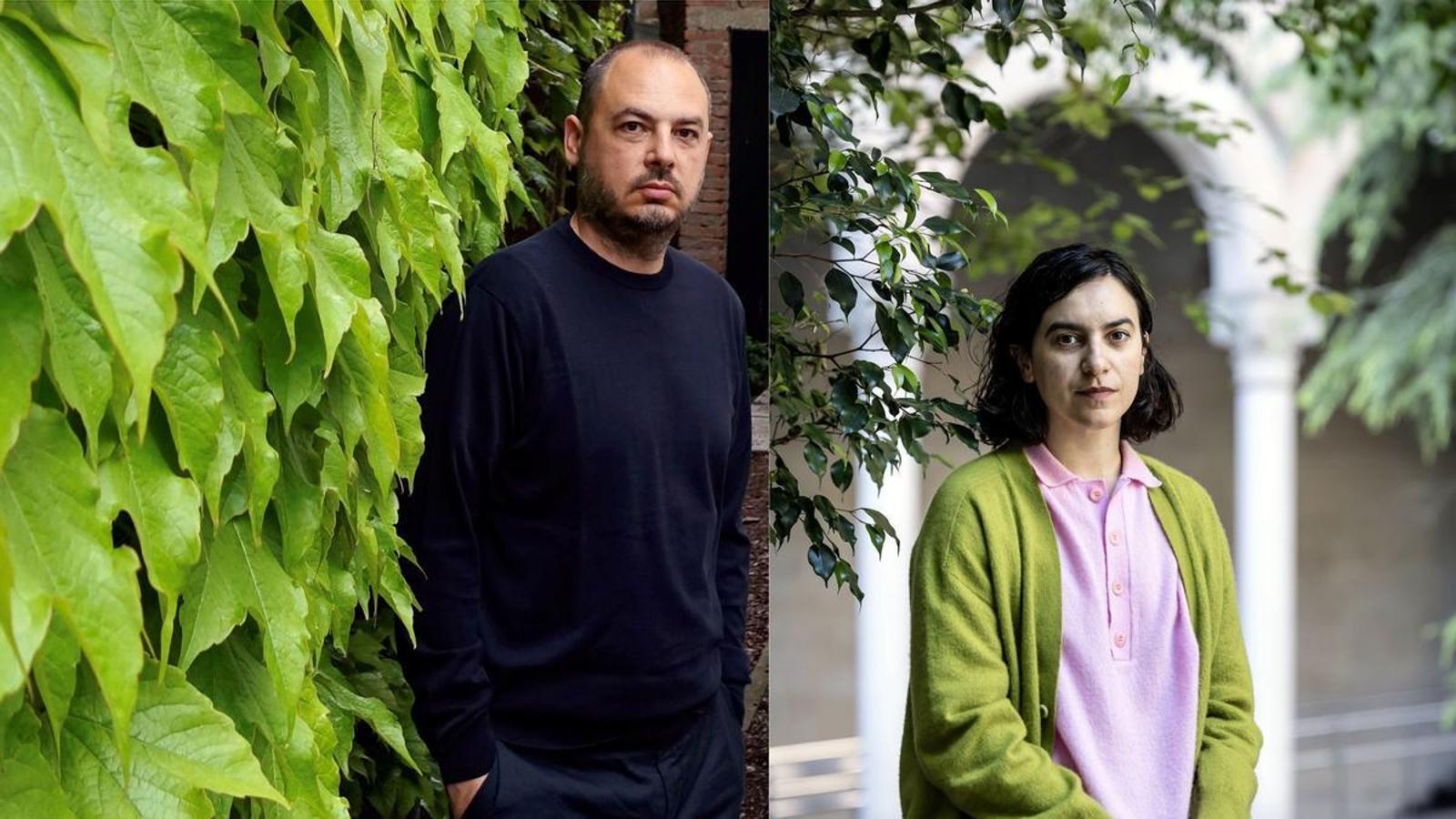
VeniceArtists have the ability to reveal the hidden stories in the most everyday objects and in almost invisible details. Thus, Clàudia Pagès represents Catalonia and the Balearic Islands at the 61st Venice Art Biennale with Paper tears, a macro-installation forged from 15th-century watermarks found at the Capellades Paper Mill Museum. Watermarks, also known as filigrees, are used to identify the maker of a paper and the person who commissioned it. Throughout history, some have been as simple as a cross, but others have been more elaborate, such as a coat of arms or images of real or fantastical animals. "I am not a historian; I use history during my research, and I make it my own through a mix of visual arts and writing," says Pagès, who is also the author of the novel Més de dues aigües (Empúries).
During the research process, Pagès detected that the silk route and the paper route were the same, that the paper importers were the Muslim population, and that the expulsions affected paper production. "I have taken the project as a way to confront a very harsh present, to face it head-on. The moments in our history that were very violent have helped me understand the current situation, with genocides, with expulsions, and also the fact that Catalonia is becoming increasingly Islamophobic," says Pagès. "In Venice, we look at the 15th-century watermarks from the archive of the Capellades Paper Mill Museum. They are very naive drawings: there are dogs, unicorns, boats... They look like they were made by small children. But when you look at what happened the year they were made, it's all barbaric," explains the artist.
The other Catalan artist at this Art Biennale is Oriol Vilanova, who represents Spain with the project
Les restes. Vilanova is known primarily for the presentations of his vast collection of postcards, which he buys by the thousands at flea markets. Les restes includes about 50,000 of the more than 250,000 he owns. Years ago, Pagès also worked with the social dynamics of flea markets. "I lived next to the Encants, next to a meeting point for hauliers. They were my friends, and they explained to me how everything worked. I was interested in the oral part, the circulation of goods, and all the jargon that came out of there," says Vilanova.

An object laden with meaning
For Oriol Vilanova, the title of The Remains is a metaphor for the materials he works with. "Flea markets are these spaces for digesting history where objects arrive, as if it were the last party before their destruction," explains Vilanova, who was receiving congratulations all Tuesday for the pavilion. "The objects are there like the remains of society – he adds –, of all societies, because in fact flea markets are present in all cultures." As for the postcards, he points out that it is about working with material "forgotten by history" and giving it new life. Forgotten, but not harmless: "The postcard seems like a banal object but it is very loaded with meaning and is crossed by history, by all histories. It is not a neutral object, but quite the opposite," states Vilanova. "What is interesting is how the gaze transforms images that apparently have no political content: in the pavilion there will be an aerial image, one of snow, and a third of fog that connects them with a landscape language, and in reality it can be an image edited during Franco's regime," explains Vilanova. In other cases, there are images that can be related to Belgian colonialism in the Congo and gender clichés. "The postcard is an object that has metabolized the world, that has eaten it, that has integrated it," he emphasizes.
The remains features the curatorship of Carles Guerra, who organized a major exhibition of Vilanova when he was directing the then Fundació Tàpies. "It was one of the first times we created a very specific device to present the collection, which is never the complete collection. The quantity is a somewhat vague matter. You can say it's a lot, but a lot with respect to what?", states Carles Guerra. Now they meet again in a very different scenario, both with regard to the place and architecture, as well as the evolution of the collection. "The collection is an entity that has a life of its own, and then, in each presentation, somehow the collection decides to go one way or another. Actually, what interests me is the idea of collecting. Sometimes it's from my own collection, sometimes it's in collections of other museums, sometimes it's collaboration with private collectors," says Vilanova. For Guerra, the change has to do with the political character as an element that legitimizes contemporary art. "We are at a time when artistic proposals are required to have a political stance in places like the Venice Art Biennale, just like that. What politics is there here? I always say there is an economy. The art world is a world heavily marked by all of neoliberalism, by the production of difference and the production of exponential value. Oriol's work takes refuge in a very humble, very subsidiary market, where it finds a space for circulation, a space for collectivity," concludes Guerra.
