Cambó from the intimacy of his house
The historian Borja de Riquer and the deputy director of ARA, Ignasi Aragay, talk about the Catalan businessman and politician
-
CAT -
CAST
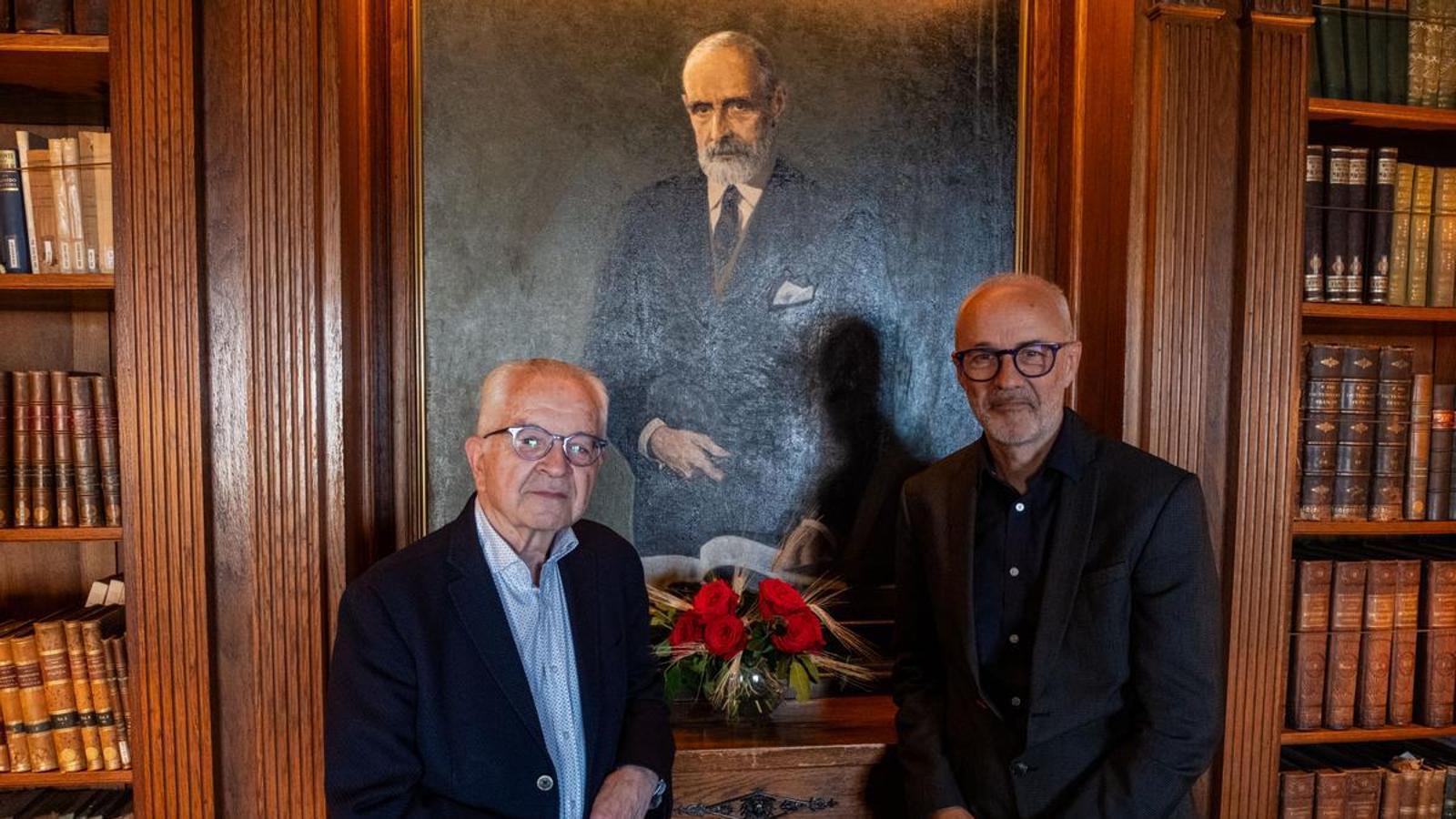
BarcelonaWhat better space to talk about Francesc Cambó (1876-1947) than the place that was his home? Specifically, his library, which remains intact, with all the shelves and all the books. This was the setting for a conversation between Borja de Riquer, the historian who knows the most about the factotum of the Lliga and his complex trajectory, and the deputy director of ARA, Ignasi Aragay.
Cambó wanted to build the magnificent building, designed by the architect Adolf Florensa i Ferrer, on Via Laietana, which he himself had promoted. Built between 1921 and 1931, it was not a modest ambition: it was inspired by the skyscrapers of the North American Louis Henri Sullivan. It was first his residence and the headquarters of Immobiliària Catalana, and later his daughter Helena and her thirteen grandchildren lived there. For a brief period of time, during the Civil War, it was occupied by the CNT. Helena Cambó's heirs sold it to him, and since 2005 it has been the headquarters of the Grand Hotel Central.
Nevertheless, Cambó remains present because some spaces have been preserved, which are quite restricted. One is the library, but also the attic where he had lived. Practically nothing has been touched because the hotel has not obtained permits to make renovations. There is not even an electrical installation, and the attendees at Tuesday's event had to go with flashlights. It was a journey to another era. The rooftop gardens remain splendid, as if time had not passed.
The tallest house in Barcelona
"When it was inaugurated, in 1931, it was the tallest house in Barcelona. It was one of the few in which the owner lived in the attic and the top attic, with gardens designed to be able to stroll and see the whole city. This is typical of a Novecentist; Cambó would have been terrified if Puig i Cadafalch had done it and it ended up being like the Casa de les Punxes. He wanted to live alone and have no neighbors. That's why everything else was rental offices," explains Borja de Riquer. It caused a sensation, and rightly so. Cambó even had a Gothic palace, which was behind his house, moved to Plaça del Rei, the current headquarters of the Museu d’Història de Barcelona, which was behind his residence.
Borja de Riquer dedicated more than thirty years of research to writing his monumental 900-page biography of Cambó. He knows practically all the details about his political career, quite controversial, his business ventures and his multi-million dollar deals, tarnished by corruption, his intense private life, and everything he did as a patron.
"He surely had the most Botticelli paintings in the world, including a fake one that is beautiful. Cambó's patronage is exceptional in the European sphere," says the historian. Even so, he was not very generous with those dedicated to culture. "He believed that intellectuals should be demanded a lot and paid little," says Riquer. Sometimes, however, he made exceptions. "He helped many people during the Civil War. Josep Pla constantly came to ask him for money; he made him sign the receipt and he would write: 'I have received from Francesc Cambó the modest sum of...'", adds De Riquer.
The hidden daughters
"He was a multifaceted and complex character; it is not about making harsh judgments," states Riquer. "Politically, he failed and did very risky things, such as those he attempted during the Civil War," he adds. He wanted to rule in Madrid and did not succeed. It was Prat de la Riba who advised him to go live in Madrid because only from there is Spain governed. His advice was: “They will attack you in Catalonia, but when you succeed in Madrid, everyone will come; on the other hand, if you stay in Barcelona, the Catalans will devour you”.
Cambó wrote a lot and wrote quite well, but there is one topic he did not touch much: women. Neither his lovers nor his two daughters are mentioned in his memoirs. And this despite the fact that he liked women a lot and had several lovers. First singers and then much younger secretaries. "He supported his daughters and loved them, but for a long time he kept them hidden. He did not recognize Helena until 1938. So hated and attacked by his enemies, and all these stories never came to light," states De Riquer. When he died suddenly, the battle for the inheritance began. Cambó's widow, Mercè Mallol, confronted his daughter Helena. Borja de Riquer can always offer some unknown detail about the life of a character who, as he himself says, was "unrepeatable".

