Banco Santander lights a cultural lighthouse
The new center, in the capital of Cantabria, opens with three exhibitions with works by great artists such as El Greco, Rubens, Goya, Frida Kahlo and Leonora Carrington

-
CAT -
CAST
SantanderAmong the star architects, the British David Chipperfield (London, 1953) is one of those who have rehabilitated the most iconic historical buildings. Before winning the Pritzker –the Nobel of architects– in 2023, Chipperfield received the Mies van der Rohe award for the restoration of the Neues Museum in Berlin, and later made history again in the same city with the recovery of the Neue Galerie, by Mies van der Rohe. In his rehabilitations, Chipperfield is delicate, meticulous and, when necessary, forceful, as can be seen in his most recent work, the Faro Santander cultural center, which opens its doors this Tuesday in Santander.
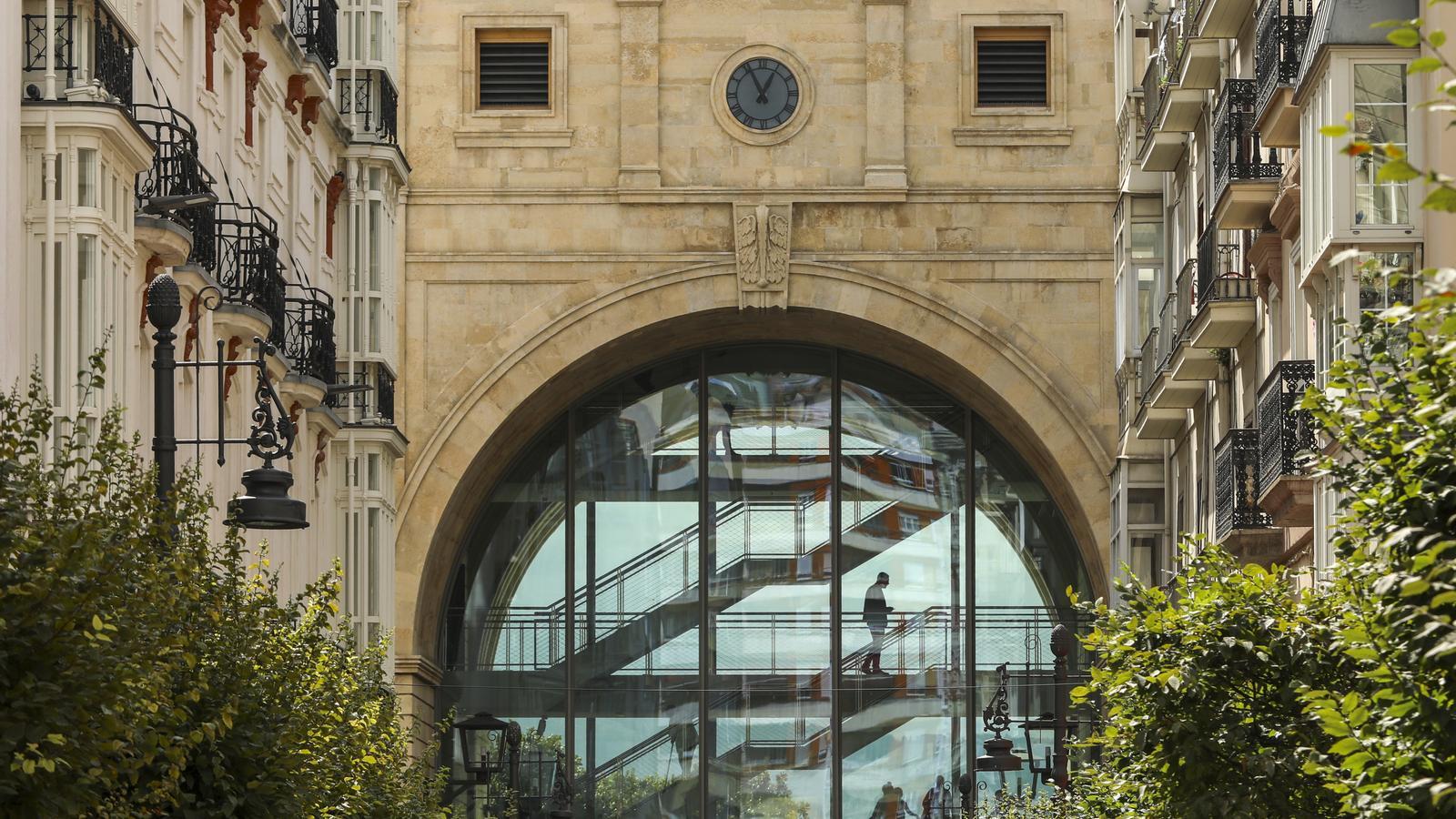
Chipperfield has not touched the facades of the building, which is listed as a Property of Cultural Interest, but he has completely renovated the interior. The most surprising thing is that he proposed the core of the project inside the existing large arch, which now serves to connect the two parts of the building. "The arch gave an apparent unity to a quite complex spatial structure. In reality, it was a building with a void in the middle. Although it seemed to join the two buildings, it only connected them at the upper levels," Chipperfield explained this morning during the inauguration. "The arch becomes the heart and the lung of the building," says the director of Faro Santander, Daniel Vega, who also highlights that the arch visually connects the city's Eixample with the bay.
Even so, the decision to pacify the passage through the arch has raised a controversy that is not yet resolved: the court has ordered as a precautionary measure that the passage under the arch be restored, at least for taxis, buses, residents, emergency services, and delivery services. Currently, the Santander City Council maintains the closure and will reopen the passage on September 20 on the occasion of the inauguration and activities of the Faro Santander.

A vertical museum center
The Faro Santander has more than 10,000 m² across ten floors, 3,000 m² of which, distributed over five floors, are dedicated to exhibitions. And in the basement, there is an auditorium with a capacity for 150 people. The foundation has not made the budget public, but this Monday the city's mayor, Gema Igual, thanked the Botín family for "the highest private investment in the city's history." It should be noted that the Faro Santander is an initiative of the Banco Santander foundation, and the Centro Botín, located very close by, is an initiative of the Botín family. "A lighthouse helps people find their way, connects the sea and the land, welcomes those arriving from other places, and is there for the land. A symbol of the commitment to our roots, our culture, and our heritage. With Santander, with Cantabria, and with Spain. And with future generations," said Ana Botín, the chair of the board of directors of Banco Santander.

Chipperfield's proposal is that of a vertical museum center. It may seem like a challenge, but it has the reward that at the top of the building there is the bar, the restaurant, and the terraces, in a new lightweight steel construction. In line with his style, the interiors stand out for their minimalism: the architect has used only four elements –stone, wood, steel, and glass– to distinguish the new from the old. The only license he has allowed himself is a sculptural helical staircase in the lobby, which connects to the interior of the arch, where one can see Juan Muñoz's sculptural group Conversation piece I. "The exterior is monumental, but the interiors have a human scale, they have a domestic character, in order to have an intimate relationship with the works," says the art historian and director of public programs at the Faro, Ana Botella.

Creating a museum center from scratch
The management of museums and cultural centers has a major challenge on its hands: at the same time that they must carry out traditional conservation and dissemination tasks, they must adapt to social changes. How is the offer defined? What does the public want? At the Faro Santander, Vega and her team have opted for a hybrid model, the most significant part of which are the rooms where exhibitions can be seen: one from the Gelman Collection, by Jacques Gelman, the historic producer of the Cantinflas films and friend of Frida Kahlo and Diego Rivera; a second one of a selection from the Banco Santander art collection, and a third one about the dramatic passage of Leonora Carrington through Santander. All three will be open until January 10th (with tickets at 14 euros). On the other hand, in the lower part of the building there is a space for immersive experiences, El Cubo; another for the emerging projects that the foundation supports, Marisma, and a pedagogical and play space called Llamita. At all times, Botella emphasizes that the center will be a very "lived-in" place.
The management of the works that make up Modern Mexico in the Gelman Santander Collection has not been simple either. In fact, it caused the opening of the center, which was scheduled for June, to be postponed for a few months. In January 2026, the Santander Foundation announced a long-term agreement with the Zambrano family, the owner of the collection since 2023, to "manage, conserve, research, exhibit, and internationalize" some 160 works from the fund, renamed as the Gelman Santander Collection, by great artists and photographers including Frida Kahlo, Diego Rivera, José Clemente Orozco, Rufino Tamayo, Manuel Álvarez Bravo Gabriel, Tina Modotti, and Graciela Iturbide.
The works are a guarantee for twelve and a half years for a 150 million euro loan that Santander granted to the collectors. The transfer caused a stir in Mexico, because it was feared that the departure of the works from the country would be permanent. The temporary export permit is for two years, so the works will return to Mexico in 2028 and will be able to be seen in a major exhibition. But this does not mean they cannot leave again. After Santander, some of the exhibited Frida Kahlo works, among which stand out two magnificent self-portraits, Self-Portrait with Monkeys and Diego on My Mind, will be able to be seen in a retrospective of the artist at the Beyeler Foundation (Switzerland). In a recent video, Madonna, who owns another portrait of Kahlo with monkeys, said that the artist trained them to spy on Rivera and start screeching to expose Rivera when they saw him going off with another woman.
The Banco Santander collection is the fruit of the merger of funds from banks it has absorbed, collections with artworks, and other acquisitions. Regarding the exhibition Masterpieces of the Banco Santander Collection,María Dolores Jiménez makes modern and contemporary works engage in dialogue, from El Greco, Titian, Rubens, and Goya to Tàpies and Ángela de la Cruz, in areas dedicated to sacred art, landscape, portraiture, and still life. At the beginning of the tour, one can see one of the last paintings by El Greco, a gigantic Annunciation that he left unfinished.
Finally, Symptomatic Surrealism: Leonora Carrington shows for the first time together in the city the two paintings, Villa Pilar and Down below,which the artist painted during her internment in Santander in 1940, after being raped in Madrid by a group of soldiers. This exhibition is a new version of the one that could be seen at the Freud Museum in London. Villa Pilar, Carrington gave it to her doctor at the sanatorium, Dr. Morales, and it now belongs to one of his heirs.
In a territorial dimension, Faro Santander joins an ecosystem that includes the Botín Center and the Lafuente Material Culture hall, belonging to businessman José María Lafuente. Lafuente himself sold his archive to the State, and this space he maintains is an appetizer for the grand headquarters of the Lafuente Archive, which the Ministry of Culture is building in the former Bank of Spain as an associated headquarters of the Reina Sofia Museum. The Museum of Prehistory and Archaeology of Cantabria (MUPAC) is also under construction. Unlike some museum franchises installed in Malaga, for Vega the Santander model is "very genuine, because it is very connected to the local." "What we are looking for is to integrate ourselves in a relevant way into what already exists. We come to contribute, to complement, to try to bring things that we think are not there or for which there is space. By no means to compete," says Vega.
