Babies with sunglasses at the Venice Art Biennale
The Japanese Arakawa-Nash introduces care and tenderness in an edition marked by Israel and Russia

-
CAT -
CAST
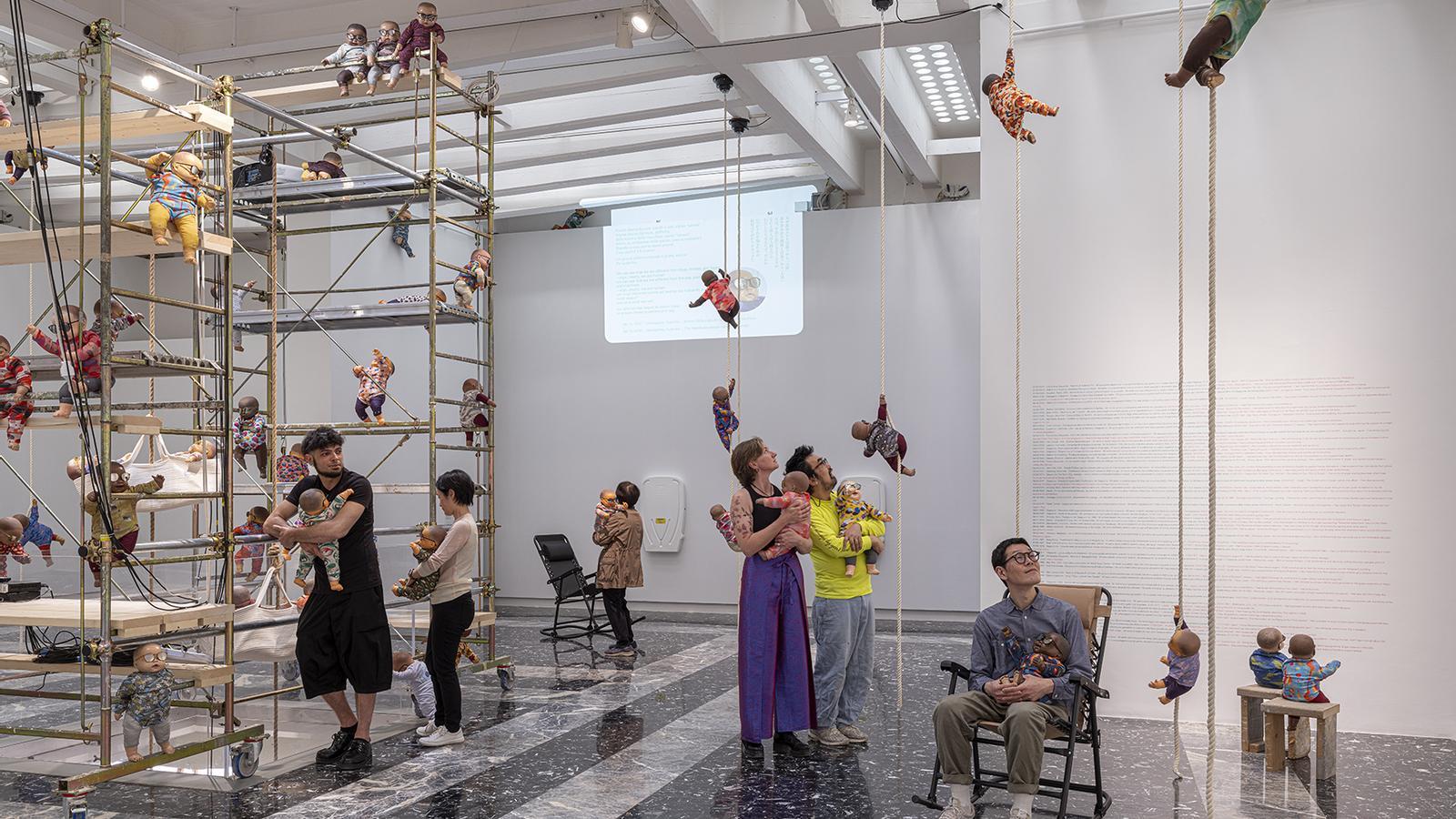
VeniceIn an edition of the Art Biennale marked by protests against Israel and Russia, the queer artist of the Japanese pavilion, Ei Arakawa-Nash, has placed himself in a much more personal space. His project, titled Grass babies, moon babies [Grass babies, moon babies], is, at the same time, humanist, political, and a bit comical. Arakawa-Nash has filled the pavilion with about 208 baby dolls of different races, available for visitors to hug – they weigh about six kilos – and take for a walk in a stroller. They all wear sunglasses so that whoever holds them can see themselves reflected while holding them.
The project stems from the fact that Ei Arakawa-Nash and his partner, Forrest Nash, became parents to twins at the end of 2024, and now Arakawa-Nash is raising a reflection on care, parenthood, and the future in a context of low birth rates.
Another of the most talked-about pavilions this year is the Belgian one, thanks to the performance staged by creator Miet Warlop, known in Catalonia for her appearance at the last edition of the Temporada Alta festival with Inhale Delirium Exhale. In It never ssst [It never stops], six performers vent their frustrations in a monumental installation made of shelves filled with plasterboard panels with sculpted words. In a furious choreography, they pass them to each other, use them as percussion instruments, and sometimes they drop them and they break. “We live in a world that we can no longer keep up with, that we can no longer properly understand, in which we sometimes cannot distinguish lies from truth, and therefore we find ourselves in a kind of lane of desperation”, says Miet Warlop about this work. “Emotionally, this raises the question of how you can contain it or how you can coexist in an adequate way, but also how you can express disagreement or wonder if change comes through protest –she adds–. Thus, the space I wanted to create is the space of this desperation, combined with the possibility, as a person, of letting all this affect you without it destroying you”.
On the other hand, India stands out among the national pavilions in the Arsenale complex. Among the exhibited works, all evocative of traditional techniques and materials of the country, Adreça permanent, by Sumakshi Singh, catches the eye. It is a reconstruction made with embroidered threads of the family home in New Delhi, which was demolished. With this work, suspended from the ceiling of the room, Singh wants to talk about the idea of home, loss, and memory. In the Peruvian pavilion, Sara Flores, the first indigenous artist to represent her country, exhibits five paintings that show the complexity of the visual language of her people, the Shipibo, known as Kené, characterized by symmetrical designs that aim to connect the human and natural worlds.

"Joy, comfort, hope"
Following the sudden death of the Biennial's artistic director, Koyo Kouoh, the project In minor keys [In minor keys] was continued by a team she herself had selected: advisors Gabe Beckhurst Feijoo, Marie Hélène Pereira and Rasha Salti, editor Siddhartha Mitter and Rory Tsapayi as assistant. As Kouoh herself said, the guidelines for the central exhibition are those of a show “that invites us to listen to the persistent signals of the earth and of life, connecting with the frequencies of the soul”. "If, in music, minor keys are often associated with strangeness, melancholy and sadness, here their joy, comfort, hope and transcendence also manifest themselves,” they state. Despite everything, as has been the case for some years now, this biennial once again carries the burden of a certain “anything goes”, legitimized by well-intentioned social and environmental discourses. These large exhibitions acquire a commercial air, in which curators seem to work to discover new names for global collectors.

In the exhibition there are about 111 artists. One of the first works in the Giardini is Amistad Takeover, by Big Chief Demond Melancon, a monumental costume with which he reinterprets in a contemporary key, and as an act of resistance and liberation, the revolt of the slave ship Amistad in the year 1839. In fact, textiles are once again very abundant in this edition. Further on there are other gigantic characters, the New Moon Sentinels, by the Puerto Rican artist Daniel Lind-Ramos. They are made with materials such as fabrics, drums, and tools that Lind-Ramos often receives from people around him and they pay homage to the activists who care for the mangroves in the face of institutional neglect, racism, and real estate interests.
As for the Arsenale, Alfredo Jaar presents a critique of extractivism with The End of the World (2023-2024), consisting of a small cube made with ten superimposed layers of minerals coveted by the technology industry: cobalt, neodymium –one of the rare earths–, copper, tin, nickel, lithium, manganese, coltan, germanium, and platinum. The piece is very small, but it is exhibited in a cathedral-like room lit with red light. Another of the most interesting contributions is that of Kader Attia, who once again delves into how cubist Picasso drew from African cultures. On the other hand, the musician Nick Cave comes off poorly in the monumental sculpture Amalgama (Origin). At times it seems more like a tribute to Vecna, the villain from Stranger Things.
