Nicolas Winding Refn: “Art is an act of violence, it must penetrate your mind, body and soul”
Filmmaker, presents 'His own hell' at the Sitges Festival
-
CAT -
CAST
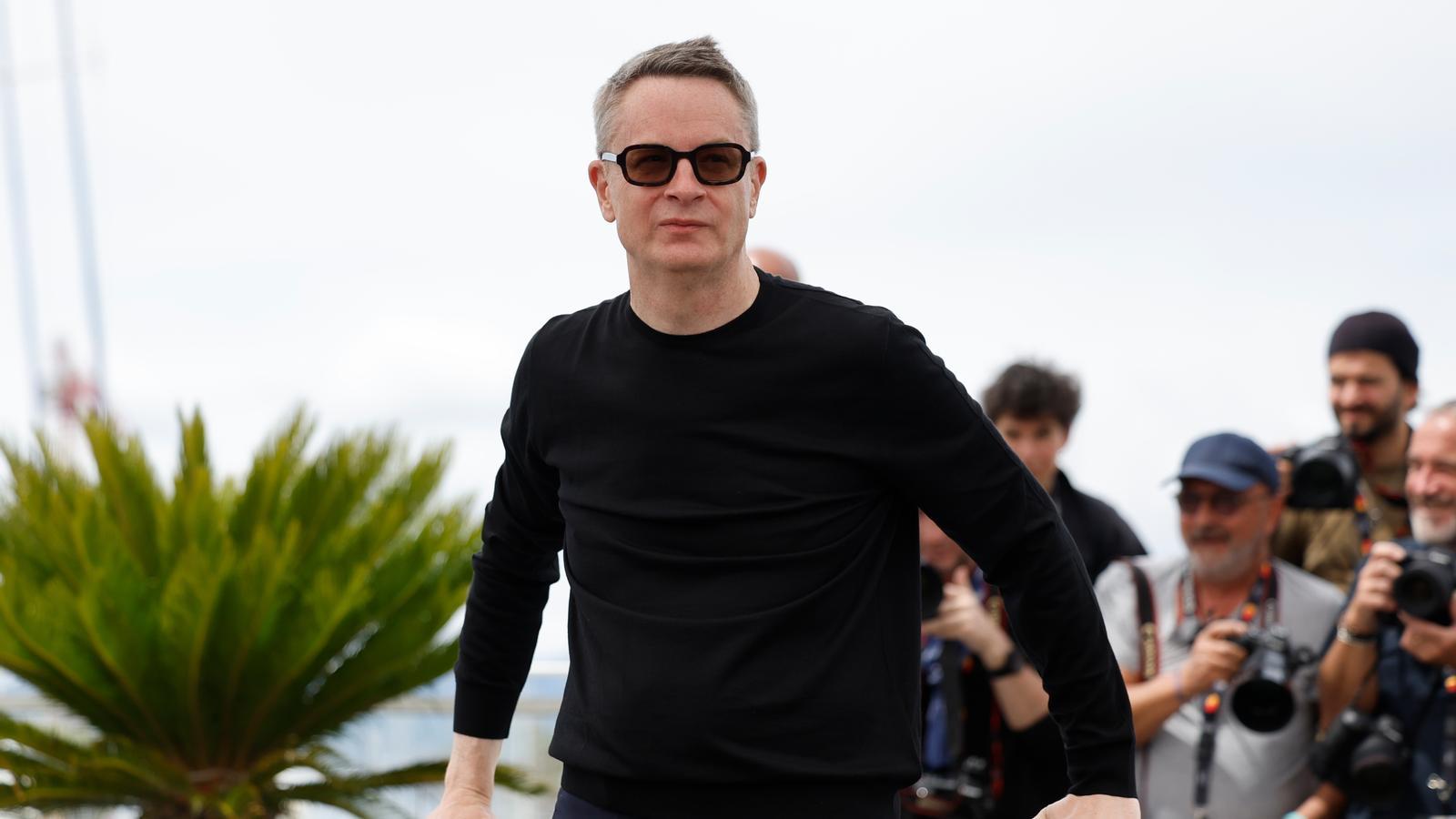
SitgesRecovered from the open-heart surgery that saved his life, Nicolas Winding Refn (Copenhagen, 1970) maintains his characteristic ironic smile, but his discourse is more direct and urgent. The director has traveled to the Sitges Festival to present Su propio infierno, which arrives in theaters on Friday. It is his most stylized and radical film, a symphonic horror tale that delves, led by Sophie Thatcher and Charles Melton, into an urban neon-pink dystopia where a killer murders with impunity and a soldier searches for his missing daughter. A fascinating work from a prodigal son of Sitges who, inevitably, has eclipsed the festival's official opening film, Found alive, by Carlota Pereda.
Before filming Su propio infierno he underwent surgery for a heart condition and was on the verge of dying...
— I was dead for 25 minutes.
Has having this experience changed the way you approach and represent violence, which has always been one of the mainstays of your cinema?
— I do not think I have changed my way of approaching it, or at least I am not aware of it. I am sure that critics do not see it that way, but I have always thought that art is an act of violence. Art must violate you. This does not mean that it is a negative experience, but it is a way of penetrating the mind, the body, and the soul. You can do it in a kind or aggressive way, but art is an act of violence. I do not know if what happened to me has changed my work, but it has indeed changed my perception of time.
In what sense?
— It sounds like a cliché, I know, but it has made me realize how valuable time is, and that we have very little of it. I am not the first to say something like this after returning from the other side, and I will not be the last. If creativity is to inspire us to make a better world, cinema is essential because it is a collective experience. And nowadays we are increasingly separated because of technology and silence. We no longer have to confront our opinions with different opinions; the algorithm brings us the information we want to hear. Cinema is one of the few sacred places that almost everyone can afford and where people of diverse backgrounds and different opinions mix. Without this interaction, humanity will head towards a digital existence, and that is very sad. Every town needs a place of worship, a cinema, a theater, and a bookstore. If not, where will we meet? The digital world is an augmented reality, a fantasy version of ourselves. It may seem real, but it is not. We are still flesh, and we should keep that in mind.
Not only is he presenting Su propio infierno at Sitges, but on Saturday he will present two screenings in Barcelona (Cinemes Girona and Renoir Floridablanca), on Sunday two in Madrid, and on Monday three in Valencia. He had never done this before. Is it to vindicate cinema as a collective experience?
— Absolutely. This film was made for the cinema. It is a combination of a museum art installation and a multiplex popcorn movie. The mission of the film is to bring people into a collective space and show them images that go beyond love or hate. It is irrelevant whether you hate or love the film; what matters is the fact of the experience. Otherwise, I would be stealing your time. And believe me, you will never get it back. I can assure you one thing: there is nothing on the other side. So live your life, and do it now. Do not leave it for the afterlife.
It was recently learned that he will work again with Ryan Gosling. After the success of Drive they made another film together, Only God Forgives, which took the actor to a very different place and subverted the expectations of Drive fans. Do they want to continue working in this vein?
— In my experience, collaborations go through a series of stages. When I discovered Mads Mikkelsen, we worked on several films until we made two films that could not be more opposite: Valhalla rising and Pusher 2. And it was like the grand finale, because... Where can you go after that? Probably nowhere. Even though we still have a relationship and see each other on a personal level, where could we go creatively? Ryan and I have made the action movie, and we have made what I call the exploitation movie. And that means we still have one thing left to do: a comedy.
What kind of comedy?
— [Mysterious smile]
Okay, we will find out. A collaborator with whom he debuts on Su propio infierno is Pino Donaggio, a frequent composer for Brian DePalma. His music has a lot of prominence in the film, and it even has an operatic quality. How did you work with him? Did you give him many instructions?
— It is difficult to give directions to a master like him. At the same time, he is a very old-school composer, in the sense that he works for the film, so it was incredibly easy. I do not understand music and I do not master musical language: I do not know what a chord or a crescendo is. But I would tell him what I wanted to hear: “More opera! Bigger! More melodrama! More horror! More science fiction!”. And since he is a master, he knew exactly what I meant. It was an absolute pleasure working with him. In fact, I liked it so much that I have hired him again to do the music for Maniac cop, my next film.
A few years ago it was announced that this remake of Larry Cohen's 1988 film would be a series, but in the end it will be a film. After a few years focused on series (Too old to die young, Copenhagen Cowboy), has he lost interest in this format?
— No, all creative worlds interest me. But from a philosophical point of view, making cinema is now more essential than producing, let's say, content. Every time I pass by a supermarket that used to be a cinema I get sad. First, because I hate supermarkets; and second, because that was once a place to dream. Art is the fuel of the soul. You have elections coming up, and when all the politicians have stolen your money or created new wars to enrich themselves and gain power, art will still be there to remind us of our humanity and bring us to a collective understanding. Because the power of art is empathy.
You do not use your personal life as raw material for your cinema. But if you were to do so and wanted to explain how a Danish boy who grew up in New York ended up becoming one of the defining voices of contemporary cinema, what would the first scene of that movie be?
— I don't know what the scene would be. Maybe I can explain it like this: I have no skills, I am not particularly good at anything. On the contrary, I am dyslexic and colorblind. I took piano lessons but failed miserably. I also don't know how to sing or dance and I cannot sculpt or paint. So, what can I do? Because I do have emotions. In fact, I have a diagnosed high sensitivity disorder. Therefore, I have to find a way to manage emotions; if you don't, you explode. When I was very young and lived in New York, I discovered that I could isolate them and turn them into an object. And that is how I make my films: I take my emotional situation or what attracts me at that moment and put it all on the canvas. Actually, I do have a film that talks about me: Bronson, which is about a man who, basically, excludes his physical existence to create an alter ego. It is his dream, his fantasy. But if I had to talk about myself more literally, surely the first scene would be a little boy looking at a pile of Lego pieces.
