Anacarsis Ramos: "I wanted to tell a story beyond the idea of personal failure"
The Mexican creator premieres 'My mother and the money' at Espai Lliure, within the Grec Festival
-
CAT -
CAST
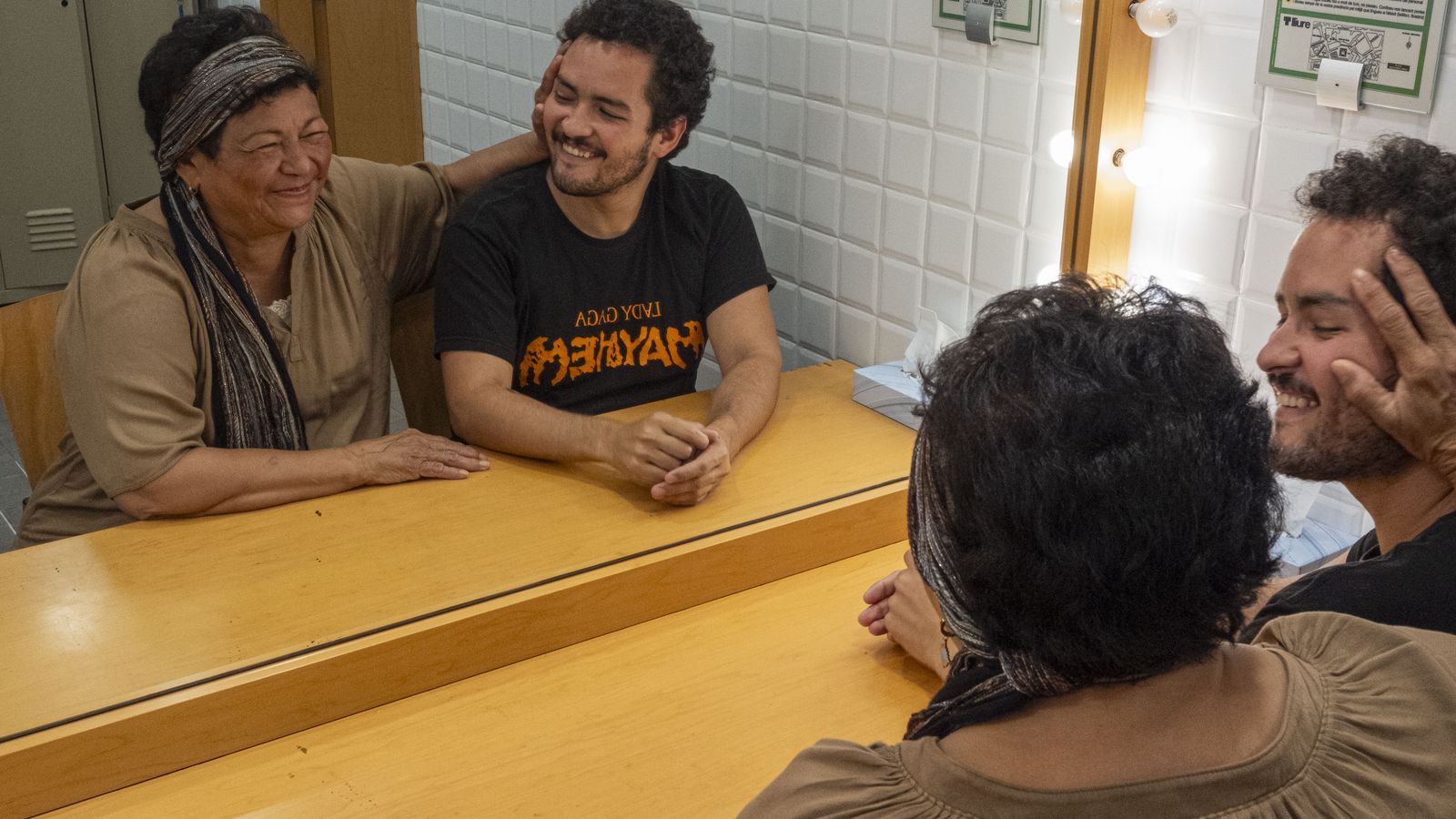
BarcelonaThe Mexican playwright, director, and actor Anacarsis Ramos (Campeche, 1996) has been working since he can remember. Born into a family of salespeople, during his childhood and adolescence he saw dozens of businesses come and go from his home without any of them truly taking root. His mother, Josefina Orlaineta, has had more than 40 different jobs – most of which involved using the house as a warehouse or workshop – and all of this made household economics an inseparable element of his daily life. With all this experience, Ramos has built a show that he has titled "My mother and the money, and which gives the mother a new job: that of interpreter. The show has been to Belgium, Greece, Canada and Germany, and will now be seen at the Espai Lliure on Tuesday 7 and Wednesday 8 July, as part of the Grec Festival.
"The show was born at a time of burnout. I had been working with my company in Mexico City for five years, directing, teaching, and despite everything, I couldn't make ends meet," explains Ramos. At that moment he returned to his parents' home, and there he reconnected with the family businesses, especially the one for making sausages. "All of this made me realize the time that work steals from us and how it has affected my family. Perhaps there is a more romantic idea of artists, but in the end, what we do is the same as others: sell our work," says the director. On stage, Ramos and Orlaineta rescue shared experiences to explore the relationship with work from a direct and ironic perspective. Together they reproduce some of the family businesses, such as a shoe store, a hair salon, a shop ofgroceries –a very characteristic type of establishment in Mexico– and a sausage workshop, which they will end up selling to the spectators.
The impact of precariousness
The story of the family with businesses began in the early 80s, when Josefina Orlaineta met her future husband precisely on the Barcelona metro, where they were both street vendors. "He was from the Canary Islands, and we lived in Tenerife for a while. Then we moved to Mexico and started opening businesses. Some worked for a while, others didn't," says Orlaineta. The family experienced the crisis that affected the country in the early 21st century and suffered from Mexico's lack of economic muscle. "Salaries were very scarce, the big supermarket chains arrived, and family businesses began to disappear," explains Orlaineta.
Based on these experiences, the show seeks to create a collective narrative about the impact of precariousness, the savagery of capitalism, and the representation of poverty in art. "I wanted to tell a story beyond the idea of personal failure, of that feeling that you're doing something wrong even though you haven't stopped working," says Ramos. Thus, the play contrasts the viewer with their own experience of work, but also raises reflections on what we have accepted as a collective. "Poverty is inevitably accompanied by violence. I remember experiencing it when I was little," explains the director.
One of the driving forces behind the show has been precisely the act of transforming personal pain into something useful for others and that transcends the local sphere to appeal to anyone, wherever they live. "The vast majority of us are immersed in precariousness and live in an extractive system that feeds on it. At the very least, we must take narrative control and be the ones to tell our own story," argues Ramos.
