'Guernica' no, but Sixena yes?: the contradictions of the Spanish government
The Reina Sofía Museum once again denies a request to exhibit it at the Guggenheim in Bilbao

-
CAT -
CAST
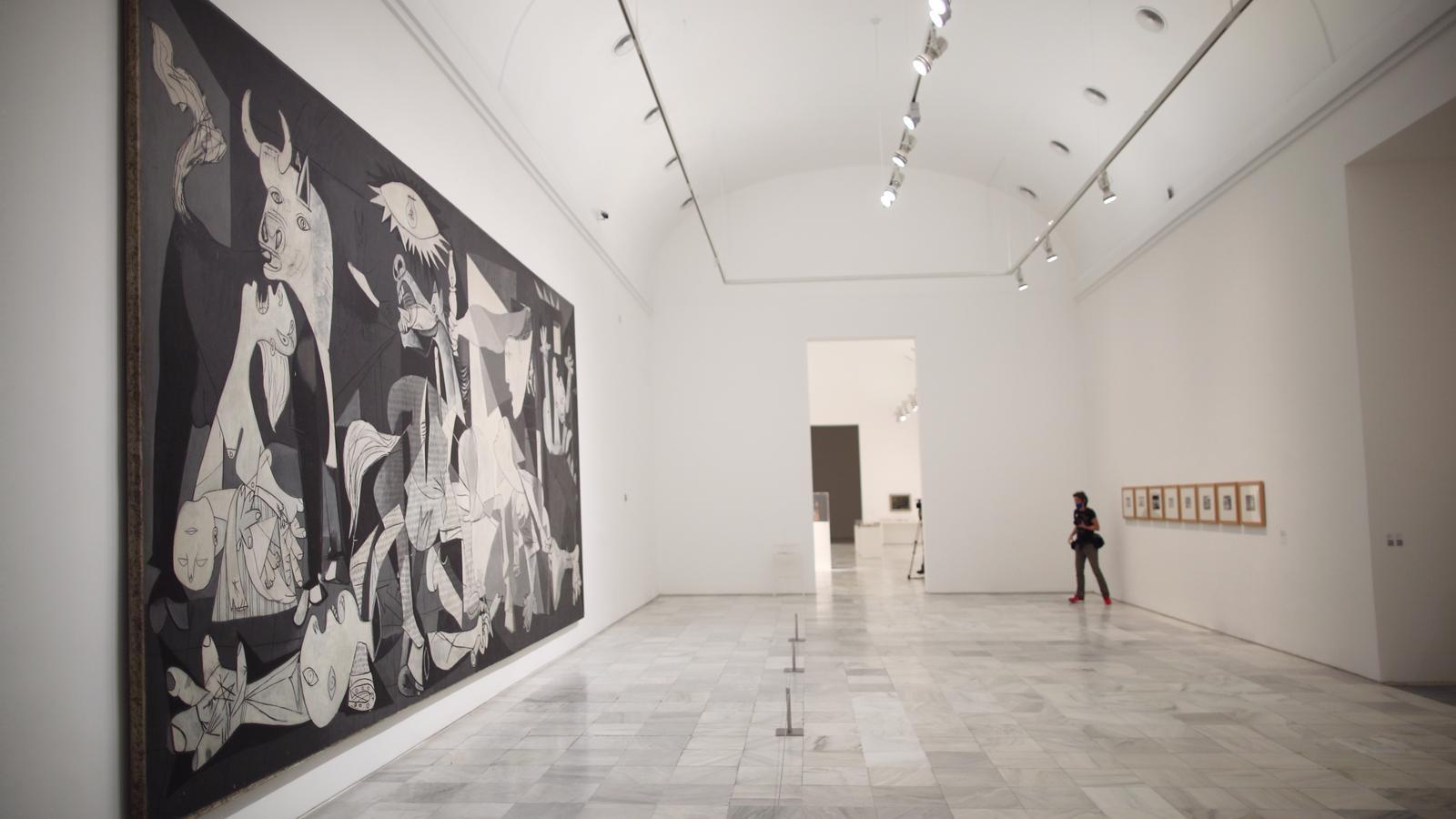
BarcelonaShocked by the German bombing of April 26, 1937, on the Basque city, Pablo Picasso painted the Guernica in the studio he had on the rue des Grands-Augustins in Paris, between May 1 and June 4, 1937. The painting was commissioned by the Spanish government for the Republic's pavilion at the Paris Universal Exposition, and Picasso decided on this subject when he saw the photographs of the bombing reproduced in the French press, specifically in L'Humanité. But, as Manuel Borja-Villel recalled when he was the director of the Reina Sofía Museum, "at the time, Guernica pleased almost no one" when it was unveiled at the pavilion, because no one expected the dramatic impact of the work. Over the years, however, Guernica has become a commemoration of the innocent victims of all wars.

The contradiction of the Spanish government
The painting is part of a multitude of highly coveted works, but which are in a state of conservation that advises against their transfer. The most obvious case is that of the murals in the chapter house of the monastery of Sijena, preserved in the Museu Nacional d'Art de Catalunya (MNAC). While the Spanish government does not authorize the exit of the Guernica from the Reina Sofía Museum, it does not mobilize for the technicians of the Institute of Spanish Cultural Heritage to issue a report on the state of conservation of the Sijena paintings, which perhaps would make the judge of Huesca who is handling the case and who has ruled that they return to Sijena change her mind.
Other cases of controversial transfers have indeed occurred, as happened with Alphonse Mucha's cycle of monumental paintings The Slav Epic, which went on tour in the United States and Japan. And it is planned that next autumn the Bayeux Tapestry will leave France after almost a thousand years to be exhibited at the British Museum. All this, a patrimonially dangerous mix of judicial, political, and economic decisions.
A very dilapidated canvas
The Guernica was sent to the MoMA in New York in May 1939 following the outbreak of World War II, at the request of Picasso himself. The painting's fragility is nothing new: as it was rolled and unrolled more than thirty times between 1937 and 1957 to exhibit it around the world, the painting ended up in such poor condition that in 1957 the founder and chief restorer of the MoMA's Restoration Department, Jean Volkmer, consolidated the pictorial layer by applying a mixture of wax and resin to the reverse. And in 1958 Picasso renewed the loan of the painting to the MoMA indefinitely, until democratic liberties were re-established in Spain. Over time, it has been seen that the application of the wax and resin mixture has been fatal because it has infiltrated the canvas and hardened the pictorial surface.
Victim of an attack on the MoMA
The Guernica suffered an attack with acrylic paint on February 28, 1974: the artist and activist Tony Shafrazi sprayed the canvas with red spray paint and wrote on the surface “Kills lies all” [Death to all lies] in protest against the Vietnam War and the release of officer William Calley, guilty of ordering the My Lai massacre on March 16, 1968. The paint could be removed without permanent damage thanks to the varnish layer that protects the painting, but the most recent studies reveal that there are still traces of red paint, even though they are not visible to the naked eye.
The arrival in Spain
This is about the arrival of Guernica in Spain, and not a return, because Guernica was not in Spain until September 10, 1981, eight years after Picasso's death. Upon arrival, it was moved to the Casón del Buen Retiro, an annex of the Prado Museum, protected by a bulletproof display case designed by architect José María García de Paredes. The exhibition of the painting in Spain was considered a symbol of "national reconciliation", but in the book Federico Sánchez bids you farewell (1993), Jorge Semprún warned that the painting was regaining its political significance and that for this reason it had to be protected from possible aggression. In fact, it had been Picasso's executor, Roland Dumas, who had requested that the painting be exhibited protected by a display case. Furthermore, the Spanish government had it escorted by a pair of civil guards and a Spanish flag. Visitor capacity was controlled for fear of an attack, which caused long queues during the first weeks.
The transfer to the Reina Sofía Museum
To avoid controversies about whether the Guernica should be exhibited at the Prado Museum or the Reina Sofía Museum, the Guernica had been exhibited in 32 cities, he assured that the painting would not suffer damage during its transfer.
The magnitude of the painting's poor conditionThe Guggenheim of Bilbao requests it for its inauguration
A few months before the inauguration in October 1997, the Guggenheim Museum Bilbao requested the temporary loan of Guernica, but the request was unsuccessful. Spain was governed by José María Aznar and the Minister of Culture was Esperanza Aguirre. For the then president of the Solomon R. Guggenheim Foundation, Thomas Krens, the transfer, which would have coincided with the 70th anniversary of the bombing of Guernica, was a deserved recognition for the Basque people with a painting considered the most important of the 20th century and which carries great political, historical, and emotional weight. Likewise, Krens, who recalled that Guernica had been exhibited in 32 cities, assured that the painting would not suffer damage during its transfer.
The magnitude of the painting's poor condition
According to reports from the Reina Sofía Museum, the work presents "linear deformations caused by successive rollings and spatula wax applications made on the reverse". The pictorial surface is "totally cracked" and presents "vertical cracks, lifting and losses, with specific areas where there is a risk of detachment". Additionally, there are numerous losses on the margins and "tears in the support that are held together only by wax and paper and adhesive reinforcements". Regarding the resin wax, "it has infiltrated the different elements that make up the work, hardening the components and making them very sensitive to any type of vibration". Among all this flood of information, there is a very eloquent detail of everything the painting has experienced: it initially measured 349.3 x 776.6 cm and the current measurements are 353 x 782 cm. For all these reasons, the museum technicians advise against any temporary loan.
More requests, all of them denied
After the one at the Guggenheim in Bilbao, more requests arrived from different museums around the world, and all were denied: MoMA of New York (2000), Royal Ontario Museum (2006), Basque Government, for an exhibition on the painting at the Guggenheim in Bilbao (2007), Fuji Group (2009), and Gwangju Museum of Art (South Korea) (2012).
Photos, yes
Shortly after taking over as director of the Reina Sofía Museum, in September 2023 Manuel Segade lifted the ban on taking photos of the Guernica. Nevertheless, selfie sticks, tripods, and flash are not allowed. With this measure, Segade wants to improve the experience of viewing the painting and allow everyone to have a photo, "as happens with any other cultural phenomenon". The ban was put in place to protect the painting when it arrived at the museum in 1992. It has been possible to remove it because current technology does not harm the painting.
