

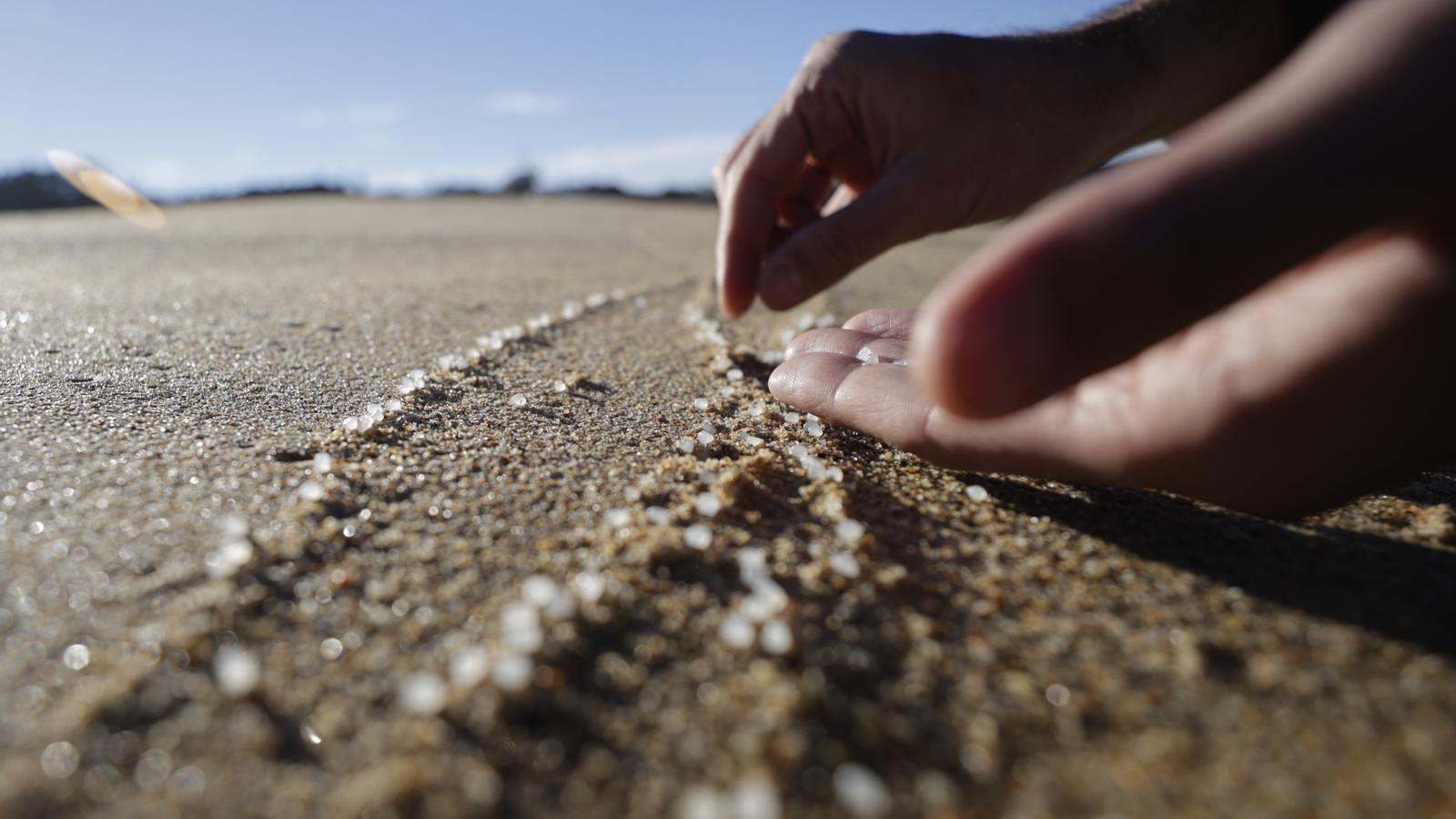
Pellets are small plastic balls (about 5 mm) produced mainly from the distillation of oil. They are the main component for manufacturing many consumer products, from syringes to plastic bags, toys, car parts... Their size and the general lack of awareness have meant that until now there has been no control over the losses of this material, which has been used for 80 years. The millions of pellets spilled over the years have altered ecosystems. Fish and birds confuse them with food, which can ultimately lead to their death. The introduction of the new European law warns that "the damage that microplastics cause to the environment and, potentially, to human health can be exacerbated by the presence of harmful chemical additives and other substances of concern added during production and processing".
The rains fill the beach with pellets again in Tarragona
The Vila-seca City Council sends a report on the impact to the Prosecutor's Office and another to the Government

-
CAT -
CAST
Vila-secaThe intense rains that have fallen on Tarragona this winter have filled the streams that flow into the sea and have once again dirtied the beaches with pellets. The water that falls on the facilities of companies that handle these small plastics leads them through the drains to the streams, and then they end up on the beaches and in the sea. The last serious incident occurred due to rainfall between January 16 and 18, as was verified by the municipal beach inspector of La Pineda (Vila-seca), who photographed and documented the thousands of pellets that appeared on the beach.
All this information, filled with photographs, is in the hands of the Environmental Prosecutor's Office, which is collecting information to see if it is necessary to reopen a case that was closed at the end of 2024, when it was concluded that based on the investigation carried out, "specific incidents cannot be attributed to specific companies." That closure decree warned the public administration that, given the evident presence of pellets, "constant monitoring of the prevention systems of all companies that manufacture or manage pellets, as well as the cleaning and remediation tasks of the beaches by the competent entities" was necessary.
In parallel, the mayor of Vila-seca, Pere Segura, also sent a letter to the Government delegate in Tarragona denouncing "the new presence of plastic pellets on La Pineda beach" and demanding "the need to put an end to uncontrolled dumping." In the letter, the mayor also demanded the "immediate convening" of the steering group of the Zero Pellet Loss Platform and recalled that new European legislation obliges to prevent these losses. The letter states that "this problem clearly exceeds the local scope and requires a political, clear, and effective response."
In statements to the newspaper ARA, Segura denounces that pellets reach the sea through the streams, which are the responsibility of the Catalan Water Agency (ACA), and through the port, which is the responsibility of the Port Authority. "These administrations must be able to intercept the pellets," he states. Sources from the Port of Tarragona, consulted by ARA, defend that they are also "an affected party" and that they are "open to dialogue between producers, logistics chain agents, and administrative officials in order to foster consensus to carry out actions that allow the elimination of these microplastics from streams, rivers, beaches, and seas." All this work falls on the government of the Generalitat, which, moreover, is obliged to find solutions within a year and a half.
Forced by the EU
At the end of last year, the European Community took a major step to prevent pellet spills and established a new regulation that "all entities handling plastic granules throughout the supply chain, regardless of their end use" will have to comply with. The regulation, which will be mandatory from December 2027, aims to ensure "the traceability of plastic granules handled and transported in each member state so that competent authorities can effectively carry out compliance checks". The objective is clear: to prevent investigations from ending up like the one in Tarragona, it is necessary to be able to determine at what point in the chain the spill occurred.
Currently, it is possible to know who manufactured a specific pellet found on a beach, but this does not imply responsibility, as it may have fallen at another point in the process. This is why the European regulation includes producers, who are the first link in the chain, but also transporters, those who store them, or those who use them to manufacture plastic products. The text also states that, in order to "ensure traceability", a register of all facilities that handle and transport the small plastic balls must be kept, and it obliges "economic operators" to have a management plan that specifies, among other things, the tons of pellets they handle per year, as well as the locations in the facilities where these losses can occur.
To move forward with this regulation –which ends the impunity of pellet dumping– the role of Good Karma Projects, a non-profit organization founded by two Catalans, has been key. One of them, Jordi Oliva, participated along with Mayor Pere Segura in the conferences organized by the European Union to draft the text. "Once the pellets reach the beach, you can no longer know who they fell from," laments this industrial engineer. Therefore, the norm focuses mainly on prevention and requires companies to have "collection devices".
The Department of Territory, Housing, and Ecological Transition is responsible for ensuring that all this is complied with. Both the working group and the steering group created to implement the new regulation have already met. For now, the objective is to start the registration process and improve coordination with the affected municipalities, as some of the companies that handle pellets are governed by municipal licenses. These working groups also include the chemical companies of Tarragona. Sources from the Association of Chemical Companies of Tarragona (AEQT) recall that in 2018 they promoted an internal project to reduce pellet loss and defend that companies "are committed to reducing involuntary losses". They also assure that they are working to raise awareness among other agents who may also have responsibilities in this problem, such as transporters.
Despite everything, there is an open case between companies and the Government. Following a complaint from the Surfrider Foundation Europe foundation, the Department of Climate Action of the previous Government (ERC) investigated in 2024 the presence of pellets in the Francolí basin and found "deficient practice at different stages of the chain". Based on these conclusions, the department approved a plan that obliged dozens of companies in the Tarragona petrochemical complex to take measures to avoid these losses – thus getting ahead of European regulations – but the companies appealed and the case is in the hands of the High Court of Justice of Catalonia (TSJC).
