Enric Garcia Jardí: "The maquis were normal people, aware of a very unequal, almost suicidal struggle"
Author of 'The maquis who still fights'

-
CAT -
CAST
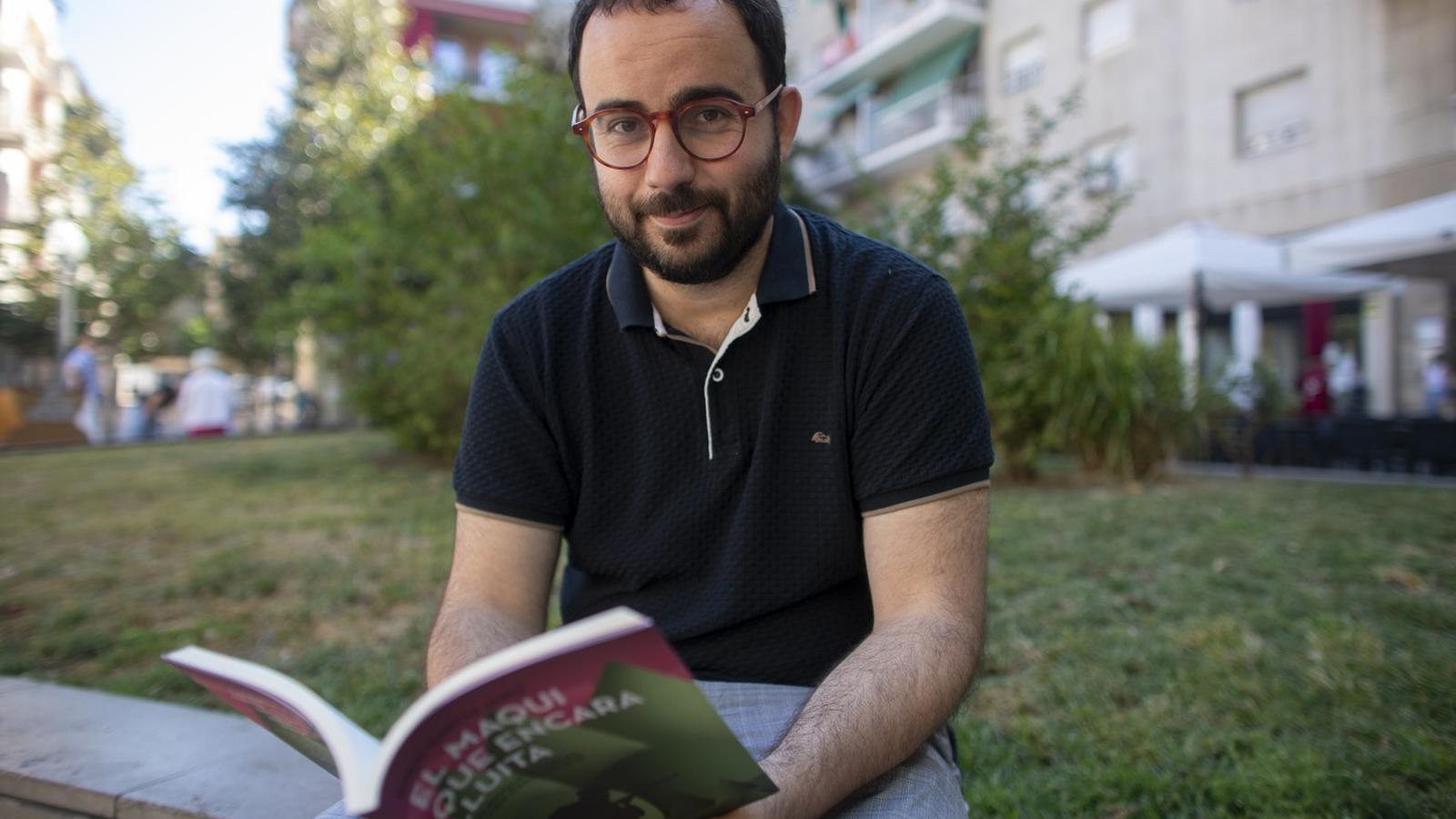
TarragonaThe Tarragona-based journalist Enric Garcia Jardí (1992) wrote a report a couple of years ago in Ara Diumenge about the maquis fighter Joan Busquets Verges, born in Barcelona in 1928. Busquets was arrested by the Civil Guard and spent twenty years in prison after his death sentence was commuted. After weeks of living with the former guerrilla fighter in his Normandy home, the Tarragona-based journalist has published the book El maqui que encara lluita, in which he reviews the long life of this anarchist fighter who still visits Catalonia from time to time.
Are you still in contact with Joan Busquets?
— Yes, yes, we keep in touch. He lives a very normal life in Normandy. He had a somewhat difficult time with his health, but he is well again. He is a man who will turn 98 on July 25th, who cooks, who drives, who still leads a very autonomous life. And he intends to come down to Catalonia in the autumn to continue his work of remembering and ensuring that the figure of the maquis is not forgotten.
Is the figure of the maquis greatly forgotten?
— Good grief. In general, there is a deficit of memory and historical awareness. I told my niece I was going to interview a maqui and she asked me which Japanese restaurant I would go to. For me, it's an alarm signal. It's clear that not all young people are like that, but of course, the distance is growing with these events and oblivion too. It's an uncomfortable legacy and I also believe that many people are interested in all this being forgotten.
This discomfort, where does it come from?
— The anti-Franco struggle is something that is well valued, but perhaps the armed struggle generates this discomfort. Many of the comments Joan receives today go along these lines. He is linked to terrorism. If you call him a terrorist now, you are placing him in a word connoted by the last twenty-five years of international terrorism, of radical Islamism. He was fighting against a dictatorship. It was an armed response to others who were also armed. Joan is part of a political family that is dangerous in terms of ideas, because they do not give up, because they fight against the dictatorship. Even the communists integrated from the 70s onwards into a party system, into pacts, the Constitution... On the other hand, the anarchists have always gone their own way and their account of the Transition has been critical from that very moment.
Joan Busquets spends twenty years in prison and, when he gets out, what he conveys in the book is that he doesn't find his place in society and leaves for France.
— Yes, yes. In all aspects. I think the book reflects it well. From the point of view of politics and of the society that is outside, which is still a dictatorship, with a very strong repression, which does not forgive his trajectory. When he comes out, he doesn't even know how traffic lights work. It reminds me a bit of when a few years ago I interviewed a Carthusian monk who had been at the Chartreuse in France and who in ten years had only learned about the fall of the Berlin Wall and Barça's first Champions League.
It must be psychologically very hard.
— From 21 to 41 years old, they spend it closed. Twenty years. It's very hard.
How is the character of Joan Busquets discovered?
— Reading the newspaper Regió 7. One day, I don't know how, I end up there in Normandy.
Someone from Tarragona reading Regió 7.
— Yes, exactly. And I see they interview him when he comes from time to time. That interview is very good, but I think it has more potential. I get his contact, I call him and I tell him: “My name is Enric, I am a journalist from Tarragona and I want to go to Normandy to meet you”. And he replies: “Come, you won't tire me out”. And I think he sinned a bit from overconfidence, because he got tired. He was very open right away. I think he also had a need to explain himself, and one of the first effects of the report we do in the newspaper and then the book is that Joan reaches more massive media. He was a person until then known mainly in rather libertarian circles, in athenaeums, where he has been giving talks for more than twenty years. I still noticed this need to explain himself.
While making the book, at some point did you think it might not end up coming out?
— When we go up with Fran Richart to do the reportage, he thinks: "What are these two looking for, who have traveled 1,300 kilometers to come here?". There was a bit of a game of glances and silences that took us a couple of days to break. If there's one thing he regrets about himself from when he was young, it's that he was too confident, he says. At first, yes, I notice it, the distrust. But it's also mutual.
Why?
— First, because when I go there I have a kind of Enric Marco syndrome. I saw a man who says he is 95 years old and I see him in great shape. Where did he come from? Is he who he says he is? I suffered a bit, until I touched documentation. I spoke with him and I saw that the family was also very long-lived. I kept adding ingredients and contrasting things. But on my part there was a point of distrust. It's just that these are lives like from a movie. Sometimes they tell you things and you think: legend, reality?
How were you able to verify everything I told you? Did you consult documentation, archives, did you speak with other people?
— In the case of oral testimonies like yours, it is very difficult. You always end up going to secondary sources. There is no one alive from his time, no colleague who can corroborate that anecdote. There are no Civil Guards from that era either. In fact, it is one of the things Joan boasts about: that he has killed them all [laughs]. I have consulted the war council records, bibliographies on the subject allowed me to cross-reference certain things. That was very useful. Joan coincided with two very well-known maquis, Caracremada and Marcel·lí Massana. But yes, it has been delicate work, where above all what weighs more is rather the oral testimony.
Joan coincided in prison with the brother of another well-known maqui, Quico Sabater.
— Exactly. Manel Sabater. I think it's part of the book's appeal: to take a man who has always been a footnote in the biographies of others, of the better-known maquis, and put him at the center and have others pivot around him. It's also interesting for humanizing these figures, who are sometimes a bit legendary, both Massana and Caracremada. Joan was able to know them very well, and this also allows for a psychological portrait. In the end, they were normal, ordinary people, aware of a very unequal, almost suicidal struggle with many hardships.
Do you have any more projects related to the maquis theme?
— No, what I would like to do is to pay tribute to the figure of Josep Sánchez Cervelló, who has been an important figure for university history studies in our regions and in the country. He has an impressive, very powerful career. And I have some documentation that he worked on the Patacons. They were brothers, maquis who moved mainly through the Prades mountains. I would like to write an article about them. To talk about the maquis from here. We always think of Berguedà, Bages, the Pyrenees, and there were them in many places. With the book presentations, I have met many people who told me that their grandfather was younger and helped them, or on the contrary, they suffered from them. At the very least, I see that there is a very vivid family memory, but we have a lot of work to do collectively.
