Last year of works to recover the first cathedral of wine
The ambitious project of Cellers Domenys also foresees the construction of a new winery

-
CAT -
CAST
Rocafort of QueraltRocafort de Queralt is a small village in Conca de Barberà, or it only has 247 inhabitants, but it boasts a first-class modernist gem: the first wine cathedral built by architect Cèsar Martinell, a disciple of Antoni Gaudí. In fact, the people of Rocafort can boast of having the first and the last of Martinell's 21 wine cathedrals in Catalonia, because the first nave was erected in 1918, but the winery was expanded with a new nave in 1932 and yet another in 1948. This was Martinell's last wine cathedral. This heritage allows them to present themselves as the kilometer zero of wine cathedrals. Observing the three naves from the outside allows one to appreciate the evolution of the architect from Valls, but to sneak inside, one will have to wait a little over a year. The works to restore this modernist gem began six months ago and, if nothing goes wrong, will be completed in July 2027, as explained this Tuesday by Lluís Roig, managing director of Cellers Domenys.
The Domenys Foundation is responsible for an ambitious project that aims to restore the three naves to create "a cultural center for enotourism, wine, and cooperativism that will serve to vindicate the figure of Cèsar Martinell," as explained by Roig. In addition to restoring the three naves, Celler Domenys is also building a new underground winery, where high-quality wine and cava can be produced. These facilities will occupy approximately 6,000 square meters. They will also utilize nearly two hectares of the land surrounding the building to plant grapes and close the circle.

The project's budget is 10.2 million euros and, for the moment, 60% of this money has already been granted thanks to European, State, Generalitat and Diputació de Tarragona grants. The cooperative is still working to secure more funds, and any remaining amount will be covered by Cellers Domenys. Aware of the interest this work is generating, the promoters have committed to regularly convene the media to report at all times on the progress of the work and to keep the website updated to allow for monitoring of the works.
Espai Martinell
The three recovered warehouses will have different rooms, one of which will house the Espai Martinell. The Domenys Foundation has the support of the architect's family and together they want to create a space where the entire work of the Valls architect can be contemplated. Martinell was only a young architect when he received the commission from the agricultural union of Rocafort de Queralt to build a winery that would allow the entire winemaking process to be carried out and that would have a clear space to store the maximum number of vats. The young architect was able to create a beautiful and, above all, functional building. The buildings are full of strategically placed windows to create air currents and prevent the temperature from rising too much while the wine was in the tanks. "He even took into account which way the sea breeze blew," says Roig.

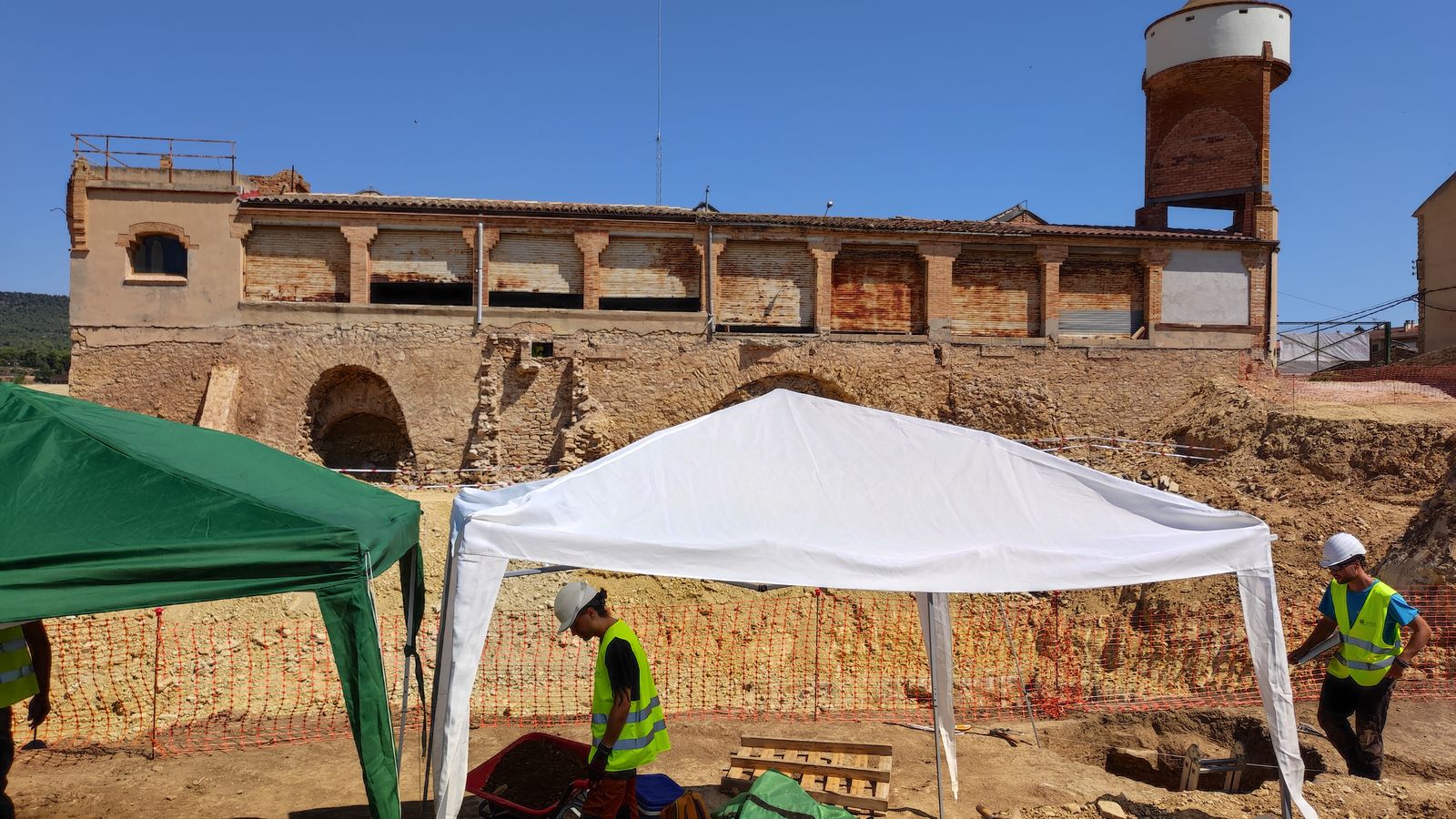
These days, at Cellers Domenys, archaeologists can be seen checking if there are important remains underground at the site where the winery is to be built, as well as workers inside the buildings. The activity is such that the water tank crowning the buildings has been shored up to ensure it doesn't collapse with so much earthmoving.
Cellers Domenys is a cooperative born in Sant Jaume dels Domenys that has been growing little by little by absorbing other cooperatives that did not have enough resources to continue. Currently, it is formed by 800 members, who in total have 3,000 hectares planted with vines and olive trees. In 2010, it was the turn of the Rocafort de Queralt cooperative, so when Cellers Domenys found itself with the first cathedral of wine, it began to dream. With small grants, the facades, roofs, and some interior elements, such as the vats, have already been rehabilitated.
