Divorce in the Philippines: the last colonial legacy becomes a taboo
Trapped in de facto dead marriages, thousands of women fight for the right to a second chance in one of the only two countries in the world, along with the Vatican, where legal separation is still prohibited
-
CAT -
CAST
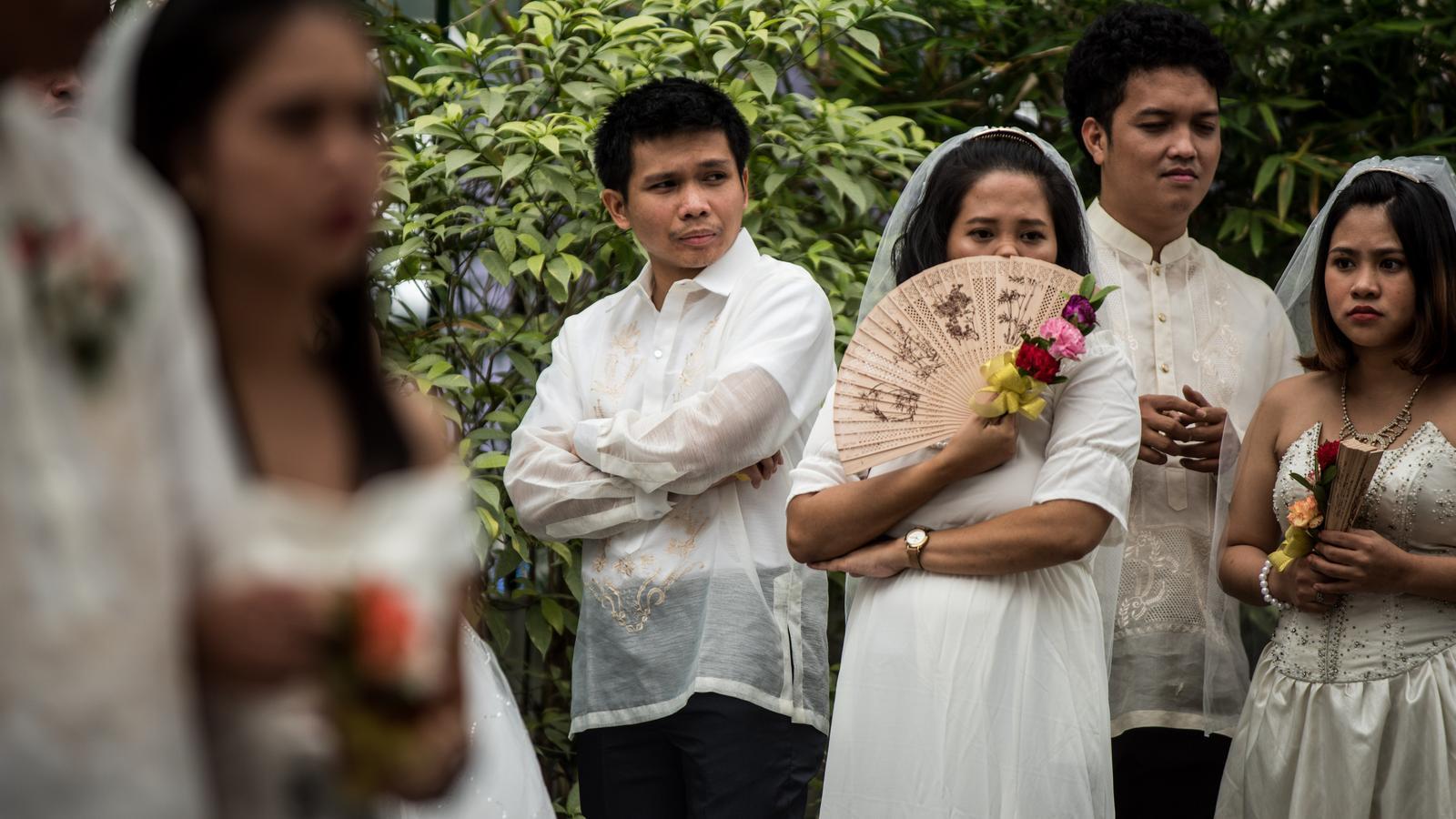
A.J. Alfafara is 47 years old and has a life rebuilt on the ashes of a past that civil law refuses to bury. Although she hasn't heard from her husband in over a decade, the Philippine state still considers her his wife. This activist encountered the cruelty of the system when trying to buy a home: a routine procedure became a wall when the notary informed her that, without the signature of a man who had been missing for ten years, she had no legal standing to acquire her own roof over her head. Her case is not an anecdote, but a reflection of a legal structure that keeps tens of thousands of women in the Philippines – one of only two countries in the world, along with the Vatican, where divorce is illegal – trapped in marriages that now only exist on the republic's stamped paper.
This “'til death do us part” is not a romantic metaphor, but a condemnation sustained by a religious lobby that has turned the Family Code into an extension of canon law. In the Philippines, the separation of powers is a mirage in front of the sacristy: the influence of the Episcopal Conference (CBCP) and ultraconservative groups like Couples for Christ has ensured that any attempt at civil legislation is treated as a sin against the nation. While the world has secularized, the Asian country maintains intact a Spanish colonial legacy that the metropolis itself abandoned forty years ago, fossilizing 19th-century morality in the midst of the 21st century.
Trapped in this void, women face a system of annulments that is, in practice, a tax on suffering: a humiliating and so costly process that only the elites of Manila can afford. For those who suffer violence or abandonment, the law offers only resignation. Alfafara, founder of the coalition Divorce Pilipinas, decided that surviving in silence was not enough. Her fight demands that marriage cease to be an indissoluble colonial inheritance and become a civil contract based on freedom, not on a divine obligation dictated from a pulpit.
The anchor of the Siete Partidas
The Filipino resistance to legalizing divorce is not the fruit of an organic evolution, but of a legal fossilization. For three centuries of dominion (1565-1898), the archipelago adopted a legal framework where marriage was an indissoluble sacrament. While Spain in the eighties opened the door to civil rights, the Philippines remained frozen, guarding a legacy that the metropolis itself had already sent to the history books.

For A.J. Alfafara, the key to imprisonment lies in the Siete Partidas by Alfonso X the Wise. This medieval code allowed for "separation of bed and board" but maintained the bond intact.
This Catholic "purity" coexists with a paradox that Ferdinand Marcos legalized in 1977. To appease tensions in the south, the dictatorship permitted divorce for the 5% of the population that professes Islam.
History recalls that divorce was not always a taboo. Before Legazpi, pre-colonial societies already practiced the dissolution of bonds, a flexibility that would briefly reappear under American and Japanese occupations. But every opening was crushed by the Church. In 1950, the new Civil Code closed any loophole, yielding to the ecclesiastical hierarchy at a time when faith was used as the identity cement of the new independence.
Today, figures like Francisco Javier López Tapia, director of the Cervantes Institute in Manila, qualify that the issue is no longer
The tax on suffering: the annulment trap
The only legal loophole for Filipino couples is annulment, a legal mirage. Unlike divorce, annulment aims to prove that the bond never existed through “psychological incapacity,” an ambiguous concept that has fueled a lucrative industry of experts and lawyers.
“It’s a matter of money,” states Alfafara. The cost of the process ranges from 3,000 to 10,000 euros, a fortune in a country with a minimum wage of 250 euros. For the elites of Makati, indissolubility is a nuisance resolved with a check; for the majority, a wall. “Many prefer to divorce abroad and return with the document in hand for peace of mind, even if it’s not valid here,” explains the activist.
This barrier creates a two-speed society. Annulment, moreover, is humiliating: it forces women to recount intimacies and abuses in front of strangers for a court to decide on the validity of a sacrament. It is a double victimization: by the partner and by the State.

This institutional humiliation has an even darker side B: emotional blackmail. In many cases, the absence of divorce becomes a tool of control for abusive husbands, who use the indissolubility of the bond to threaten women with the loss of child custody or shared assets. Without the possibility of breaking the contract unilaterally and cleanly, many Filipinas opt for submission or escape into emotional clandestinity, living in de facto partnerships that society accepts with hypocrisy, but that the law pursues with medieval rigorism.
Meanwhile, the Episcopal Conference (CBCP) and groups like Couples for Christ pressure Congress with the argument that divorce will destroy the family. “They are not interested in the reasons of those who need it”, complains Alfafara. She replies with a famous metaphor: “If there is fire, you need a fire extinguisher. Having it at home doesn't mean you want to burn it down, but to protect yourself if the flames consume everything”.
This resistance turns the country into a laboratory of contradictions. Millions of workers abroad discover in Taiwan, Spain, or the US that their situation is an anomaly. “I have friends who are Spanish citizens to be able to divorce in Madrid”, comments A.J. But upon returning home, the law in Manila continues to consider them property of a dead bond.
The fire extinguisher of freedom: click activism
Faced with the institutional wall, resistance has found a loudspeaker on social networks. The Philippines, the “world capital of networks”, has seen the debate jump from sacristies to TikTok videos. It was here that Alfafara began her journey: “I started the fight when they denied me the annulment; I was looking for a way out and I found thousands of people in the same situation”, she recalls.
Alfafara’s activism is constant pedagogy. Through the Fajeri platform, she tries to dismantle the prejudices of a society educated in guilt. “They make us feel guilty for going against God’s law, but we are claiming a civil right. Divorce is not obligatory, it is medicine for those who need it”, she explains. The paradigm shift is taking root in the new generations. Alfafara confesses that her driving force is her daughter’s future: “I fight so that she doesn’t have to go through the same ordeal. Because if tomorrow she finds herself in an abusive marriage, she will have a legal way out that her country does not deny her”.
The path to legalization runs into the “vote of conscience” in Congress. For many legislators, approving divorce is political suicide in districts controlled by the parish. Nevertheless, the Marcos Jr. administration has had to acknowledge that thousands of broken families need a solution. “We are not asking for it to be easy, because Filipinos are monogamous and we give many opportunities to marriage, but the door cannot be bolted shut”, states the activist.
This fight has an international dimension that connects with the diaspora in Spain. It is the ultimate paradox: Filipinas living in Madrid see how the country that bequeathed them religion and the medieval code is now one of the most progressive, while their homeland continues to be a global anomaly. The relationship with Spain is particularly ironic; Filipinas working there, often in the care sector, see how the families they serve divorce and remarry normally, while they send remittances to husbands from whom they have been separated for years.
“It is a reverse culture shock”, comments Alfafara. Discovering that the Motherland that imposed the faith on them is now a benchmark for civil liberties is the trigger that pushes them to join the digital fight. “We ask compatriots abroad to help us spread the message. Every video of support from abroad is another crack in the wall of the Manila Senate”, concludes Alfafara.
A geography of inequality
This legislative paralysis not only fractures society by class, but also draws a geography of inequality that many jurists consider unconstitutional. While a Catholic woman in Manila may spend decades waiting for a ruling that never comes, a citizen in the autonomous region of Bangsamoro, in the south, gains access to divorce thanks to the Code of Muslim Personal Laws. This duality creates first- and second-class citizens based on faith, an anomaly that the state justifies as respect for minorities, but which acts as a punishment for the Catholic majority.
“Civil law in the Philippines is fragmented by beliefs, and it forgets that the law should be the same for everyone, whether they pray in a church, a mosque, or nowhere,” reflects Alfafara. This fragmentation is the last wall that activism is trying to tear down: the idea that civil liberty should not depend on the postal code or the baptismal certificate.
The Senate's bottleneck and the state's morality
Today, the path to freedom has a proper name: the Senate. Although the House of Representatives has taken historic steps, the initiative clashes with the influence of the most conservative sectors and the fear of electoral punishment from the parishes. It is the final battle between a society that demands modernity and a political class that bows to the Catholic hierarchy. For many senators, divorce is not a right, but a threat to the essence of the nation.
This paralysis reveals a paradox that Miguel Blázquez analyzes with lucidity: the same religious influence that hinders divorce is what has prevented the reinstatement of the death penalty. “The Church continues to have considerable weight; it has been an obstacle to divorce, but it has prevented setbacks in the right to life,” explains the academic. It is a double-edged sword: a moral protection that becomes a nuisance for normalizing civil relations in a globalized world.
For Alfafara, time does not stop. When asked if she would ever walk down the aisle again, she replies prudently: “I can’t say no, because that’s life. Maybe I’ll fall in love again, but I’ll be more careful.” Her fight is not to destroy marriage, but to strip it of its trap-like nature. She wants to be able to choose, make mistakes, and rectify without asking for forgiveness from a state that still behaves like a spiritual colony.
The Philippines of 2026 are heading towards technological leadership in Asia, but they drag the chains of a past that resists disappearing. Divorce is the last frontier of an incomplete independence while the Civil Code of 110 million people continues to be written with the ink of medieval canon law. As Alfafara assures, divorce saves lives. Meanwhile, thousands of people are waiting for the Senate to open the door of a cage that should have been emptied centuries ago. “Until death do you part” should be a daily choice, not an imposition dictated by a past that no longer exists.
