Recovering Black pride: "In some countries they think my hair is ugly"
Only some Afro-descendant women opt for their natural curly hair. Wigs, extensions, or hair straightening products are what are most successful

-
CAT -
CAST
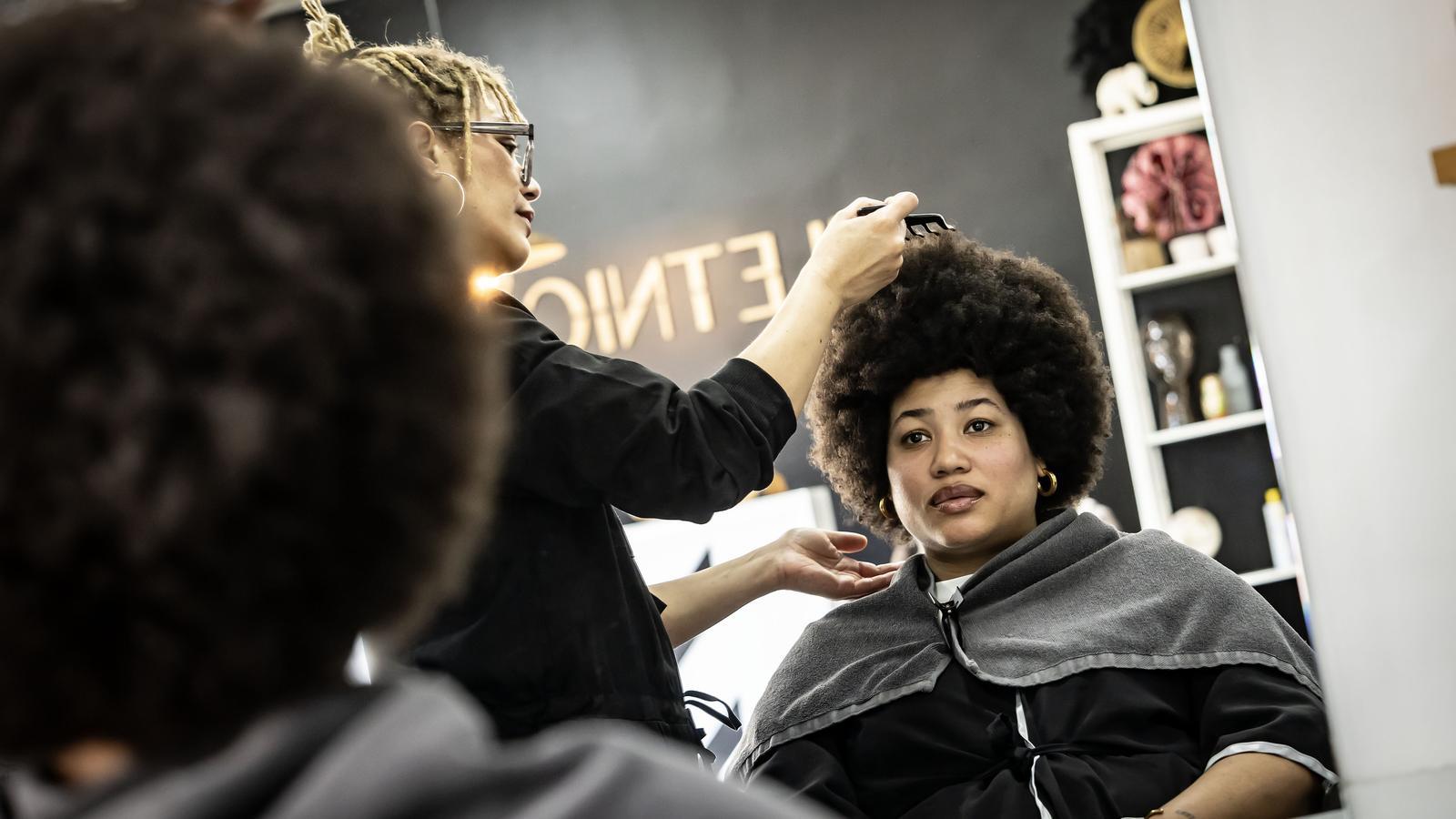
BarcelonaHer hair really catches the eye. She herself admits that she feels observed wherever she goes and that she is tired of being stopped in the street to be asked if they can touch her hair or if they simply touch it without her permission. Isabel Balde, 32, has beautiful afro hair. The kind that's a huge ball of curls. "People are not aware that touching someone's hair is invading personal space," she says, as her hairdresser styles it and she looks proudly in the mirror. It wasn't always like this. She used to hate her hair.
Isabel was born in Barcelona, but her mother is from the Dominican Republic and her father from Guinea Bissau, and she assures that at home she was always instilled with the idea that she should straighten her hair. "In the Dominican Republic, afro hair is called bad hair," she explains. That is, ugly, useless. And she had the bad luck of being born with that hair.

“When I was little, my mother used to put a very aggressive product on my hair once a month and leave it on for two hours. It would scorch my hair”. Of course, she managed to straighten it, although as soon as it grew out, it logically became curly again. She also remembers that when she went to the beach, she wouldn't wet her hair so it wouldn't get curly, and she only washed her hair when her mother had time to straighten it with the hairdryer. Until she became independent and thought she couldn't continue like that.
Isabel then did what women of African descent call “a transition.” That is, she cut her hair almost to the scalp because, it was so damaged, it was neither straight nor curly anymore. “It was horrible. I didn't leave the house for two weeks,” she confesses. Now she has gotten used to seeing herself with her natural afro hair and loves it. She lives in Madrid, but comes to Barcelona every time she needs a haircut.

Her hairdresser is Tamy Ferràs, who also has afro hair and has specialized in its care. She is the owner of the Iletnic hair salon, a beautiful establishment tastefully decorated in the Nou Barris district of Barcelona. On one of the walls there is a poster with the mythical feminist image of a woman showing biceps, but in this case the woman showing muscle is black. Quite a statement of intent.
Tamy, 48 years old, is adopted, but her biological father is African, and she assures that her whole life has revolved around her afro hair. It made her feel different and that she did not belong to a society, the Catalan one, in which the majority of the population continues to be white. “I was obsessed with my hair moving and having it long. And many of my clients feel the same way”. Often afro hair is so thick that it hardly moves and, when it grows, it gains volume but does not fall on the shoulders.

Hair diversity
"People think all afro hair is the same, but it's not, there are infinite types. It's often weak hair because it can't be moisturized as sebum struggles to reach the ends," she explains. What she tries to do is make her clients aware that their afro hair is beautiful no matter what. And in fact, 95% opt to wear their natural hair, she states. Some, however, opt for extensions or braids, although, she says, you also have to know how to do them to prevent them from causing alopecia if the hair is pulled too tight.
"One day I asked myself: why can everyone wear their natural hair except me?" says Fatima Seriki, who is of Nigerian father and Barcelonian mother and is also sitting in front of the mirror at the Iletnic hair salon to have her hair cut. She is now 41 years old, and until she was 28 she always wore braids or used a kind of gel so that her hair would fall downwards instead of gaining volume upwards. "My lifelong African hairdresser didn't support me when I told her I wanted to let my hair grow naturally," she laments. She now sports a full and splendid curly mane.

To another client, on the other hand, they are putting straight hair extensions. Her name is Rebeca, she is 32 years old, was born in Germany, but her mother is from Sierra Leone and her father from Liberia. “I would like to wear my hair natural, but I work in a company where I am the only black person. It has already happened to my sister and some of my friends: they go to work with afro hair and they are considered not professional enough,” she assures. Applying extensions is also an art: Penda Mboup, who is from Senegal and works with Tamy, first braids Rebeca's hair carefully, and then sews the straight hair extensions to the braids with thread.
White beauty standards
“It is one thing to be white and have curly hair, and another thing to be Black and have it curly. In many places there is a belief that if you are Black and have curly hair, it is because you are of low class because you don’t have money to go to the hairdresser to straighten it”, explains the writer and disseminator of anti-racist education Desirée Bela-Lobedde. Added to this is the constant bombardment of images of white women with long, straight hair as the great beauty ideal in advertising, which logically doesn’t help either, she points out. In fact, Michelle Obama herself always wore her hair straight while she was first lady of the United States, because she considered that North American society “was not ready” to accept her natural afro hair, as she confessed herself in one of her books. The Irish writer Emma Dabiri highlights in her essay Don't Touch My Hair: The Black History of Hair that afro hair has always been stigmatized, belittled, modified, and is often a symbol of oppression against the Black community, but also a symbol of its liberation.

“In Africa, chemicals are often used to straighten hair that have hormonal disruptors that can cause uterine fibroids or breast cancer”, warns Bela-Lobedde, who also went through the famous “transition” process after years of straightening her hair. Now she wears it natural. “Black people, whether they wear their hair straight or afro, must take care of it”, she emphasizes. And that takes time. And also money.
Specialty stores
Products for straightening hair, others for detangling it, for activating curls, or to prevent the scalp from getting irritated with braids. In addition to shampoos, conditioners, masks, dyes, sleeping caps, extensions, or wigs. Many wigs. La Bella Cosméticos is one of the chains of stores specializing in Afro hair in Catalunya. It has establishments in Barcelona and Santa Coloma de Gramenet. It opened about fifteen years ago and was one of the pioneers then. Now, however, there are many other similar stores, whose common denominator is that their owners are always Pakistani. Perhaps because most of the Afro products they sell are imported, especially from the United Kingdom, the United States, and Latin America. Few come from Africa.
“They are specific products and that makes them more expensive. For example, moisturizing lotions are made from avocado or shea butter. For a white person's hair, they would be too greasy,” gives as an example the manager of the store on Sepúlveda street in Barcelona, Carlos Castelli. According to him, 50% of his clients have Afro hair, and of them, half buy wigs.
In fact, the store has entire shelves with plastic heads displaying wigs of all kinds: short, long, curly, straight, brown, dark brown, blonde, or even striking colors that only a very daring person would wear. Synthetic wigs cost around 60 euros, but natural hair wigs can range from 400 to 700 euros.
Two clients from the store are precisely looking at wigs. They are from Cuba and both have afro hair. Margot Milanés wears hers tightened and gathered in a small bun. On the other hand, Flor Alba sports a striking curly wig that, at first glance, looks like her natural hair. According to her, she always wears a wig. Be it winter or summer. She is already used to it, it doesn't cause her heat or itching, she assures.
The wigs
“I wear them for comfort and because they give me personality. Depending on what I wear or my mood, I put on one or another. I have fourteen wigs at home”, she states. Daily, to go to work, she uses short-haired wigs. On the other hand, if she wants to dress up a bit more, she opts for more striking ones. In the store, she chooses a wig that is a long mane of lilac and fuchsia color. She takes off the one she is wearing and, with surprising dexterity, puts it on in a matter of seconds. The fuchsia wig really suits her. Before taking it off, she immortalizes herself with her own mobile phone, which she places on a ring light in the store so that customers can take selfies.
“For Western European women, wigs are a taboo. However, for us they are just another accessory. We have them totally integrated, they are part of our culture”, clarifies Rosa Mangue, 39, from Equatorial Guinea, who runs the Rosy Style hair salon in Parets del Vallès, which she has given a special style, as its name suggests. It is a particularly bright space, with large mirrors, plants, pristine white walls, and a beautiful poster of a Black woman. “We work for the empowerment of women”, she assures.
According to her, "afro hair is not difficult, but it needs routines." "Before going to sleep, you have to braid or bun it, moisturize it and wear a bonnet to avoid friction, because otherwise you wake up with all your hair tangled. And in the morning, you have to detangle it again, moisturize it and style it," she explains. "That takes an hour and a half at night, and another hour and a half in the morning. What we propose are protective styles," she continues explaining. That is, methods to avoid having to manipulate your hair every day and save time.
Those protective styles are wigs, braids, and crochet. The latter is an African-American technique that, according to Rosa, comes from the United States and in which she has specialized after training in England. It consists of making root braids so that they are attached to the scalp, and then inserting and fixing curly or wavy extensions with knots until a mane is formed. The extensions she uses are high-quality synthetic fibers, so they look like real hair. In fact, the result is spectacular: curly manes that look natural, and that can be washed and styled. They last two or three months.
Beatriz Fernández Adiko, one of Rosa's clients, has been using the crochet technique for ten years and has been delighted ever since. She is 33 years old, was born in Sabadell, but her mother is from Ghana and her father from Andalusia. Like so many other Afro-descendants, she also tried to straighten her hair with chemical products to the point where she developed scabs on her scalp. "When I was little, they told me my hair was a scouring pad," she confesses. Now she sports an impressive head of curly hair that doesn't leave anyone indifferent.
Burning hair
“My mother used to straighten my hair with a metal comb that she heated on the fire and then ran through my hair” , explains another of Rosa’s clients, Marga Mbande, 46, who was born in Barcelona but her parents are from Equatorial Guinea. In reality, what her mother was doing was burning her hair. That comb, known as pressing comb or hot comb (flat iron comb or hot comb), was traditionally used by the Black community. Marga also now uses the crochet technique.

In the Can Serra neighborhood of Hospitalet de Llobregat, Anita Lou styles a client while carrying her nine-month-old son Alejandro on her back, in the traditional African way. Anita is from Ivory Coast, she is 31 years old and in 2019 she opened Peluquería y Belleza Afro Europeo, a neighborhood establishment where she works tirelessly. She has a lot of clientele.
It is a simple but spacious place: there are four chairs, four full-length mirrors, and a hair-washing station where the client can almost lie down while her hair is washed. In the shop window, a large poster with photographs of all kinds of braids shows some of the many hairstyles Anita knows how to do. Braids are what they ask for most in the summer, she says. In winter, on the other hand, what is most successful is the crochet technique. In fact, all kinds of hair extensions are displayed on the walls of the salon.
“Natural hair extensions are too expensive. They cost 300 euros without counting the labor. I can’t afford them”, says a client, Ángela María, who is from Venezuela and whom Anita is styling with the crochet technique. She does it with astonishing speed, inserting the extensions with a kind of crochet needle. The client has brought the extensions from home: six packs that cost her a total of 28 euros. She gets the crochet technique done once a month.
In another seat, another client is straightening her hair herself with a brush and a dryer to save time, before another hairdresser starts braiding it for her with amazing agility. And further on, a third client entertains herself by looking at her phone while waiting to be attended to. She is also going to get braids.
“African hair is very difficult to manage,” assures Ángela María. Anita explains that in her country, what clients asked for most was for her to straighten their hair. Anything but natural hair: it is the result of decades of colonialism and, above all, the lack of role models of Black women proudly wearing their curly hair.
