Ghana, the landfill of global 'fast fashion'
Only the United Kingdom sent 57,000 tons of textile waste to the country last year, many of which end up in informal landfills or protected natural areas
-
CAT -
CAST
Every day, in the vast Kantamanto market in Accra, Francis, an experienced vendor, walks its busy aisles from dawn until dusk selling modern empty shopping bags with eye-catching designs, including one with the United Kingdom flag. It is no coincidence: the United Kingdom is one of the largest exporters of used clothing to Ghana, a trade that has transformed both the market and the country's environment. Every week, more than 15 million second-hand items arrive in Ghana, mainly from the northern hemisphere.
In Kantamanto, vendors like Francis unpack bales of textiles that arrive ship after ship. They sell what they can, repairing and reselling items in a dynamic circular economy that supports thousands of jobs. However, the rise of fast and ultra-cheap fashion has worsened the quality: around 40% of the clothing imported by this market cannot be sold and ends up as waste. These discarded items end up in informal dumpsites or are washed into rivers and the ocean, where they mix with plastic waste and accumulate on beaches like Jamestown.
Every Thursday morning, at the Kantamanto market in Accra, huge metal containers from the port of Tema are opened and hundreds of bales of clothing are unloaded. Each 12-meter container usually contains about 400 bales, each weighing approximately 55 kg, filled with hundreds of used items collected and packed in Europe and North America. This equates to millions of kilograms of clothing arriving every week at Ghana's second-hand market.
For many merchants, buying a bale is a risky bet. They pay between 75 and 100 euros or more per bale, depending on the origin and perceived quality, but there is no guarantee that a large part of the content can be used. Between 40% and 50% of the items cannot be sold (because they are stained, torn, or simply too worn out) and become waste that ends up in sewers, dumpsites, and, increasingly, on the beaches of Accra.
At the center of this frantic trade are the kayayei, the women and girls who move the weight of this global fashion surplus. These porters carry bundles on their heads through crowded alleys and uneven terrain for as little as 30 cents to 2 dollars per trip, a wage that barely reflects the physical toll. Many kayayei are migrants from northern Ghana who arrive in Accra in search of work. They balance heavy loads that far exceed their body weight, often suffering injuries, exhaustion, and chronic pain, just to earn a living and support their families.
Agbogbloshie dump
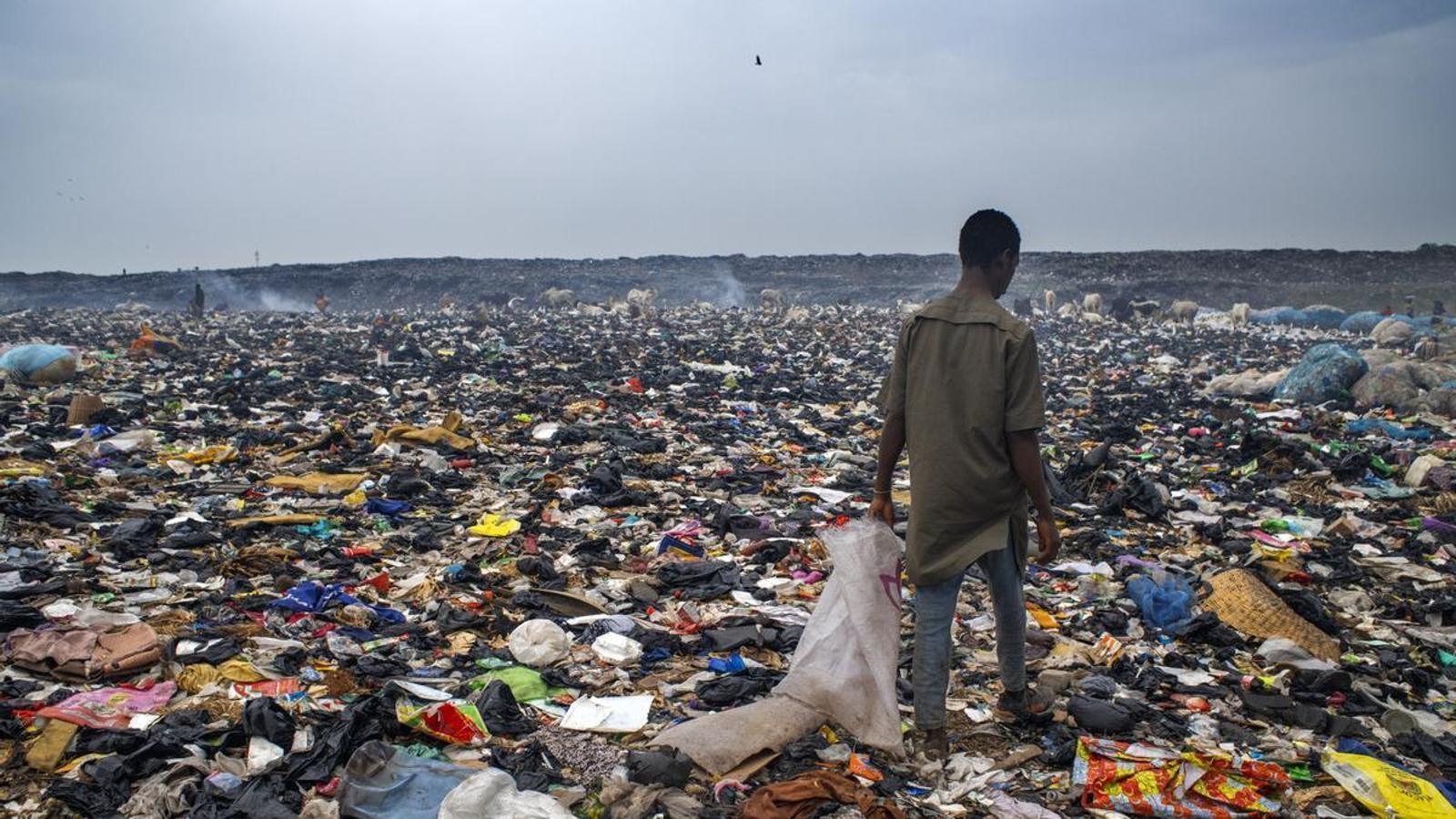
On the outskirts of Accra, Agbogbloshie stands as one of the largest illegal dumpsites in West Africa, an extensive wasteland where waste from all over the world converges. In addition to discarded textiles, the site is also a graveyard for unusable electronic devices. In fact, it is the largest electronic waste dump in the world. The government of Ghana attempted to dismantle it in 2021, but it remains open, and now, in addition to devices, it hosts an increasing amount of textiles. Every week, millions of garments that cannot be sold at the Kantamanto market, often due to poor condition or overproduction, end up here. Around half of the unsellable clothing is discarded in Agbogbloshie, creating a harsh reality of waste, pollution, and human suffering.
Clothing items appear tangled in a mountain of cables, plastic, and broken appliances. The recyclers, generally young men and women, work in dangerous conditions, sorting through piles of debris to recover the little they can sell or recycle. These workers are exposed to harmful chemicals and extreme temperatures, while earning miserable wages and being extorted by local gangs.

Periodically, the landfill catches fire with open-air bonfires, burning the trash to make room. These fires not only burn clothing, but also plastic and electronic devices, releasing toxic gases into the air and further contaminating the land and water. The fires are a desperate and dangerous attempt to manage the enormous amount of waste that has no other destination.
The Korle Lagoon dam, located just 500 meters upstream from the mouth of the Odaw River, constitutes the last line of defense against the plastic waste and old clothes flowing down the river towards the Gulf of Guinea. Located next to the Zoom Lion integrated recycling and composting plant, this dam should prevent the trash from reaching the sea. However, it has become an increasingly ineffective barrier, as it struggles to contain the growing volume of waste.
Jamestown Beach
On the beaches of the capital of Ghana, what look like sand dunes from afar are actually mountains of synthetic fibers and plastics. Every week, Jamestown beach in Accra, Ghana, is also flooded with tons of discarded clothing and plastic. The Or Foundation, a local non-profit organization, organizes a dedicated team of about 60 people every Tuesday to clean the beach and address the crisis. Together, they remove up to 20 tons of waste, hoping to restore the beauty of the beach and preserve its recreational value for the community.
Unfortunately, the cleanup is an endless task. Every high tide brings more debris, while the amount of clothing sent to Ghana continues to increase. The volume of discarded clothing and other waste has reached such alarming levels that it is almost impossible to manage for a single organization or group.

People living near the coast, many of whom depend on fishing for their livelihood, are constantly struggling against the relentless tide of waste. Furthermore, the health risks associated with the accumulation of waste are serious. Waste often creates pools of stagnant water, which become breeding grounds for mosquitoes and other disease-carrying insects.
A wildlife sanctuary, flooded with waste
On the outskirts of Accra, the protected wetlands of the Densu Delta, one of Ghana's most important coastal ecosystems, face growing threats due to the mountains of discarded clothing arriving from the Agbogbloshie landfill. What should be a sanctuary for wildlife is increasingly being flooded by fast fashion waste: clothing, shoes, and synthetic materials that pollute the environment.
The presence of textile waste also alters local fauna. Birds get trapped in the remains of clothing, while fishing nets become tangled with discarded garments, which causes injuries and even death. As these materials decompose, microplastics from the clothing leach into the water, poisoning the food chain and threatening fish species crucial both to local ecosystems and the fishing communities that depend on them.
This textile pollution also suffocates mangroves and wetland plants, reducing their ability to filter water, prevent erosion, and provide natural protection against flooding. The obstruction of drainage systems causes stagnant water, which further degrades the habitat and promotes the spread of diseases that affect both humans and animals.
Enock, a fisherman from Wiaboman, near the protected wetlands of the Densu Delta, has seen how his once-thriving fishing grounds have deteriorated over the years. Every day he casts his nets with the hope of catching fish, but most of the time, he collects plastic bags, clothing, and synthetic fibers.
"Waste colonialism"
The environmental impact is severe. Synthetic textiles, such as polyester, release microfibers that contaminate marine ecosystems, clog fishing nets, and threaten the livelihoods that depend on the sea. Monsoon rains exacerbate the problem by washing textile waste from markets and landfills directly into the Atlantic. Despite cleanup efforts, the volume of clothing that arrives far exceeds the local capacity to manage it.
Fast fashion (cheap, quickly produced clothing designed for short-term use) has transformed the global textile industry, but its environmental and social costs increasingly fall on countries far from where they are consumed. Ghana has become one of the world's main destinations for discarded clothing, turning the boom in fast fashion into a growing ecological and economic crisis.

The country has become the epicenter of an environmental crisis that combines overwhelmed waste management with a constant flow of waste imported from the northern hemisphere. The Republic of Ghana finds itself today at a historical crossroads, facing an environmental crisis that threatens its long-term economic and public health stability: the uncontrolled proliferation of plastic waste, which in its vast majority also arrives—like clothing—from other countries. This phenomenon, which has intensified alarmingly over the last decade, reached a critical point last year, with an estimated generation of more than 1.1 million tons of plastic waste per year. This figure is especially worrying given that the country has the infrastructure capacity to formally collect only 45% of its daily waste in key urban centers like Accra, leaving more than half at the mercy of informal burning or dumping into natural ecosystems.
The crisis facing this African country is not only environmental, it is also political. Activists and NGOs describe the situation as "waste colonialism," where wealthier countries export the consequences of excessive consumption to nations with limited waste management infrastructure. Ghana, currently the largest importer of second-hand clothing in Africa, faces the legacy of colonial trade patterns, combined with the modern overproduction of global fashion brands. Cheap garments from fast fashion giants undermine local textile traditions, leaving Ghana to deal with the waste.
From your container to Ghana
In many of our cities, used clothing bins are part of the urban landscape. They are presented as a gesture of solidarity and sustainability: leaving a t-shirt, jeans, or a jacket that we no longer use to give them a second life. However, what is rarely explained is the long and complex journey that many of these garments follow, a path that, in thousands of cases, ends in Ghana, thousands of kilometers from where they were discarded.
Once deposited in the bin, the clothing enters an industrial sorting system managed by private companies, charitable organizations, or commercial intermediaries. In large logistics plants, the garments are separated according to quality, type, brand, and condition. Only a small part is resold locally in second-hand shops. Another part is recycled into industrial rags or fibers. But a significant proportion – especially that of medium or low quality – is destined for export.
These garments are compressed into bales weighing between 45 and 60 kilos, packed, and sold wholesale to international intermediaries. Although they are often labeled as "reusable clothing," in practice they include an uneven mix of pieces: some still in good condition, others worn out, out of fashion, or made with short-lived synthetic materials. From European and North American ports, these bales are loaded into shipping containers bound for West Africa.
With little accountability from the fashion industry and limited recycling options, Ghana's struggle highlights a global truth: the environmental cost of fast fashion does not disappear, it simply shifts to the world's most vulnerable communities.
