An army of clowns to invade the Middle East
The artist Pau Palaus performs in Lebanon and will be the protagonist of an eight-episode documentary in eight countries of the Middle East and North Africa.

-
CAT -
CAST
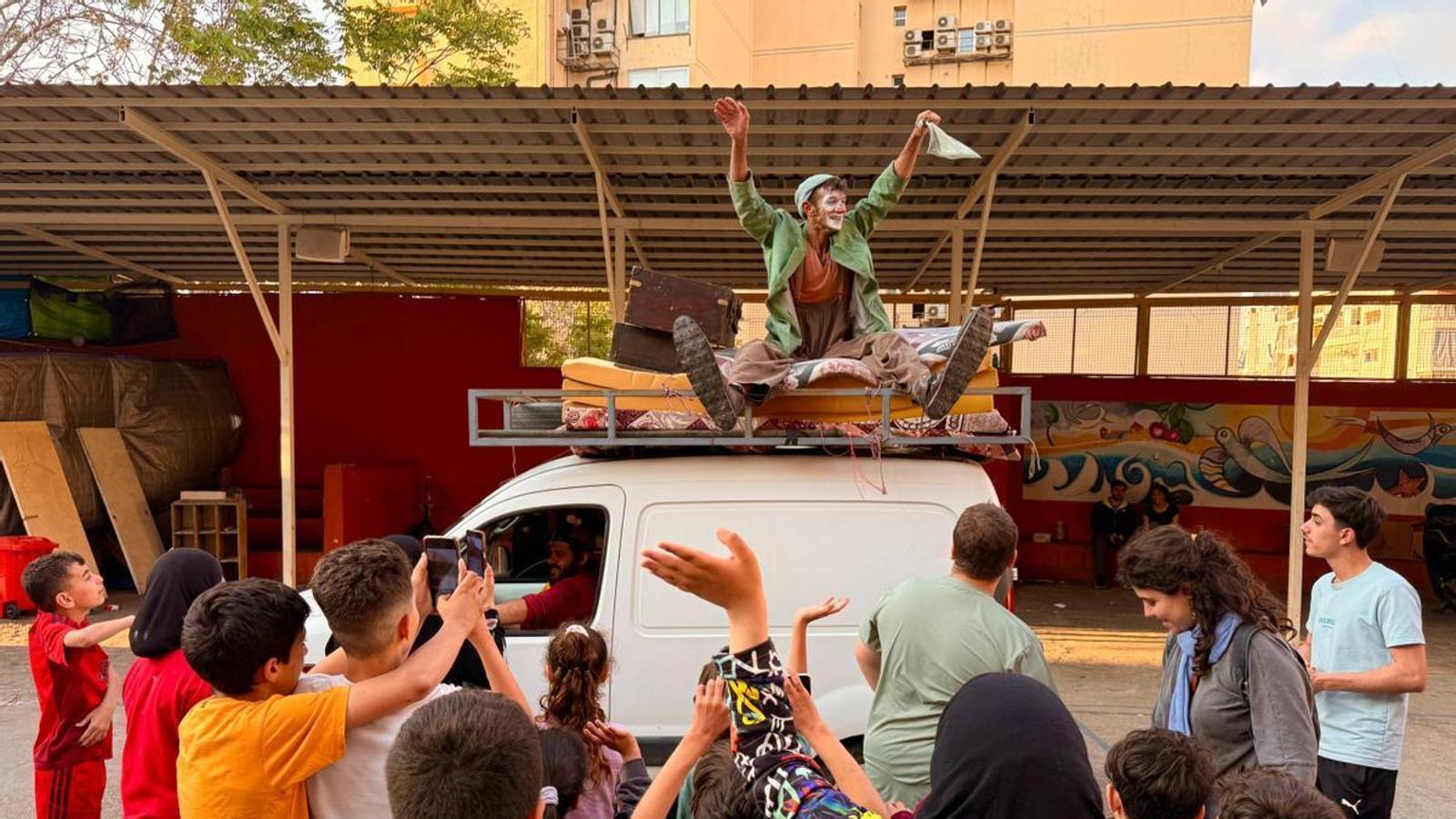
When Pau Palaus returned from his first trip to Lebanon, in May, he organized an event in the Plaça d’Arbúcies to explain the experience to his neighbors. He lives on the outskirts of the village in a farmhouse called Ca l’Ocell, where he has a small stage to rehearse shows and set up small-scale performances. Roser Loscos' violin was playing in the square, and the children were asking him questions. “And did you bring food to Lebanon?”, a girl asked him. Pau is a clown; with his company, he has visited about thirty countries, won awards like the Zirkólika, and a few years ago he set up the association Contaminando Sonrisas, with which he organizes solidarity expeditions to countries in conflict or places that have suffered natural disasters. It was the bombings in April, launched by Israel over the south of the country but also in the capital, and the contacts Pau maintains with some Lebanese clowns that prompted him to travel to Lebanon. Not to bring food, precisely, but rather “hope”: “Talking so much about the number of deaths, in the end we end up dehumanizing war, and what I try to do is bring a little humanity to the conflict”. He usually shares these trips with a small team of collaborators, but this time, for logistical reasons, he had to travel alone. He performed mainly in the most popular neighborhoods of Beirut, including Dahieh, the suburbs where Hezbollah is considered to have its main urban base, and where Israel usually has its sights set. In total there were 27 performances in less than two weeks, many improvised in the middle of the street, during days when bombs continued to fall despite the theoretical ceasefire. A ceasefire that never quite is, as has been demonstrated in recent weeks. “The bombings that fall during a ceasefire are the most dangerous, because people let their guard down. I thought I would find an empty city, with everything closed and people at home, and it's the opposite, shops are open, life goes on almost normally. In Beirut I spent the day watching the drones that flew over us all the time, but they didn't pay any attention to them.” During the last two days of my stay in Beirut, the suburbs suffered a new wave of attacks, in which the government of Israel claimed to have killed a high commander of Hezbollah, the Shiite paramilitary group allied with Iran. It is estimated that since the United States and Israel launched the offensive against Iran, there have been more than 3,000 deaths in Lebanon and one and a half million displaced people, mainly due to bombings ordered from Tel Aviv to attack southern Lebanon and occupy about thirty border towns. “During a performance I was giving, a group of people received a call saying that two missiles had fallen in their village and seven people had died. There was a bit of a commotion, but the show continued, and when it ended, those same people came to congratulate me as if nothing had happened.” During his nine days in Lebanon, Pau recounts having a dream: hundreds of buses arriving in Beirut loaded with clowns and invading the country. He told this to two Lebanese documentary filmmakers who were helping him set up performances in Beirut, and from this, a new project has emerged and is now underway: to record an eight-episode series in eight countries in the Middle East and North Africa to demonstrate that the work of a clown can be a symbol of peace and also of transformation. “They stopped making documentaries focused on war some time ago because they found it too emotionally taxing, but now they see the possibility of addressing it from the perspective of hope. The intention is to invite other artists who are willing to perform with me in these places,” he explains. The series will likely begin filming in August, taking advantage of Pau being invited to a circus festival in the town of Ramallah, in the West Bank.A destroyed capitalIn recent months, Pau has met some Lebanese clowns and artists, and from this have come different collaborations. Last week, for example, Contaminando Sonrisas promoted from Catalonia – with economic and logistical support – a series of performances by a pair of local artists who perform mask and puppet shows. “They were born in Syria but had to exile themselves to Lebanon and grew up in Shatila, a refugee camp in the heart of Beirut built in 1949 to host Palestinians fleeing the war. It can be said that it is already part of the city itself, but it is a very degraded place, with mafias and corruption, where young people have many difficulties finding work. Meeting this pair of artists with so much sensitivity has been like finding a flower in the middle of the rubble," he explains. This coming Wednesday, Pau will once again leave for Lebanon to perform in other areas particularly hard-hit by the war. He will visit the Bekaa Valley, near the Syrian border; two refugee camps in Tripoli, further north, and the peripheral neighborhoods of Beirut. In addition, he will conduct a free training workshop for about fifteen local clowns. “Many public services have not been functioning for years and the population has had to self-manage. I don't know if they have much hope left, but they have a lot of resilience,” he adds. During his performances in May, he was able to personally verify the accounts that Western media correspondents have been giving in recent times. On the one hand, the destruction that continues to plague the capital. “There are many damaged buildings, and for each one, they can tell you what year it was attacked. Apart from an explosion at the port [in 2020], which was brutal and it is still unknown who was responsible. The Lebanese say that life is what happens between one war and another, because conflicts have been constant throughout their history,” he laments.

On the other hand, Pau speaks of the enormous disappointment that the population feels with respect to their own state, with respect to Hezbollah, and with respect to the international community. They feel abandoned. “Talking to people, you understand that the majority do not agree with the way an armed group like Hezbollah acts, but at the same time, they are convinced that if Hezbollah did not defend them, no one else would. The army has very little capacity, the soldiers earn a pittance in a country where life is also not cheap, and in many cases, they are not prepared to go to war. Hezbollah are the only ones who can stand up to them,” he assures. When the shows begin, however, sensitivity somehow equalizes everyone, regardless of ideology. “When you see how they get emotional, you realize that there is a humanity that is above the fact that some think one way or another, even above culture and religion. I have performed in very different places in the world, but the way children let themselves be surprised and smile is always very similar.” Besides performing in Beirut, he also visited the mountainous areas surrounding the capital and went to Tripoli, the second most populated city in the country. He brought his show to squares, schools, and orphanages. “Lebanon has always been a welcoming place; there are refugee camps with 80 years of history. I hadn't even left yet and I was already thinking about returning.” Pau Palaus's shows are part of this contemporary circus movement in which the clown plays with silences, sensitivity, and also provocation. “Clowns without red noses,” to put it symbolically. His shows have touched on themes such as poverty, resilience, and the difficulties of finding a better life. In the latest, titled Zloty, two clowns try to move forward after a strong storm took away their tent and literally left them with nothing. In the midst of warbank account where donations can be madebank account where donations can be made. Since he created the association, 12 years ago after a stay in a refugee camp in Myanmar, Pau has performed in countries such as Sierra Leone and Nepal, at the Idomeni refugee camp, in the immigrant settlements of Ceuta and Melilla, and in Valencia, after the floods of the dana, which also left many families homeless. “Lebanon has been like another step, because until now we had always been on the other side of the war, on the other side of the border where people were fleeing. This time I have experienced the war from within”, he emphasizes.

The world of the circus, and especially that of clowns, has always been closely linked to solidarity initiatives. Organizations such as Pallassos sense Fronteres, Clown Me In, Pallapupes, or Saniclowns have been developing projects with vulnerable people and in hospitals for many years. And in the preparation of these expeditions, in fact, Pau has received the support of professional colleagues such as Tortell Poltrona, also a regular in these types of initiatives. It was precisely these colleagues who helped him to contract insurance for his trip to Lebanon. Performing in countries in conflict always carries a risk. "Fear is never a good travel companion. I always try to put it aside. And I always think that if something bad is going to happen to me, I prefer it to happen with my clown shoes on." The next stop is Lebanon again.
