"When I go out onto the balcony and they take photos of me from the street, I hide"
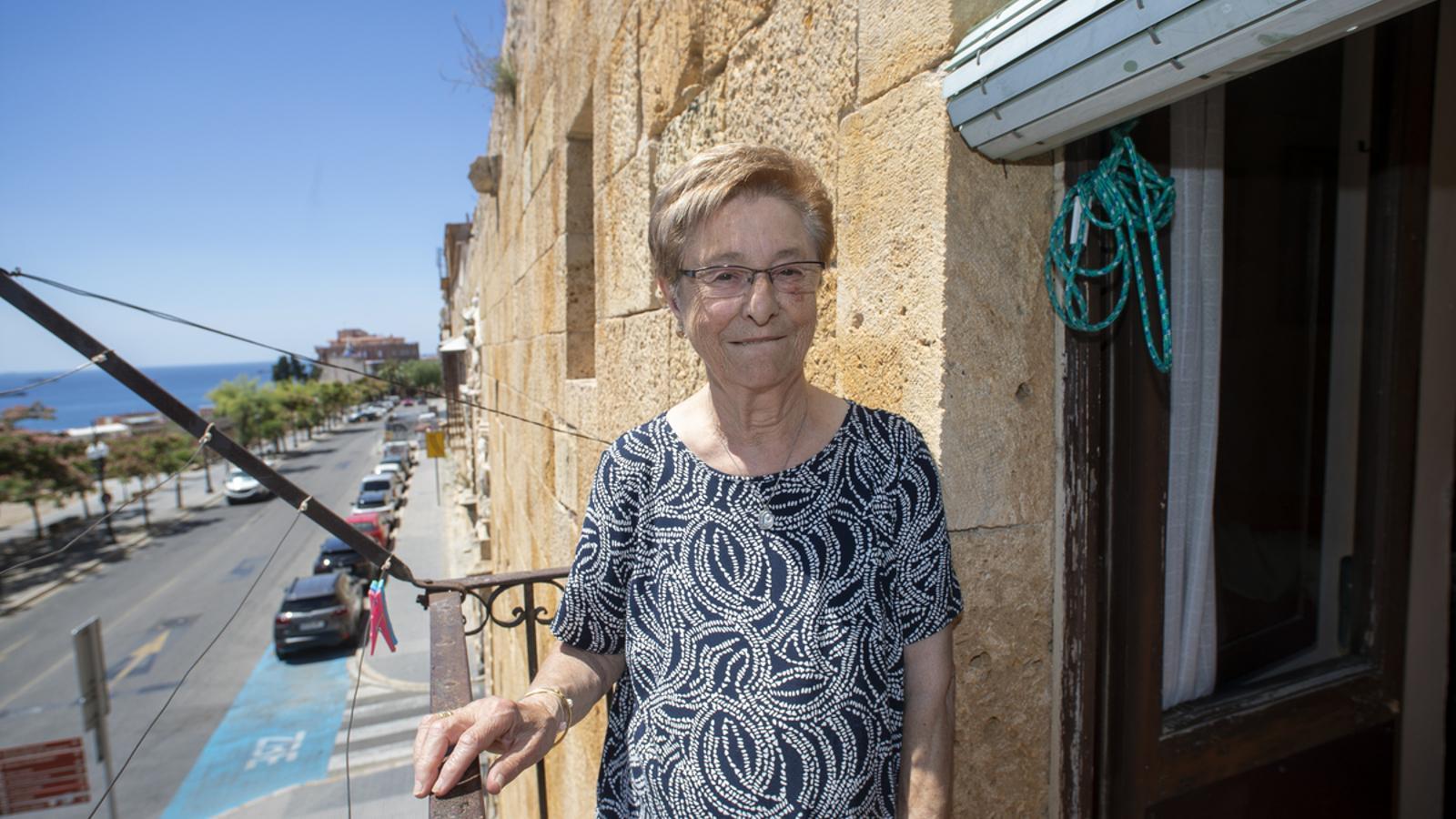
Núria Rosselló Masip lives on one of the most beautiful balconies of the Roman wall of Tarragona

-
CAT -
CAST
TarragonaIt's too hot now and it's a bad idea to go out on the balcony. The sun beats down like a slab. But in winter, when Núria Rosselló Masip goes out on the balcony, she also has to take precautions. "There's always some tourist looking and when I go out on the balcony they take pictures of me, but I hide," she explains. And that's because Nuri lives on one of the most beautiful balconies in Tarragona and probably the one most photographed by tourists: right on the Roman wall of Tarragona. Furthermore, the building where she lives is above the Portal de Sant Antoni, one of the places where this impressive work of the Roman empire looks its best.
The Portal de Sant Antoni is Baroque in style and was built in 1737, to make the access to Tarragona more majestic through one of the gates that the Romans made in the wall. Little did the Romans imagine that 1,700 years after building this access to Tarraco, a Bourbon would come to place his coat of arms on a semi-pointed arch, or that 2,000 years later, Nuri and Cristòfol would come to form a family on the same wall they were building.
"I don't know how the Romans managed to bring all these big stones up here," says Nuri. She doesn't carry a single stone, but she knows the climb well enough because every day she goes down to the Central Market of Tarragona to buy a few things. "I'm used to it now. I'd have to be feeling very unwell not to go down to buy at the market," she says at 87 years old.
One of her four children, Antonio, also lives in the apartment. Nuri's family moved into this building 53 years ago and has been paying rent ever since. She has no intention of changing apartments, even though she has to walk so much to go shopping and the building is old and has no elevator. "Here, in the upper part, it's very nice and everyone loves us very much," she says. She has lived here her whole life. As a child, she lived on Sant Llorenç street and was already delighted with this neighborhood. "We used to have a market and everything," she recalls. Now there are some businesses in the neighborhood, but once you've tasted the warmth of the market, it's hard to shop in stores where they barely greet you.

In this corner of the upper part, the lifelong neighbors still remain, those who do not hesitate to greet Nuri and lend an ear when they see her talking to two strangers with the faces of journalists. There are also tourists, but it is not distressing. "They think I know everything... they ask me how they should get here or there," explains Nuri, who makes it clear that it doesn't bother her.
The dampness of the stones
The building has three floors, but the only one that is inhabited is hers. In reality, her house occupies two floors, as the family was quite large and they added a floor from the adjoining building. Now, for only two people, it is even too big, and that's even though the wall facing the city wall takes up a quarter of the dining room. "The problem with these stones is the humidity. In winter I get a bit cold, but in summer it's fine," says Nuri.
Her house couldn't be more Tarraconese: a Tarragona flag on the balcony and virgins and saints decorating all the walls, accompanied by a Nàstic calendar. She also has some promotional postcards of Tarragona showing a photograph of the city wall and the Portal de Sant Antoni, that is, her home.
Nuri's family is well known in Tarragona because years ago they opened the Tòful restaurant, in Plaça del Fòrum, the classic local spot that never disappoints customers. The whole family has worked there, and they have also lived in the walled apartment.
Although she doesn't like having her picture taken when she goes out on the balcony, she makes an exception for the ARA newspaper. From her balcony, besides the tourists looking for shade, you can see how the city wall descends towards the city. In front, in the foreground, is the building that houses the Diputació de Tarragona on Passeig de Sant Antoni and, beyond that, the sea.
