Why is Lamine Yamal decisive even if it doesn't seem so?
The Rocafonda winger makes the difference even if he is not at 100% thanks to the intimidation power he has with rivals
-
CAT -
CAST
BarcelonaWith the numbers in hand, Lamine Yamal is far from the offensive contributions of other stars of this World Cup. For now, the Barça winger scores a single goal in the tournament and has not played any assistance. Of course, with the exception of the match against Portugal, he has not been able to play all the possible minutes. In the debut against Cape Verde he was a substitute and only played 19 minutes. Against Saudi Arabia he was a starter and was substituted at halftime after scoring. Against Uruguay, 76 minutes; and against Austria, 85. With the 90 minutes of the round of 16 against Portugal, he adds up to 315 minutes out of a possible 450. 70%. A low percentage if you consider that the top scorers (Leo Messi, Harry Kane and Kylian Mbappé) exceed 90% participation.
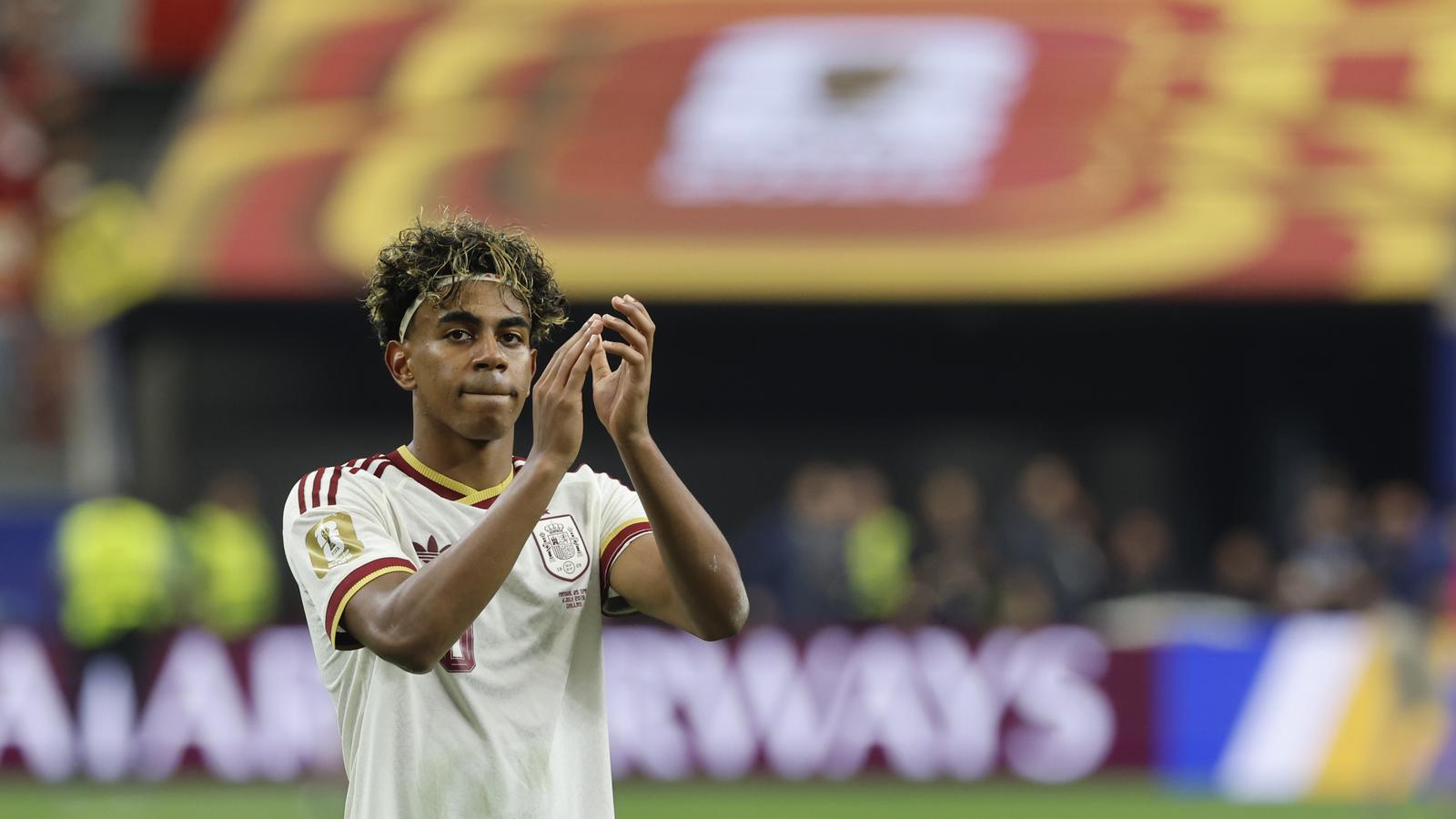
But Lamine Yamal is not explained only with statistics. At just 18 years old, with three Leagues and a European Championship under his belt, his visiting card frightens opponents who change their way of playing depending on whether he is on the field or not. A power of intimidation that he has earned precociously and that he exercises on the field even though, as is the case in this World Cup, he is not at 100%.
It all starts with the injury that Lamine Yamal suffered to the hamstrings of his left leg on April 22, in a league match between Barça and Celta, just after scoring a penalty. The prognosis was about two months out, and initially this meant he would miss the initial matches of the World Cup. As ARA explained, the blaugrana squad and the RFEF met to analyze the case and, apart from guaranteeing that Barça could supervise the recovery of its footballer while he was concentrated with Spain, it was agreed that he would not play the group stage matches if it was not especially necessary. But that was not the case.
With the score 0-0 in his debut against Cape Verde, a match that theoretically was to be very accessible for Spain, Luis de la Fuente brought him onto the pitch in the 71st minute. He managed to attract the attention of up to three defenders, but showed a lack of rhythm. As the debut ended in a draw, Lamine Yamal started out of necessity against Saudi Arabia and completed a good first 45 minutes – including a goal – before being substituted at halftime, when the match was already decided. He also played from the start against Uruguay and against Portugal. Of course, playing at half-speed, without being able to make a difference, as he was used to doing with Barça or with the national team.
A conservative readaptation to avoid relapses
The explanation for all of this lies in the extremely conservative readaptation that has been done with him, where the priority has always been to avoid a relapse. Had the World Cup not been in the way, the treatment would have been different, but Spain's haste – and the player's will – have conditioned a very delicate process, in which the number one priority has been for Lamine Yamal to be at the tournament even if he couldn't give his best version. In addition to his tactical abilities, the injuries of the other wingers, Víctor Muñoz, Yeremy Pino, and Nico Williams, are added, which is why De la Fuente only has one specialist on the wing whom he needs to look after.
That Lamine Yamal is not at 100% can be seen on the pitch. His sprints are less intense than usual, and he has more difficulty dribbling past opponents. What is seen on the field is also seen in training, where the footballer is not working on RSA (repeated sprint ability) with the same intensity as if there were no risk of relapse. RSA is a training method to improve footballers' performance by doing short, repeated sprints within a specific time interval. This formula, diametrically opposed to the laps around the pitch that have always been done, aims to reproduce in practice sessions what will happen in matches later on. The total number of efforts will depend on the player's physical condition, which is why, if there is a high risk of relapse – as is the case with the Barcelona winger – his capacity to be decisive decreases considerably.
Lamine Yamal was key in Merino's goal against Portugal
And, despite everything, Lamine Yamal continues to be essential: his presence on the pitch means that opponents are constantly aware of his actions, with two or even three defenders marking him. Good proof of how he influences the game was the round of 16 match against Portugal: the Portuguese team faltered when Nuno Mendes, the full-back tasked with marking him, got injured. At that moment, Nélson Semedo came on and the result was not the same. Afraid of Lamine Yamal receiving the ball with an advantage, Portugal took a step back, retreated, and Semedo received more support to prevent Lamine Yamal from beating him. The consequence was that other players, like Ferran Torres and Mikel Merino, were able to play with more freedom: Ferran provided the assist and Merino scored the winning goal that qualified Spain for the quarter-finals.

