"When they see a boat with only women, they ask us where the men are"
An all-female crew recovers a 70s boat to compete in the Ruta de la Sal

-
CAT -
CAST
BarcelonaYears ago, during Holy Week, a multitude of white sails fills the Mediterranean heading for Ibiza. The Ruta de la Sal, the offshore regatta with the most sailors in the Mediterranean, has been moving thousands of sailboats for over thirty years, participating in a competition born to commemorate a forgotten historical event. In 1846, when the Carlists managed to blockade Barcelona during the First Carlist War, a Barcelona businessman offered money to all sailors who volunteered to go to Ibiza to fetch salt and bring it to Barcelona, as it was running out. It is said that a schooner named Halcón Maltés, captained by the Greek Andrea Potrus, was the fastest to break the blockade.
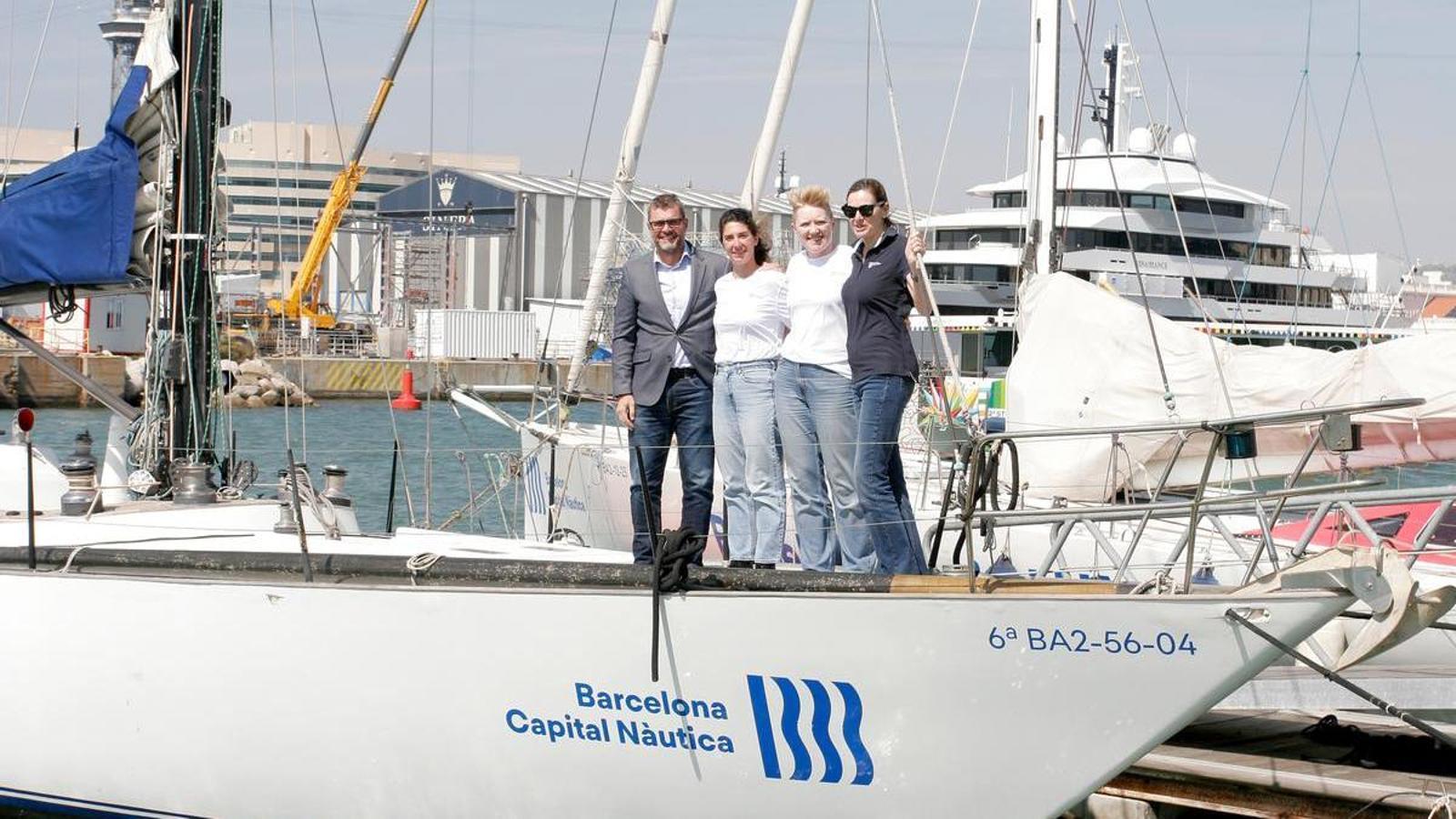
That 1846 sailboat was made in an American shipyard, like the Charisma, a beautiful sailboat that this year has joined the regatta with a special crew: all women, many of whom are sailors who learned to navigate as adults. The boat was donated to the Fundació Barcelona Capital Nàutica, which lends it to this all-female team, whom the Foundation supports to demonstrate that women have "as much to say at sea as men," as defended by Natàlia Via-Dufresne, a two-time Olympic sailing champion. The team will compete aboard the Charisma in the Salina category with a crew of seven women. The skipper will be the experienced Pilar Pasanau, who has just returned from Antigua and Barbuda, where a few days ago she finished in fourth place in the Mini Globe Race, a solo round-the-world race with boats under six meters.

The crew is made up of a group of women who have made the sea their life, like Gráinne Costigan, an Irishwoman who has been living in Barcelona for years working as a data scientist. "My father sails in Dublin, he had the house in front of the sea. Being able to sail gave me a sense of confidence, I was a shy girl and sailing made me feel strong. And consider that in Ireland we always have rough seas. So sailing made me strong, especially when I took the leap to sail alone. It was a challenge," says a woman who has crossed the Atlantic solo.
"I had role models like Djemila Tassin. Women who had sailed alone and seemed like astronauts to me for what they did. And then I met them and they were normal women," she adds, referring to this Canary Islander, daughter of Belgians, who studied marine sciences and has participated in some of the best world regattas, some individual ones like the Mini Transat. Tassin will now be Gráinne's teammate on board the Charisma. "It will be special, I think on board we will be an interesting group of women who have fought hard. When you see all the professional or competitive teams, you always see men. If you are a woman, you know you will have to fight harder to reach their level," adds the Dubliner.

On board will also be Cecilia Zorzi, an Italian who has studied cultural heritage and is, of all the crew members, the one with the most experience in competitive sailing, with world titles to her name. But in many sailing teams Cecilia has been a part of, it's frustrating when the sailors are introduced. Everyone is introduced by their role, and they say about her that she's the woman on board. A female quota. "You always have to prove your worth, if you make a mistake it affects you much more," says Costigan. "What can we do? Well, things like this regatta! Being able to form teams just like they do. It's important to build community, it gives us more energy, it allows us to help each other. We just want to be sailors. We don't want to be women sailors. But for now, we still need to create role models and advocate for it, we haven't reached that point yet," she adds.
While Gráinne speaks, Martina Bernabai listens to her. An Italian by origin who has lived in Catalonia for years, she is one of those women who dared to start sailing when she was already an adult. "I started four years ago! I went on vacation with a friend who had a boat, I had never sailed before. And living in Barcelona, I thought I could do it and I learned to sail at the school... which I now run, MásNavega," she explains. From not knowing how to sail, in a few years she has gone on to compete in the Catalan offshore circuit, as skipper of a small boat, the Rateta, with two crew members. "Having your own boat allows you to learn more. And I'm getting encouraged to sail solo, to see how I can do it. I'm daring myself. There's a lack of female role models to encourage women to sail. When we sail with a crew of two women... do you know what the men we meet say to us? They ask us if we're alone. They see the two of us and they can't help but say 'Are you alone?'. They say it because they expect to see a man on board," she comments.
The crew is completed by Marie Gillier from Brittany, an experienced sailor, and Auxi Roselló, who has also crossed the Atlantic solo with her boat Gintònic, another woman who didn't come from the sailing world and is self-taught and advocates that offshore sailing can be done by training later in life. Together with Cecilia Zorzi, Djemila Tassin, Martina Bernabai, Gráinne Costigan, and Pilar Pasanau, they will take the helm of the beautiful Charisma, this boat that has circumnavigated the world and will now embark on a new adventure.
