Trump's interference opens a controversy in the middle of the World Cup
The American president and Infantino justify the pressures on FIFA in favor of the USA selection
-
CAT -
CAST
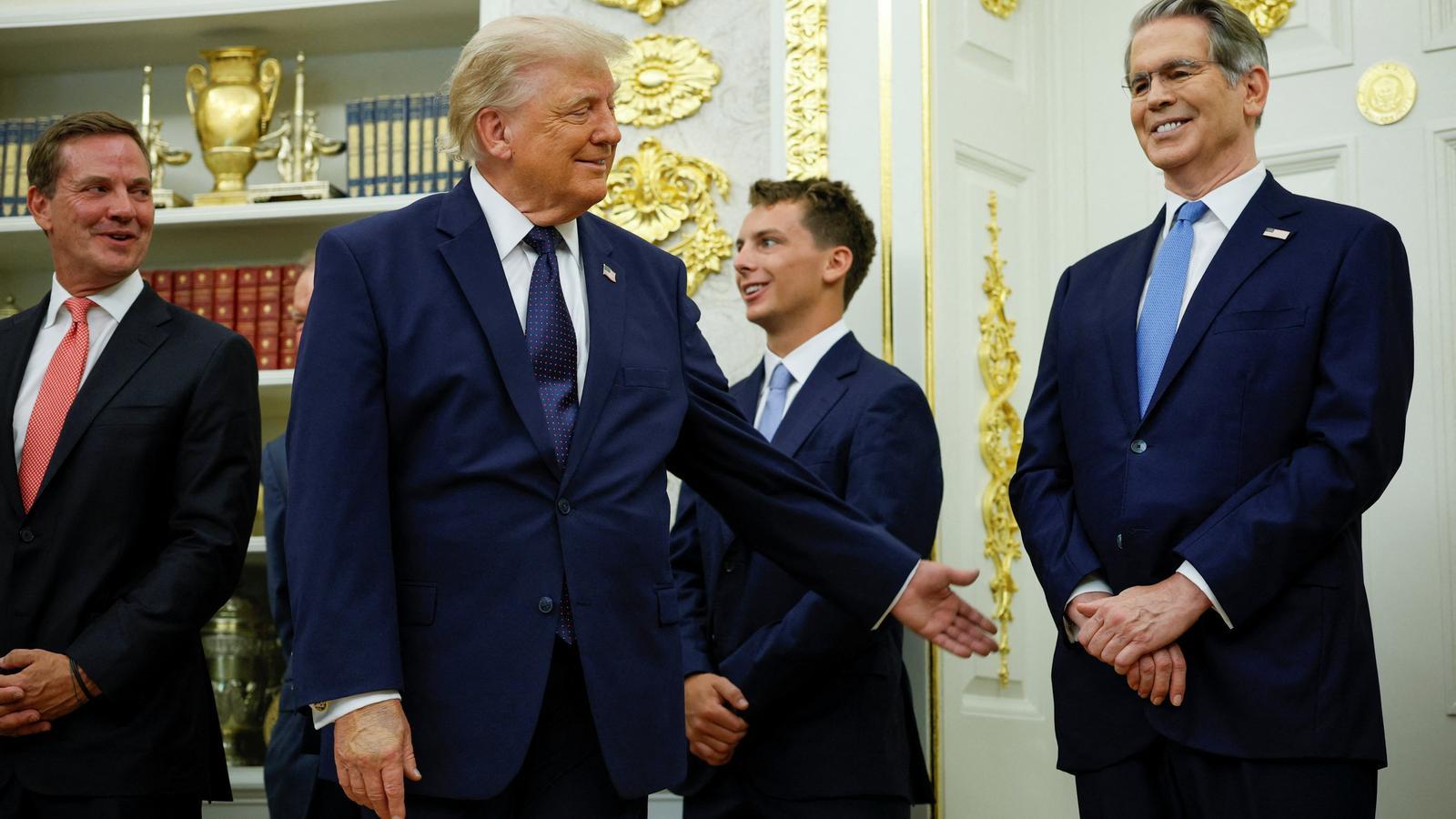
Washington / BarcelonaNeither Donald Trump nor FIFA president Gianni Infantino find the amnesty for American forward Folarin Balogun scandalous, following pressure from the US president on the World Cup organization. The Republican was the first to admit it this Monday morning to the press as a logical situation –"That wasn't a foul. So yes, I asked FIFA to review it"– and shortly after, Infantino came out to justify the decision and assured that he speaks "regularly" with the leader. The FIFA chief and the US president have unleashed the latest controversy amidst a competition already marked by the shadow of the current US administration.
The pardon for Balogun, who had received a red card against Bosnia and Herzegovina and therefore would have had to serve a one-match suspension, has generated much controversy. The one who has complained the most is Belgium, the United States' rival in the quarterfinals. While coach Rudi Garcia was beside himself and jokingly asked if it was April Fools' Day, the Royal Belgian Football Association (RBFA) filed an appeal against FIFA's decision. The appeals committee decided not to admit it, citing formal reasons. The last resort, the Court of Arbitration for Sport (CAS), although hopes for the Belgian team are rather nil.
Infantino admits he spoke with Trump
"Yes, I regularly speak with the President of the United States about FIFA World Cup-related matters and, in this case, I received a call from President Donald Trump, just as I receive calls from heads of state, government officials, football representatives and business executives from all over the world on many different issues," Infantino said in a statement issued by FIFA.
In the statement, the FIFA president also assures that he has reviewed the decision of the Independent Disciplinary Committee on Balogun's case and insisted that the pardon is "independent". "FIFA's judicial bodies are independent. They act autonomously, apply FIFA's disciplinary code and resolve cases in accordance with applicable regulations and the specific facts before them. Their independence is essential for the credibility and integrity of football, and this must always be respected," he writes. According to Infantino's account, the only thing that happened during the call with the Republican was that he explained the legal situation and that "the case would be resolved when it was time by the competent bodies." And he insists that the Committee's decisions must be respected.
"What I always do, however, is respect these decisions and the autonomy of the bodies that make them. Whether we personally like a decision or not, that is irrelevant. Respect for independent institutions and the rule of law is what protects the integrity of our competitions and the credibility of FIFA at all times," assures Infantino. The reference to respecting "the rule of law" in the context of the competition held in the USA (as well as in Canada and Mexico) contrasts with the recent doctrine of the US president, who decided to intervene militarily in Venezuela and overthrow its president Nicolás Maduro.
From the Oval Office, Trump explained the reasons why he pressured FIFA to withdraw the red card received by the American player Folarin Balogun in the match against Bosnia and Herzegovina. "I saw the play. And I am a person who really likes sports and was a good athlete. I understand sports very well, very well. And that was not a foul. It wasn't even an infraction. And that referee, who is a bit suspicious... I don't like to create controversy, but he is very suspicious. He made a decision that nobody could believe," Trump told reporters in the Oval Office, adding: "So yes, I asked FIFA to review it."
For Trump, the decision to interfere in the competition made perfect sense, as it had happened to the "best player" of the American team. "It would have been unfair even if it had happened to another player, but when they take away your best player, or almost the best, because they have great players, and they tell you he can't play, it's very unfair. It's one thing to sanction someone for the game in which they committed the offense, but how can you punish them for a game that hasn't been played yet? That's very unfair. You can't do that," Trump said. On this occasion, he didn't need to sign any decree to impose his will; he just had to pick up the phone.
UEFA believes that "a red line has been crossed"
The situation has caused a scandal in the sporting world. UEFA yesterday described the amnesty for the North American striker as "unprecedented, incomprehensible and unjustifiable" so that he can play against Belgium in the round of 16 of the World Cup, which is being held, precisely, in the United States. In a statement, the European body says that "a red line has been crossed" and that "when the certainty of the rules is no longer guaranteed, the integrity of the game is called into question".
In the text, UEFA says that "football, like any other sport, is based on rules that are the cornerstone of fair, honest and transparent competition". "Sometimes rules are open to interpretation. In this case, they are not," it adds. Beyond the dimension and significance of the events, UEFA's reaction is partly explained by its poor relationship with FIFA.

