The World Cup that pits three pairs of brothers against each other: friends at home, rivals on the field
286 players of this edition of the tournament play with a different selection of the country where they were born

-
CAT -
CAST
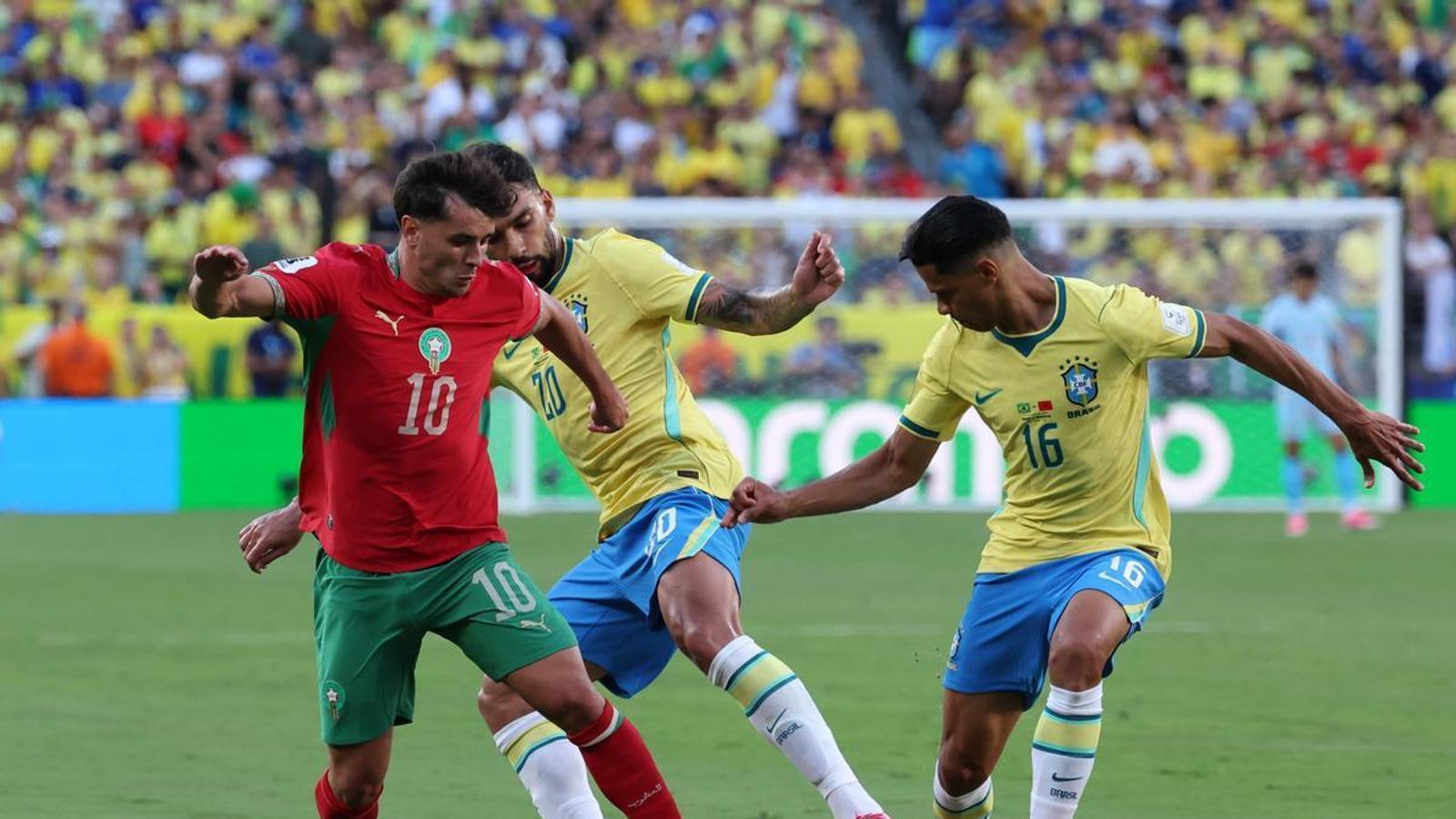
BarcelonaWhen the Moroccan national team achieved a brilliant and deserved draw against Brazil in their World Cup debut, many people reacted with a grimace. For the first time, a team played in the final phase of a World Cup where none of the footballers had been born in their country. The initial squad had only one player born in Morocco, Ounahi. But with substitutions, 11 players born abroad coincided, two of whom were from Catalonia, Ismael Saibari and Ayoube Amaimouni. All with roots in Morocco, in this case. But born abroad, children of the Moroccan diaspora. Morocco opened an office in Spain years ago where a group of people work to identify players throughout Europe who are sons or grandsons of Moroccans, in order to recruit them, as they tried to do with Lamine Yamal without success.

Never before had so many footballers defended the jersey of a national team different from that of their country of birth: 286 out of 1,248 registered players, almost 25% of the total. At the 2022 World Cup, the figure was 137 players out of 832, marking a clear upward trend, as in 1978 there were just 7 out of 352 registered players. "It's a reflection of the planet we live on. Most cases have to do with a colonial past and immigration. You may like it or not, but there's an explanation," said former Argentine player Jorge Valdano in an interview. "When I went to interview Mbappé in Paris, young players were coming out of the Federation headquarters and they were all of African origin. In football, children from needy families almost always succeed more than the children of the rich, so it makes sense that the children of immigrants with roots in former colonies succeed," he added.
"What is happening now is that the players' countries of origin have understood that they can raise their level of play by calling up European players, trained in good clubs," explained the veteran coach from Curaçao, the Dutchman Dick Advocaat. "You have professional footballers in Europe who may never play for the senior national team, but if they are called up by the team of the country where their father was born, they can indeed become internationals," he added. Some people criticize it because a country ends up playing with footballers trained elsewhere. "The key is an increasingly globalized world, but also a football that moves more money and that leads federations to seek victory at all costs. And, therefore, they look for players to call up who perhaps, deep down, have little to do with their country," says American journalist Clemente Lisi, author of a book on the history of the World Cup. And it is true that there are players who have relatives in the country they represent, as is the case with Morocco, while other national teams call up footballers who have few ties to the country. A clear case would be that of striker Folarin Balogun. An English footballer raised in London, son of Nigerians, born almost by chance in New York, as his parents were visiting that city when his birth advanced. Balogun has never lived in the United States and his relatives are not American. But since he was born in New York, they selected him. Former Barça player Sergiño Dest also plays for the United States, where he has never lived. He plays there because his father, born in Suriname, worked in the United States for a few years and obtained citizenship before moving to the Netherlands, where he met a Dutch woman, the player's mother.
"Another key moment is the change in the rule that allows players to change national teams if they have not played more than three matches for the senior national team," points out Lisi. In 2020, FIFA modified the regulations, which is why many players called up by teams like France or the Netherlands can end up playing for their fathers' land if they see that they will have more chances of regularity, as has happened with Brahim Díaz, who debuted with Spain but ended up playing for Morocco. The result has been this most globalized World Cup ever, full of curious stories.
The World Cup of the French
France, for example, has a total of 72 players in the World Cup, 53 of whom were born in the Paris region. All of his national team and those who play with other teams such as the 12 players who go with Algeria, the 11 from the Democratic Republic of the Congo or the 10 who go with Senegal and Haiti. Others play with Ivory Coast, Morocco or Spain, as would be the case for Laporte and Le Normand. Goalkeeper Luca Zidane, son of the 1998 World Cup champion with France, Zinedine Zidane, has decided to go to the World Cup with the country of his grandparents, Algeria, since France does not call him up. A significant case: fathers and sons defending different jerseys.
The Netherlands has 42 players in the World Cup, because, apart from the oranje national team, there is Curaçao, a territory that belongs to the Kingdom of the Netherlands. The Balkan diaspora, produced especially in the 90s due to the war, causes five Swiss players to have roots in the Balkans and 16 out of 26 Bosnian players to be born outside of Bosnia. The only national teams without any players born abroad are Saudi Arabia, Austria, Brazil, the Czech Republic, Colombia, Panama, South Africa, and Sweden.
It is a World Cup that explains a changing world, whether it is due to the desire to find a new life or because people are fleeing wars, like the Canadian Alphonso Davies, born in a Liberian refugee camp in Ghana. Or the Australian Awer Mabil, born in a refugee camp from the South Sudan war, in Kenya. The Mexican Obed Vargas is the son of Mexicans who emigrated and ended up in Alaska, far from their country. And former Celta player Dennis Eckert has ended up being called up by Iran, when he was born in Germany, the son of a Galician woman and a German citizen of Iranian descent. Since two grandparents were Iranian, a boy who grew up as a Celta supporter in Bonn is now playing in the World Cup.
In an increasingly interconnected world with people who love their birthplace as much as their parents' homeland, in this World Cup we find three pairs of brothers who can face each other, because each brother has chosen a different path. John Souttar is part of the Scotland squad, where they were born, while his brother Harry is serving with Australia, the mother's land. Nico Williams has been selected for Spain while his older brother, Iñaki, prefers to play with Ghana. And Désiré Doué, a PSG star, plays with France while his older brother, Guéla, goes with Ivory Coast, the land where his father was born.
In Tunisia there is Rani Khedira, who is debuting in a World Cup twelve years after his brother Sami Khedira won the World Cup with Germany. Divided families can find themselves in uncomfortable situations, such as that of Swedish forward Yasin Ayari: his father is Tunisian and his mother is Swedish. The son received an offer to play with the Tunisian national team, but his father told him that he had to fight to play with Sweden as a sign of respect for the land that had welcomed them. And on the first matchday of the World Cup, the draw presented a Sweden-Tunisia... where he scored two goals. He did not celebrate the first one as a sign of respect: "For a country where I have family." He did celebrate the second one.
