The eternal footprint of Pep Guardiola
The zero year begins in the Premier League after the Catalan technician
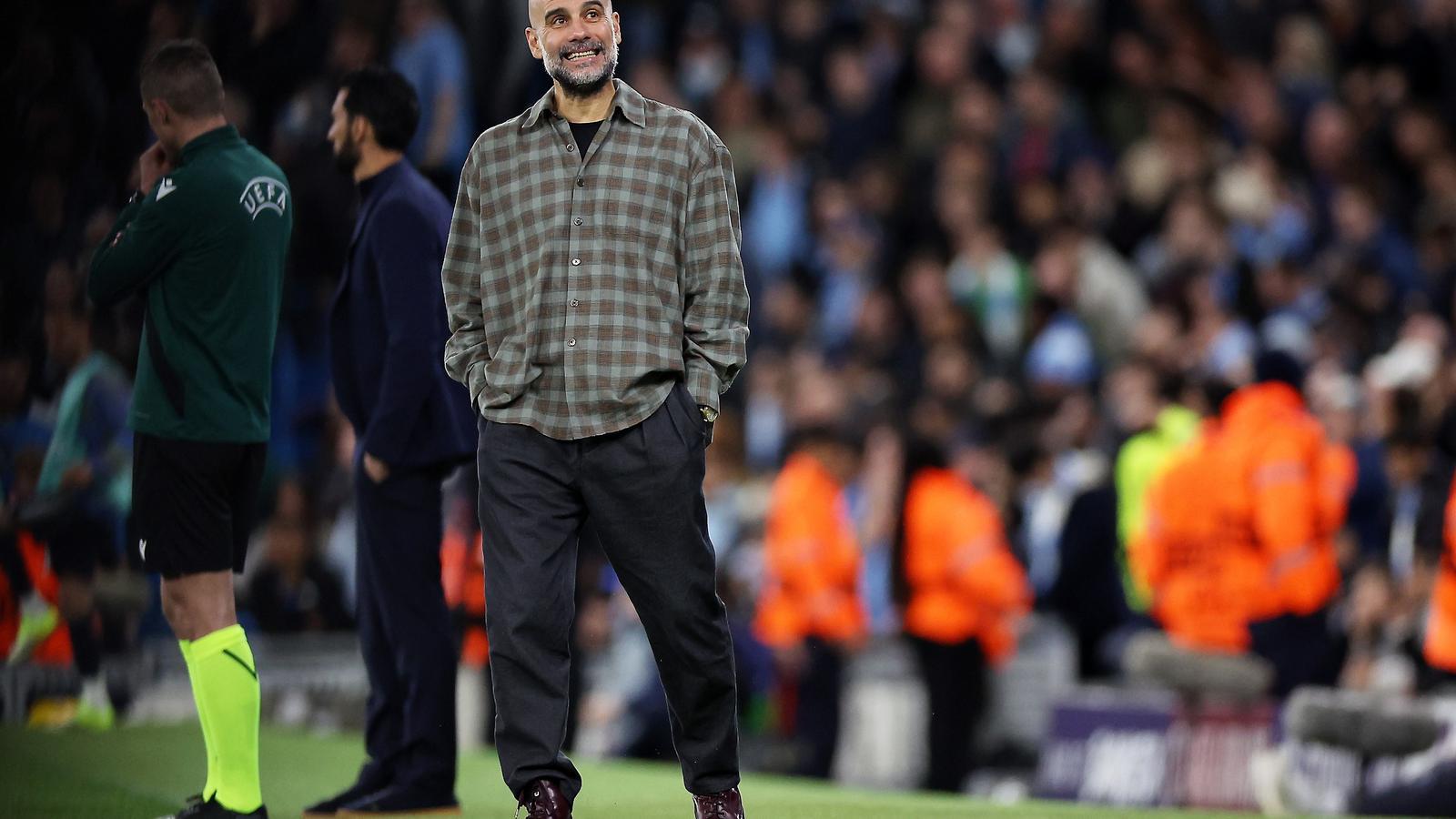

-
CAT -
CAST
BarcelonaOn days when Manchester celebrated titles in Salford, that is, at Old Trafford stadium, on the other side of the city, at City's ground, a banner was hung in the stands with a snippet of an Oasis song: “Some might say we will find a brighter day” (some might say we will find a brighter day). City was already owned by Sheikh Mansour bin Zayed bin Sultan Al Nahyan, but things weren't taking off. Until things worked. And yes, much brighter days arrived.
The day the 1996-1997 League began, Jorge Valdano wrote in El País: "The year zero after Johan Cruyff begins". This Friday marks the start of the first Premier League in ten years with Pep Guardiola on the Manchester City bench. It begins without Pep, but with more coaches born in Gipuzkoa than in England. Because, in many ways, nothing is the same in England anymore.
Ten years have passed since Guardiola arrived in Manchester, a decade in which he has changed not only City, but also English football. His mark is indelible. From the club's offices, Ferran Soriano, the chief executive officer citizen, has never denied that the foundation of success was built on an identity that City did not have before signing Txiki Begiristain. "Don't look at me, the genius is Pep," Txiki usually replies.
Soriano had already worked with Begiristain at Barça during Joan Laporta's first term. In Manchester, however, Roberto Mancini did not fit the idea of football they wanted to build. Guardiola, who at that time was in New York after leaving Barça, was already committed to Bayern and had even rejected an offer from Manchester United.
Txiki then looked for a plan B: Manuel Pellegrini. The Chilean won the League Cup and the Premier in his first season, but it was clear that his spell would end when Guardiola was available. And so it was. In 2016, after three years in Munich, Pep informed Txiki that he was free. The signing was quickly finalized.
Ten years later, England faces its legacy. The same City, too, which after having won everything, faces the challenge of continuing without him.
"What Pep leaves behind is not easy to manage," they admit from the Etihad. He has sophisticated ball control and has imposed a way of playing so ingrained that all City teams, from under-12s to the first team, share the same principles.
At the academy, Begiristain imposed the 4-3-3 and Guardiola opened the doors of the first team to youngsters. Carlos Vicens, who worked at the Academy and was then Pep's assistant, explains that players from the lower categories often participated in training sessions. This allowed them to understand tactical variations and become familiar with the way the seniors worked. Phil Foden, Cole Palmer, O’Reilly, or Rico Lewis are examples of this.
A different way of understanding football
In the stands, Guardiola's legacy will also be eternal. Russ Cowper, a City supporter since he was little, assures that Pep has allowed them to live the dreams of previous generations of fans. Nick Campbell, another long-time fan, doubts the club will win four consecutive Premier Leagues again and admits he's still in denial: "I can't believe I won't see him sitting on the City bench anymore."
Mark Aspinall, founder of the City fan club in Barcelona, highlights that, beyond the titles, Guardiola has managed to impose a working style that is "dignified, respectful, and decent," with no excuses after defeats and with bravery as a principle.
"They no longer know how to experience football in any way other than the one Pep has imposed," explains Txiki. He recalls that when Guardiola started playing out from the goalkeeper, the crowd protested. Now, however, "they murmur if we don't start playing from the wing."
Begiristain also believes that this transformation has crossed City's borders. The old English football of looking for the tall striker, crossing balls to him, and relying on the second ball has been disappearing. "Pep has forever changed the mentality of English football. Now teams are proactive from the start, and very few simply go out to wait for the opponent," he states.
Journalist Pol Ballús agrees that Guardiola's philosophy has been contaminating all of English football. Teams like Bolton or Stockport have tried to play differently, and so have youth academies. Even the English national team has been criticized for defending without the ball in certain matches. Pep's legacy is also reflected in the coaches who have passed through his teams, especially Mikel Arteta, although Ballús qualifies that his Arsenal does not play exactly the same football.

The legacy of numbers and effort
After 593 matches, 423 victories, 77 draws, 93 defeats, 1,462 goals for and 557 against, Guardiola leaves City with one Champions League, six Premier Leagues, one Club World Cup, one European Super Cup, three FA Cups, five Carabao Cups, and three Community Shields.
But, beyond the titles, he leaves an intangible legacy: the recognition of the club's employees. "He was the first to arrive, he didn't have a bad word for anyone, and he was the last to leave, giving thanks," they explain from the City Football Academy.
And he also leaves a culture of effort inherited from his family. His message to the players was clear: "I will forgive you for everything except not trying your best."
Carles Planchart, who has worked alongside him since Guardiola's beginnings as a coach, sums it up like this: "His great legacy is the ability to work. After so many years, after defeats and victories, Pep has taught me to work hard. The rest comes or it doesn't; sometimes it depends on a referee or a specific mistake. But the legacy is effort."
Ferran Soriano maintains this philosophy. "The consolidation of football is to maintain the bar or raise it; we cannot settle," he told his employees before starting the new season.
Pep and Txiki are no longer here, but the club trusts Hugo Viana and Enzo Maresca to keep this legacy alive. The transition, they assure from Manchester, has been prepared seamlessly.
A full stop
Guardiola's legacy, therefore, goes beyond the training grounds. His departure is more of a continuation than a complete break. The club wants to continue growing and maintaining a way of working that has permeated all its structures.
Manel Estiarte, one of Guardiola's closest associates, will remain linked to the City Group for at least another year. Initially, he had decided to leave when Pep announced his departure, but Soriano was not resigned to losing his experience. Guardiola gave his approval for him to continue, and Estiarte will continue to help the club, especially in the creation and management of working groups.
Guardiola himself will not disappear from the City Group either. From Barcelona, he will collaborate in talent identification at the academies the group has spread across the world. He has returned to his city and is ready to enjoy time with his family, study French near his daughter in Paris, and continue traveling to scout footballers.
In Manchester, while Pep prepares for this new phase, the post-Guardiola year zero begins. From Newcastle to Brighton, passing through North London, his influence is evident. Nothing will be the same after his imprint.
Even Keir Starmer, an Arsenal supporter, acknowledged Guardiola's merits during the farewell events in Manchester. And everything indicates that Pep will soon receive recognition as a Member of the Order of the British Empire.
In the stand bearing his name, at the Etihad, a banner inspired by an Oasis song still hangs: "We see things they’ll never see" (we see things they will never see). And if they saw them, see them, and will continue to see them, it will be thanks to Pep. The Premier League's year zero after Guardiola begins. And after his imprint, nothing will ever be the same again.

