From a swimming pool in Manresa to negotiating with the most powerful men: the great journey of Pere Miró
Barcelona pays tribute to Pere Miró, a universal Catalan who for more than thirty years has held positions within the Olympic movement
-
CAT -
CAST
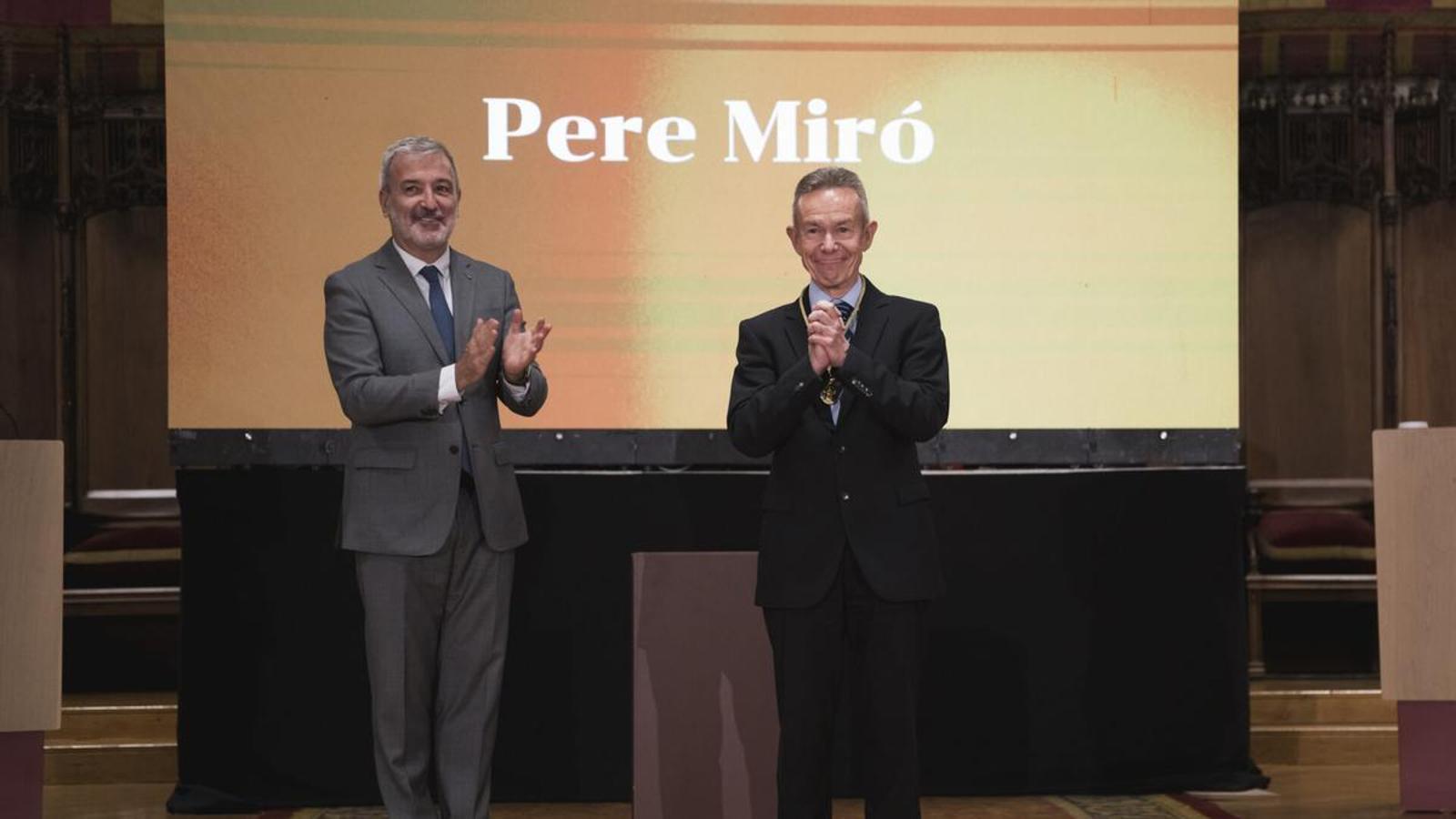
BarcelonaThe Saló de Cent at Barcelona City Hall seemed small on Monday afternoon, packed to the rafters with a crowd eager to greet Pere Miró i Sellarés (Manresa, 1955). He is one of those people who can walk down the street calmly, without being recognized by the many pedestrians who do not know that standing before them is one of the Catalans who has gone furthest on an international level. Those who know him highlight the same thing: he will not pin medals on himself in public, he will not exaggerate what he did. A modest and hardworking man. That is why it is fitting that others pin the medals on him, as Jaume Collboni did when presenting him with the city's Gold Medal for Sporting Merit. Miró's career deserves it.
Pere Miró ended up holding positions of great responsibility within the International Olympic Committee (IOC), where he worked for more than thirty years. He was the IOC's technical director, director of Olympic Solidarity, director of Relations with National Olympic Committees, and finally, deputy director general of the organization, as well as a special advisor to President Thomas Bach. "My president," as Miró says of the German, who was present in the front row. Bach did not want to miss it, as he knew it was a special moment for Miró, who was also once chosen as a favorite son of Manresa. "When we had problems at the IOC due to world geopolitics, we would call Pere. A great diplomat who has traveled all over the world negotiating," Bach explained in his speech. "And a man always proud of his identity and language, Catalan," he added, speaking of a good friend with whom he jokes about football: "I support Bayern and he supports Barça. I celebrate that Flick now unites us." Pere is a 'blaugrana', but when it comes to basketball, everything changes. His heart belongs to Bàsquet Manresa, of course. A universal Catalan who does not forget his roots and played a key role in the negotiations to create agreements in Bosnia after the war, when he sat at the same table as three opposing factions who could not even stand to look at each other. Achieving agreements.
How does a man from Manresa end up at the same table as representatives of warring factions using sports diplomacy? "I always say that I am a person who has not had bad luck," he says. He highlights the absence of bad luck, rather than talking about good luck. You have to be in the right place and know the key people. And in his case, it all begins when he was a "slightly chubby" boy. "It was July 20, 1968, a summer day at the pool, bored to tears. And I saw the swimmers and decided to go ask about swimming. There was Josep Claret, a key figure in local swimming. And a chubby boy who didn't know how to swim well arrived... He could have sent me away, but he suggested I try water polo. To this day, I still celebrate every July 20th," he explains. That day changed everything.
That boy who started practicing water polo at the same pool where Manel Estiarte, present at the event, would do so, was already captain of the children's team in less than two years. "In sports, you discover that you have to work hard, you have to know your virtues and flaws. And the strength of teamwork," explains the leader, who was surrounded by the players from that team. Years and years have passed and they remain in contact. "I like building teams," admits Miró. Wherever he has been, he has built unity. That is why when he receives an honor, everyone wants to be there. Sports had already entered his life and never left it. He went to study at the INEF in Madrid, since back then if you wanted to study sports, you had to go there. "Before, sports depended on the Movement, it was the José Antonio center in Madrid. It was Samaranch who pushed for the ability to separate sports from the schools of the Movement, and made them independent, something few remember now," he explains. Francoist sports were modernizing, and when the INEF opened a branch in Barcelona, Pere would enter as a professor.
And at 24 years old, when the Dictator dies, he is offered the position of director of the center. "The students were younger than me," he recalls of a time when "everything was yet to be done and everything was possible." Democracy was arriving and since President Jordi Pujol was told about a man from Manresa who knew how to do things well, he ended up on the Convergència i Unió lists for the Barcelona City Council, and he was elected councilor in 1987. Once again, Miró was in the ideal place at the right time, as the 1992 Games needed to be organized. "I remember organizing the INEF students the day President Samaranch announced that Barcelona would be the host city. And being clear that that moment would change the city, our lives, and that I wanted to be there." And yes, he was there.
As a City Council member and member of the executive team for the 1992 Olympic Games, he witnessed the urban, social, and sporting transformation of Barcelona up close. "There is nothing like the Games. It affects everyone. You talk to neighbors, doctors, builders, athletes, associations... It changed everything. Barcelona took it on as a collective project. And when society has a collective project, it is very beautiful," he explains. Joan Antoni Samaranch, the president of the IOC, followed the preparation of the Games in his hometown closely. He did not want to look bad. And he quickly understood that Miró was someone who worked well, so he took him to Lausanne once "the best Games of 1992, the ones that are still studied as a model," had ended, claims Miró. And he has not returned, because he lives in Switzerland, although he spends his summers in Begur.
The Bosnian challenge
At the IOC, one of the first complicated tasks he received was to go to Sarajevo to bring the three warring sides to an agreement: the Bosnian Muslim, the Croat, and the Serb. "The first time they agreed was to form the Olympic Committee. In 2000, at the Sydney Games parade, a member from each community carried the flag," he recalls with emotion. He participated in those negotiations and had to visit the city of Sarajevo more than thirty times. "I have spent my life on a plane. I have traveled too much," he admits. He has been sent to negotiate in Iraq or East Timor. He has met all kinds of leaders. And he has understood that "sport cannot stop wars. "If two sides want to fight, we cannot do anything about it. But we can help to change lives. A few years ago, we could do joint projects between Israelis and Palestinians, now it is difficult," he admits. "His common sense makes him a great diplomat, ideal for negotiating," Bach explained about Miró.
In a world where innocents always die, one of the projects he is most proud of is the creation of the refugee team. "Thomas Bach proposed it to me. I visited the second largest war refugee camp on the planet, in Kenya, with people fleeing South Sudan. We have two types of refugees: young people escaping war with the potential to compete and already established athletes who are fleeing war. In the Kenya camp, we offered a new future to young Sudanese with brilliant conditions for athletics who were able to go to the London Games. At the same time, in the refugee camps in Greece, we found the Syrian swimmer Yusra Mardini, who was fleeing the war. I still talk to her a lot," says a man who holds a special memory for Josep Lluís Vilaseca, vice president of the 1992 Games organizing committee, Joan Antoni Samaranch, and Thomas Bach. The three men who trusted him at key moments.
Miró has set foot in 167 different countries. In Europe, all except Estonia. At Monday's event, journalist Jordi Basté joked that now he should go on vacation to Estonia with Núria, on a trip, at last, for pleasure. No work. "I think I prefer to travel little, now," says Pere, who wants to learn to play the piano and continue studying languages. And preparing some much-needed memoirs, in which he will be able to explain the diplomacy of sport from the inside. The one that led a man from Manresa, who as a child did not even know he wanted to be an athlete, to meet the best world champions and the most powerful men on the planet.

