Mbappé's insubordinate history, a problem for Real Madrid
Perhaps Florentino Pérez did not foresee the consequences of building his project around a combative player sensitive to political issues

-
CAT -
CAST
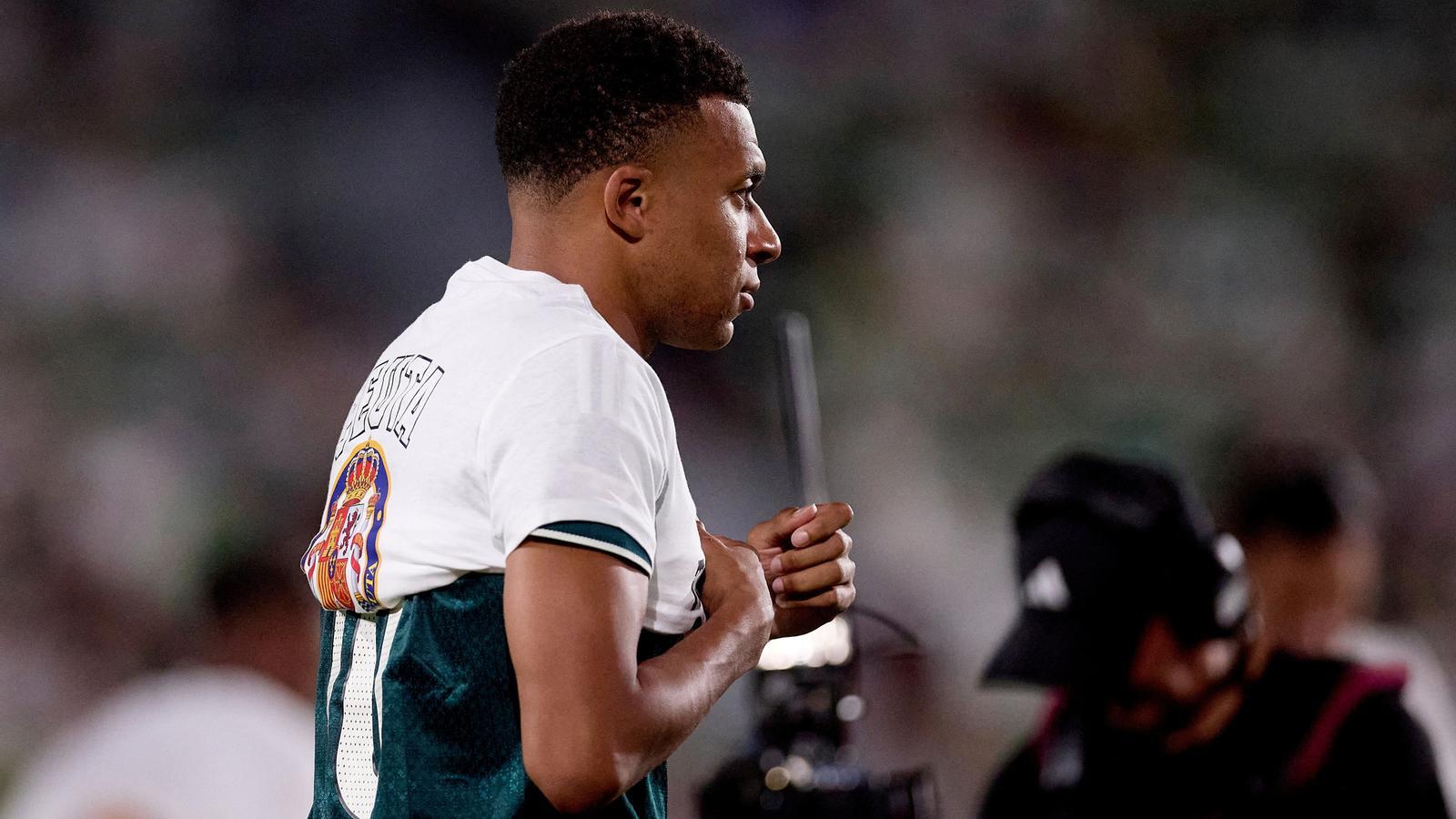
Kylian Mbappé, Vinícius Júnior and Ibrahima Konaté have ended up complicating the Ceuta crisis even further. The three Real Madrid players had a “gesture towards the immigrants who lost their lives and who live in very harsh conditions,” as explained by Mbappé, the only one of the three who, for now, has commented on the act of rolling up their shirts in support of Ceuta before the match against Elche. Although he also expressed his solidarity with the people of Ceuta, Mbappé said that he “did not want to prioritize suffering.” The great star of the white team, who has Algerian-Cameroonian roots and grew up in the suburbs of Paris, maintains a stance diametrically opposed to that of the Spanish nationalism of which his club is the greatest exponent, since he shows solidarity with immigrants, both dead and alive, to the same extent as with the people of Ceuta. In any case, he does not seem to regret his gesture, despite the avalanche of adverse reactions it has generated.
Among those who have defended the players are media outlets like El País, whose editorial describes the act as an “exercise in individual freedom,” although it also ponders that “perhaps they did not measure the impact of their gesture well.” They were also defended by David Aganzo, president of the AFE –the Spanish professional footballers' union–, who says that the protagonists “did not have enough information.” Both voices want to downplay the situation and have not fully taken seriously the message the players conveyed and which Mbappé has reaffirmed. A message that has also served the detractors of Florentino Pérez, such as the Ultras Sur or the newspaper El Confidencial, to accuse him of not being capable of running the club. The president of Real Madrid, who has avoided speaking explicitly on the subject, has explained that the visit to Ceuta that he carried out with Emilio Butragueño, the club's director of institutional relations, and José Martínez Pirri, honorary president and a native of Ceuta, had been planned for a long time and has nothing to do with “any recent news.”
Among those who do not approve of the players' act is the president of Ceuta, Juan Jesús Vivas, who states that putting on the shirt is "neither left-wing nor right-wing." This same line of argument was used by Abde Ezzalzouli, the Betis footballer, who wore it the day before the Merengue footballers refused to do so and said it was an initiative "of a social, not political nature," to defend himself from the lynching he suffered on social media from his Moroccan compatriots. Finally, those who have led the offensive against Mbappé have been the conservative media in Madrid, who describe the act as "shameful" and "treason to the homeland", as well as Marine Le Pen, who has asserted that not showing the message of solidarity with Ceuta is equivalent to not being committed to the sovereignty of Spain. But it is not the first time that the French far-right leader and the captain of the national team of the same country have clashed publicly.
Call to the polls before the European ChampionshipPerhaps Florentino did not foresee the consequences of building his sports project around a player who has demonstrated on repeated occasions that he has no problem with taking a stand on issues that concern him. Mbappé has made this one of his main causes: “You can be a footballer, you can be an international star, but, above all, you are a citizen,” he asserted a few months ago in Vanity Fair, in an interview in which he made explicit a struggle “against the idea that a footballer must be quiet and limit himself to playing.” And he insisted: “We are not disconnected from the world. People sometimes think that, because you have money and you are famous, these types of problems do not affect you. But they do affect me.” Thus, it is not the first time, nor will it be the last, that Lamine Yamal’s main competitor in this year’s Ballon d’Or race gives his opinion on tricky, sensitive, political topics.
In 2024, in the lead-up to the French legislative elections, Mbappé called for people to head to the polls, especially young people, to vote against the extremes and the ideas that divide, in a clear allusion to Le Pen’s party. “We have the opportunity to decide the future of our country and it is an important task that must be highlighted urgently. You, journalists, are very aware of it, but there are many young people who are not, at least consciously. Subconsciously yes, because you only have to look at the youth abstention rates in the suburbs and rural areas. When I was younger, I also thought that my voice could not change anything, but now I have realized that it can,” declared Mbappé in a press conference, just before starting to play in the European Championship with his national team.Other public controversies in which Mbappé has publicly taken a position have been against the murder of George Floyd, in 2020, at the hands of the Minneapolis police; against the beheading of Samuel Paty, the same year, at the hands of an Islamic terrorist, for having shown caricatures of Muhammad in class; against the racism towards Vinícius Júnior, in 2023, when they were not yet teammates, and other episodes in which the former Monaco and PSG player has shown himself to be sensitive to issues of police violence, racism, and terrorism.
Be that as it may, it is clear that Mbappé's statements will have repercussions, because deep down he has uncovered the elephant in the room: where is the difference between "us" and "the others"? Why should Mbappé feel more solidarity with the Spanish than with the Moroccans, if he is French of African origin? Because he plays for a Spanish club, someone will answer. But isn't football supposed to be an international phenomenon, and doesn't Real Madrid have many more followers outside of Spain than inside? Because football and politics should not be mixed, someone else will answer. But in Catalonia we know the power that national teams and international tournaments have in consolidating and fostering banal nationalism. And, therefore, we know that football and politics will, inevitably, always be mixed.
