Pere Millet: "After winning the Olympic medal, my father told me that I had to get to work"
Olympic medalist in sailing in 1976
-
CAT -
CAST
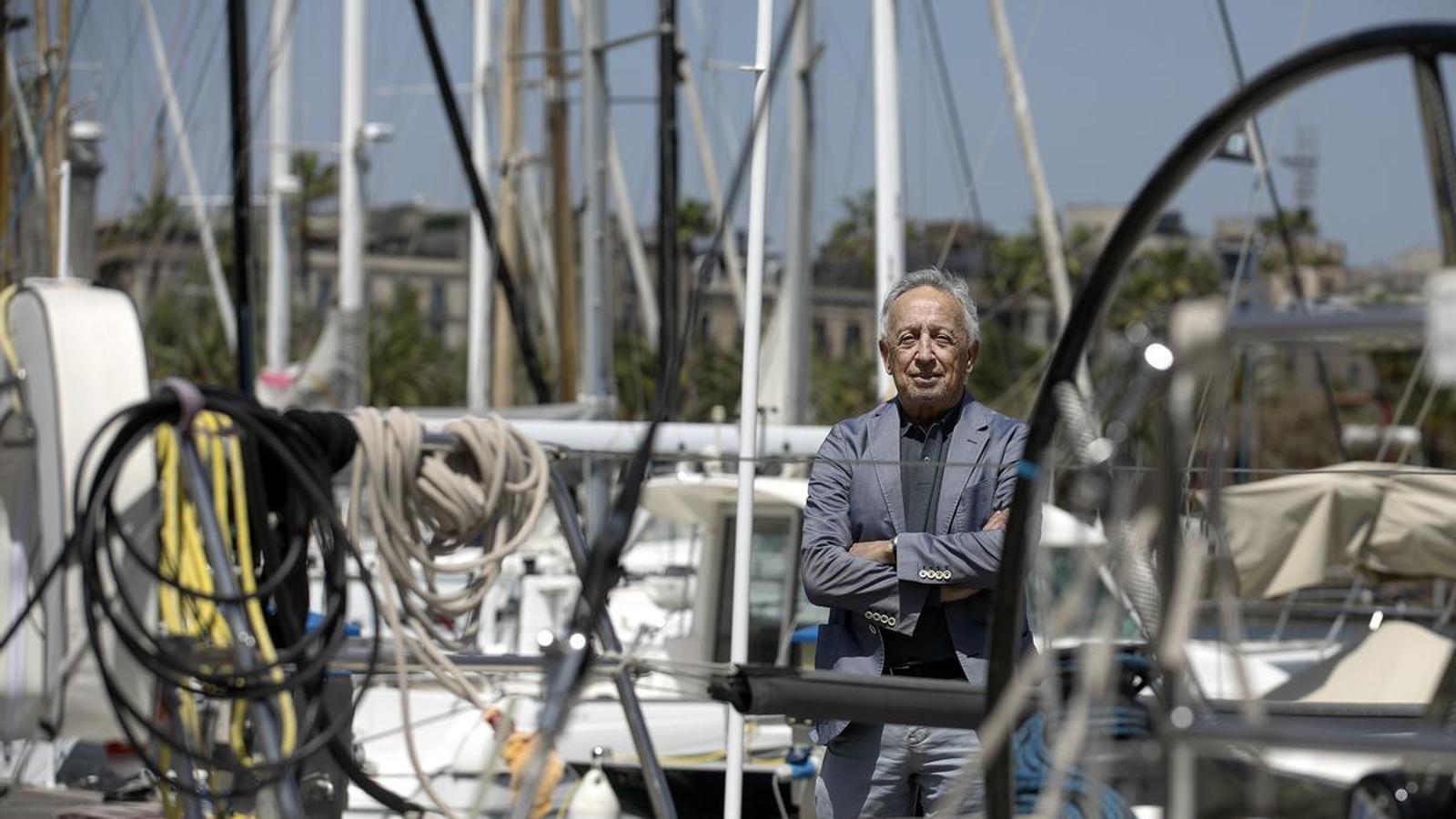
BarcelonaAt the restaurant of the Reial Club Nàutic de Barcelona, they put up a wooden sign with the name Pere Millet Soler (Barcelona, 1952) when he dines there. A gesture of deference towards one of the historic names in sailing, one of the first Catalan athletes to win an Olympic medal. He did so 50 years ago, on August 8, 1976, with a silver medal in the 470 class at the Montreal Games, partnered with Toño Gorostegui. Half a century later, he recalls that achievement speaking with ARA with sea views.
What do you feel remembering what happened half a century ago?
— It's a long time. Wow. It's nice that 50 years later those of us who lived it are still in touch. Nothing is comparable to being an Olympian. We were lucky to be in the right place at the right time, as it was at the moment when they finally committed to sailing in Spain by creating a training center in Palamós with a foreign coach, Paul Maes, who was Belgian. And in my case, I was lucky that it was the first time the 470 class was Olympic.
His career has some coincidences that worked in his favor. A lucky man.
— Yes. I started sailing in Masnou, as my father was from there. I started sailing in 1966, I think. And almost by chance, they asked me if I wanted to try a 470. There was a race and they were missing a crew member. And I won a regatta partnering with Miquel Ramentol, a guy from Masnou. Together we sailed for a few years in the 470, which luckily was chosen to be Olympic for the 1976 Games. Quite lucky, because here in Catalonia we had people who manufactured them and it was a boat we mastered. In 1973 the Federation summoned a group of sailors to take a course specifically for crew members who would train seriously in Palamós. And we were sailing until Kings' Day under the gaze of Pol Maes. It was he who made me a proposal: to go to a regatta in France partnering with Toño Gorostegui, a guy from Santander. That's how we met. We sailed for a day in Palamós. It went well and we were tenth in Cannes. And that day Toño told me that he had told his parents that he didn't want to study. He wanted to be Olympic and, therefore, he would stay in Palamós. And he asked me what I would do.
And what did he/she/it answer?
— I was studying. Second or third year of chemical engineering at the Institut Químic de Sarrià. I told him that my priority was my career, but that I would try to combine it. I went up on weekends to train. And so we started to compete. And the results started coming, winning the state championships already on the first of October.
Until then, had you dreamed of being an Olympian?
— The possibility of being an Olympian appeared very late. One must consider that there was a large group of boys training and they all wanted to go to the Games. That group of young people gained experience in important competitions like Kiel Week. I had other priorities, because in 1974 I finished my degree and went to do my military service.
What was the relationship with Toño like?
— It was love at first sight. We understood each other from the first moment. It is true that we, at first, were a very lightweight crew. In sailing, weight is an important factor and when the wind blew, we suffered. But technology was evolving and it was in our favor. When I started, there were some sailors who weighed 120 kg. But then we became leaner and leaner. That helped us. I remember the first European championship we went to together. It didn't go quite well and the next day I was entering Sant Climent Sescebes to do my military service. So I couldn't go to the World Championship that year. Toño went with Manuel Albalat, a guy from Palamós, and they were champions! And me doing my military service...
Was he afraid they would forget him?
— No, since Toño had told me to stay calm. He waited for me to go to the Games, things that mark you. He lives in Santander, but we keep in touch. From time to time we meet to play golf.
The 1976 games were held on a lake in Ontario, near Toronto. They were not held in the sea. Did it affect?
— We were used to sailing on lakes and also on reservoirs, it was common to do so in Spain, back then! We went often to one near Vitoria where the state championships were held. Or one near Badajoz or one near Madrid. Sailing in fresh water changes, due to density. We were able to go to the regatta course in Canada in a pre-Olympic week and also when a World Cup was held on Lake Ontario on the United States side. Then we would take the car to cross to Canada, to Kingston, where the Games would be held. We slept in student barracks. It was fun until Toño felt ill. He had hepatitis, it was a scare.
Spain had only won one medal in sailing until then, Santi Amat's gold in 1932. No one was expecting a medal, I understand.
— That medal from Amat really had merit, in 1932. I got to know him, he was passionate about sailing. We were cautious at the Games. The year 1975 had been bad. Luckily, we qualified. And the people from the Roga shipyards, from Vilassar, who made the 470s, appeared. And they made us a new boat just for us. And it was a matter of trying it and seeing that this boat was fantastic. In fact, they made us a second boat. And we made the mistake of sending the newest one to Canada, when we had hardly tried it. Toño always said that if we had sent the first boat, we could have done better.
Could you have won the gold?
— Who knows. We were very consistent. We didn't win a single race, but we were the most consistent, always between second and eighth place. The last day was nerve-wracking. The Soviets fell off the podium, the Australians got on it. It was too windy. We started second and were cautious. Upon arriving, we knew the silver was ours.
What was the atmosphere like at the Games? Were they Nadia Comaneci's Games, did you see her?
— On television. We couldn't be in Montreal. We had to be at the sailing venue, in Kingston, a very quiet university city near Toronto. We arrived 15 days early. On the day of the inauguration, they offered us to go to the opening ceremony, but we didn't go. There wasn't a single journalist in Kingston. And the day before the last race, the first ones arrived when they saw that we could win a medal. Àlex Botines arrived and Avelino Pi, a photographer. On the day of the closing ceremony, we were able to go to Montreal. We wanted to go out partying, but the Olympic Committee didn't let us, they made us go straight to the airport, and upon arrival we discovered that the plane that was supposed to take us was just leaving Madrid. They hadn't let us go out partying for fear that we would make a scene. I'm not sure how that return flight took off, since everyone had bought everything. Gifts, technology... in 1976 going to Canada was going to the first world, it wasn't like now.
How was the reception in Barcelona?
— Exciting. There was a huge crowd at the airport. The whole Masnou club, friends, curious people... Think that in a month I had only made one call to my parents. And my father spent years reminding me that it was a collect call that cost them a lot. And months later my father was already telling me that I had been able to enjoy sailing, but that it was time for me to start working. Months later I was already working. I continued sailing with dinghies, but it was the end of my competitive career. I have always continued sailing, but in a different way. I still sail. Tomorrow we will go to Blanes if the weather permits.

