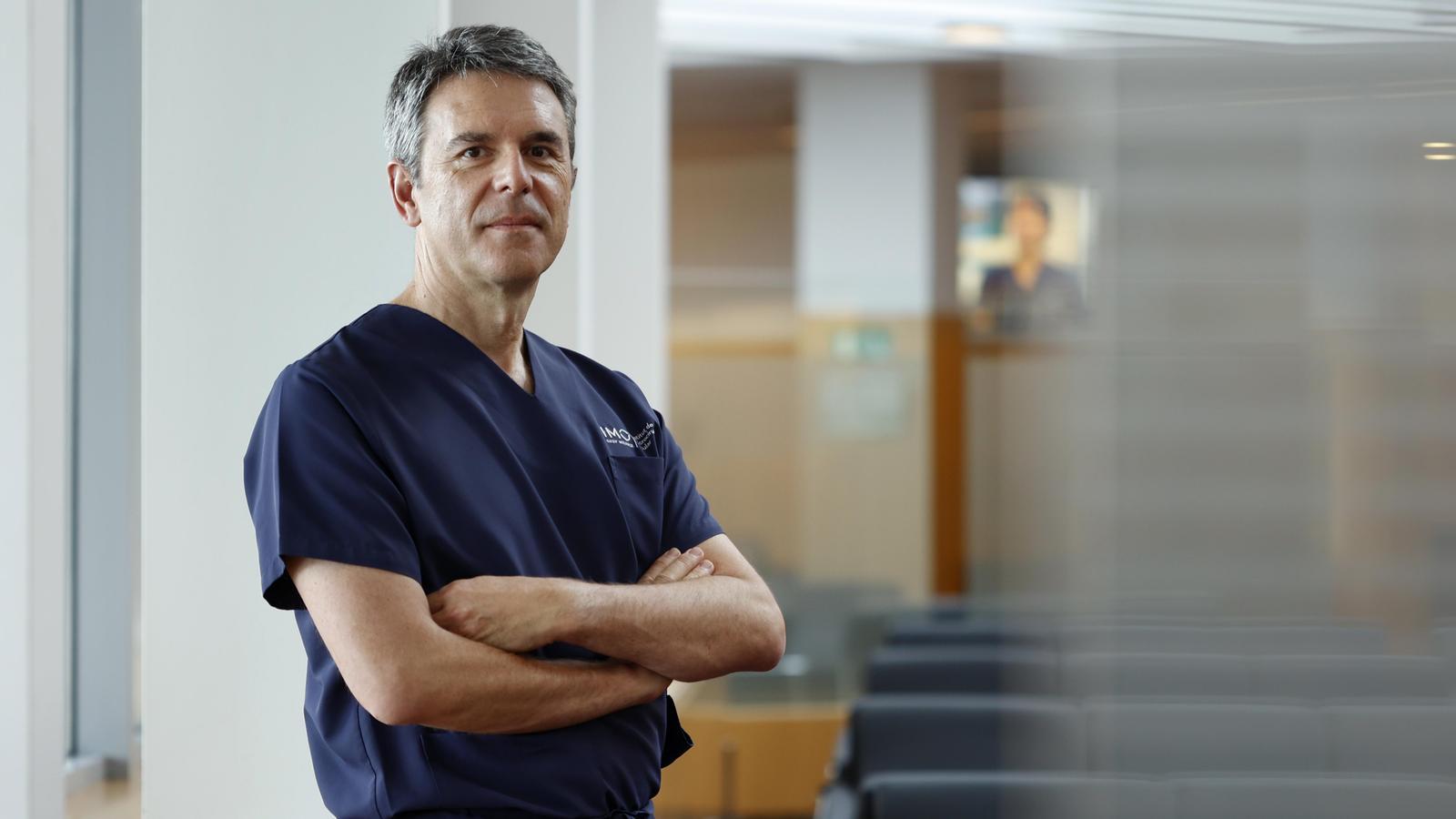
Dr. Daniel Elies: "We have advanced solutions to say goodbye to glasses"
The medical director of IMO Grup Miranza Barcelona explains the latest innovations in the correction of myopia, hyperopia, astigmatism, presbyopia (tired vision) and cataracts
-
CAT -
CAST
Thanks to refractive surgery, it is now possible to reduce dependence on glasses and contact lenses and regain freedom to drive, read, or play sports without limitations. It is a safe and effective option, backed by the experience of specialists. Dr. Daniel Elies, medical director and expert in refractive surgery at IMO Grup Miranza Barcelona, explains the latest advances in surgical techniques.
What does the success of refractive surgery depend on?
— Success depends, mainly, on choosing the most appropriate surgical technique and on knowing how to convey realistic expectations in each case. No two eyes are the same and each person is different, which is why techniques and postoperative follow-up are individually adapted to guarantee the best results. In this regard, the choice of technique depends on the characteristics of each patient's eye —their ocular health, lifestyle, and visual needs— and it is we specialists who determine the most appropriate option in each case.
What techniques are used?
— Mainly, there are two techniques to correct myopia, hyperopia and astigmatism: laser-based ones and intraocular lenses. Laser surgery reshapes the cornea precisely, adapting the correction to each patient's characteristics and achieving a quick recovery with minimal discomfort.
In patients with high diopters or depending on the cornea and ocular anatomy, phakic intraocular lenses (ICLs) may be a better option. These lenses are placed between the iris and the crystalline lens without removing it, and provide safe and stable correction. Furthermore, it is a reversible technique: the phakic lens can be removed if necessary, making it especially suitable for young patients to preserve the accommodation of the crystalline lens.
When presbyopia appears, how can it be treated?
— We usually perform lens surgery, an option especially indicated from 50-55 years of age in cases of presbyopia (tired vision) or with initial signs of cataracts. At IMO Grup Miranza, we have premium intraocular lenses (IOLs) that allow vision to be adapted to the needs of each patient and improve visual quality at all distances.
What does this surgery consist of?
— The intervention consists of removing the aged lens and replacing it with a lens adapted to the visual needs of each patient. This solution not only offers high-quality vision at all distances (far, intermediate, and near), but also allows for the correction of refractive errors and the prevention of future cataract development in a single procedure.
Are there advances in these interventions?
— Advances in the optical design of intraocular lenses have improved outcomes and reduced adverse effects. Lenses such as trifocal or EDOF lenses now allow more cases to be addressed with a high level of precision and personalization. At the same time, technologies such as the femtosecond laser allow for greater accuracy in incisions and better lens positioning.
— Furthermore, we have innovative ocular assessment systems, some based on artificial intelligence, which facilitate the choice of the most suitable intraocular lens for each patient. In the operating room, advanced platforms guide the surgeon in real-time, allowing for more precise, safe, and personalized interventions.
The onset of presbyopia can make reading difficult, as wearing glasses can sometimes be a hindrance. With this in mind, IMO Grup Miranza, during the month of April, coinciding with the celebration of Book Day, promotes culture and reading habits by offering patients undergoing surgery the opportunity to exchange each pair of glasses they no longer need for a book, in addition to other special conditions.
