Why is Spain the EU country with the most kilometers of high speed?
With 3,192 kilometers, the Spanish state concentrates more than a third of the European bloc's network

-
CAT -
CAST
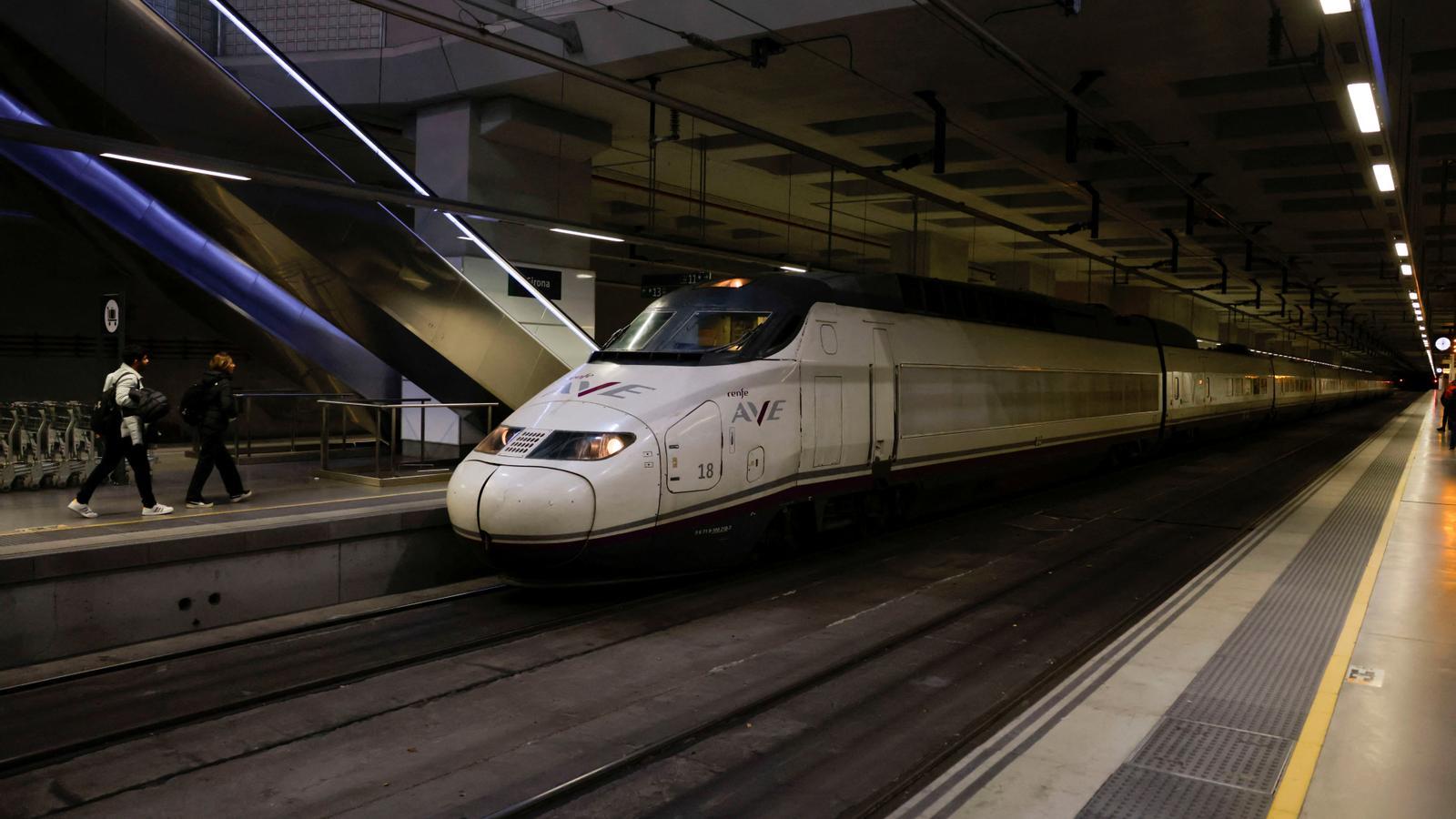
BrusselsSpain is the fourth largest economy in the eurozone, the second largest country in terms of square kilometers, and the fourth in terms of inhabitants in the European Union. And it is also the country with the most kilometers of high-speed rail lines in community territory. In fact, it is the second in the world, only behind China. The tragic train crash in Toledo—which has caused at least 68 deaths—has put the Spanish railway model in the spotlight. Above all, it has raised doubts about investment priorities, the use of the network, and the maintenance of infrastructure.
With 3,192 km of high-speed railway tracks –according to the latest annual data from Eurostat, from 2024–, Spain accounts for 37.3% of such tracks in the European Union. It is followed by France with 2,748 km (32.1%) and, further behind, Germany with 1,159 km (13.5%), Italy with 1,097 km (12.8%) and Belgium, the Netherlands and Denmark, with less than 250 km each.
Faced with this scenario, experts consulted by ARA explain what has made Spain bet so strongly on this model. For Armando Carrillo Zanuy, a researcher at the European Railway Research Network of Excellence, it is above all a political decision. "All politicians of any persuasion, at one time or another, have bet on this type of technology," he says. "It is neither good nor bad; it is simply a political decision." He adds an industrial argument: Spain has its own manufacturers and, according to him, high-speed rail is today "the best" there is in railway technology.
For Joan Carles Salmeron, director of Terminus, the commitment to "pharaonic" high-speed infrastructures stems from an electoral promise made by José María Aznar: in 1996 he pledged to connect Madrid with every provincial capital. "That investiture changed the country's railway policy," he states, while arguing that the investment came at the expense of conventional rail.
But politics does not explain everything. Carlos Rico, head of railway policy at the organization Transport & Environment (T&E), points to geography and cost as decisive elements. The majority of large cities in the Spanish state, he says, are less than 700 km from Madrid; a distance too long to travel by car and too short to travel by plane. Instead, it is suitable for high-speed rail. On the other hand, Rico cites a report by the public engineering and consulting firm Ineco, which estimates the average cost of high-speed rail in Spain at 17.7 million euros per kilometer, compared to 45.5 million in the rest of the countries that have it.
Be that as it may, the deployment of high-speed rail lines in the Spanish state has also been faster than in the rest of the European countries. Although it was Italy that inaugurated the first European high-speed line –with the first section of the Florence-Rome line in 1977–, France has been the pioneer on the continent in the model, with the Paris-Lyon line, inaugurated in 1981, and the development of the TGV, which inspired the rest of the European networks. In contrast, Spain began the AVE service in 1992, with the Madrid-Seville line, precisely where the two tragic railway accidents of this year have occurred: the one in Adamuz (Cordoba) last January and the one in Toledo this Wednesday.
In 34 years, however, Spain has made up ground. In 2005, for example, it was the third country in terms of the number of kilometers of high-speed lines, behind France and Germany. Since then, Germany's figures have remained almost the same and Spain's have tripled: it has gone from having 1,043 km to 3,192 km.
The French use the TGV more
The country most similar to Spain in terms of the railway system is France, which has also opted for the development of high-speed rail. Usage data, however, show significant differences and fuel some of the criticisms of the Spanish model. Principally, that a very extensive network does not, on its own, guarantee equally high utilization nor that the investment is recovered economically.
According to data from the National Commission on Markets and Competition (CNMC), in 2023 there were 58 daily circulations per kilometer of network in Spain, compared to 96 in France. A mirror that also reflects a 2018 report by the European Court of Auditors, which shows that France has 3.7 times more passengers per kilometer than Spain.
Furthermore, despite the size of the network, Spain remains poorly connected to European capitals. A fact that both Rico and Carrillo attribute to the lack of cooperation from neighboring countries, France and Portugal, which have not developed their high-speed infrastructure toward the Spanish borders.
The challenge of maintenance
As a network grows, as is the case in Spain, "it is necessary to invest more in maintenance than in construction," explains Carrillo. That is why he believes that countries like Germany or Switzerland, which have already built almost their entire network, allocate investment mainly to maintenance.
Maintenance is an essential condition for railway safety, but it is not the only factor that determines the risk of an accident. Carrillo states that they are multicausal: "design errors, a human error or bad luck." "We have had, in truth, quite bad luck with these recent accidents. But that does not mean that we have done things completely wrong," he adds. Rico and Salmeron also argue that safety does not depend only on whether a country prioritizes high-speed or conventional trains: both services are subject to safety standards and systems. "The train, whatever it may be, is the safest means of transport of all," concludes Salmeron.
