"We don't want to stay in Ceuta either"
Three young Moroccans who arrived by swimming explain how they survive trapped in the city and their plans to continue the journey towards Europe

-
CAT -
CAST
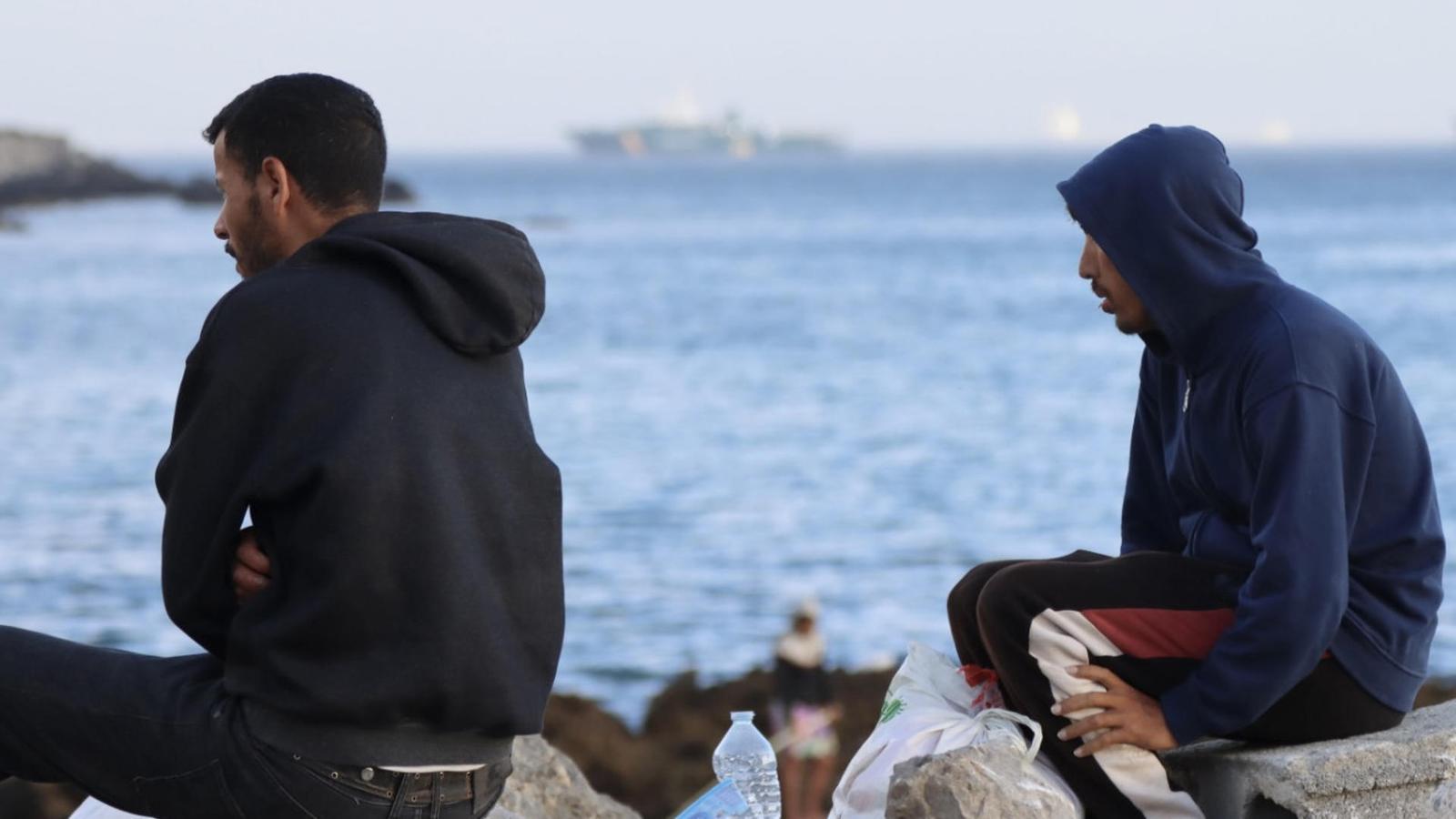
CeutaL'Ilias, Alfa, and Job have only known each other for a month, but they seem like lifelong friends. All three are Moroccan, they crossed the border by swimming during the massive influx of people on the last weekend of July, and they met in Ceuta. The first is a minor and is the only one who has wanted to give his real name. The other two, aged 22 and 23, prefer to remain anonymous in case of reprisals. They chat animatedly on the promenade in front of Benítez beach in Ceuta, where a few days ago a group of protesters stormed one of the camps in the city and set it on fire. Tonight, there is practically no one on the sand and the sea is calm, everything invites a swim under the moonlight. Although they have been surviving as best they can in the city for a month now and have seen it all, they are still surprised when a neighbor walking her dog glares at them.
"Could you reach the Peninsula by swimming?" asks Job, although from the tone of disappointment with which he asks, it seems he already knows the answer. He speaks excellent English, explains that he had a great teacher in Morocco and that he now strives to use complex words. Tonight he acts as a translator for the other two, especially for L'Ilias, who only speaks Darija, the dialect of Arabic spoken in Morocco. The youngest comes from Tangier, where he worked whatever he could, mainly doing manual labor, but he was often not paid. His mother died in childbirth and his father abandoned him at four years old, he lived on the street and sometimes had to work 12-hour shifts to earn a living. That's why when he saw that he could cross the border, he didn't think twice and went to try his luck in Spain.
For now, however, he explains that his stay in Europe has consisted of sleeping in the woods, fleeing and hiding, and wandering through the city while waiting for a solution from the Spanish government. "Shall we go for a swim?", suggests Alfa, who chose this pseudonym because he acts as if he were the leader of his group of friends. They watch out for each other, they worry especially about Ilias, whom they want to take to a minor's center so he doesn't have to sleep rough or spend what little he has on a hostel. He wants to too, but he's scared. Finally, only Alfa and Kora, a volunteer from an NGO they met in Ceuta, dare to go into the water at midnight. Job watches from afar, longing, but he only has one pair of trousers and doesn't want to get them wet. He admits that this month has been tough, tougher than when he had to make a living in his country of origin. "Even someone who is having a hard time in Morocco doesn't suffer as much as we have suffered this last month," he assures.
The water is cold and the two brave ones don't take long to get out. The group returns to the promenade, in front of a bar decorated with several Spanish flags. "You eat well here, they make good burgers. The owner says he doesn't want immigrants, but he is Moroccan and all his workers speak Darija, so I go anyway," says Job. Spain is not the final destination they have in mind. Job explains that his dream is to cross to the Peninsula and from there go to the Netherlands, where he believes he would fit in well with his type of character. Alfa also says he wants to go to Northern Europe, he is very interested in learning Dutch. Ilias, on the other hand, wants to go to Belgium, where a cousin of his lives.
A GTA Ceuta
The young people understand the unease of the residents of Ceuta after this last month of growing tension in the city. They know that entering a country illegally "is bad", but, although they hope that moments like those experienced on July 30 and 31 will not be repeated, they argue that there are immigrants with the ambition to have a good life and contribute to the economy of the country that opens its doors to them. "Paying taxes, having papers in order, and helping our families: anyone who does anything different is a bad person and deserves to return to their country," explains Job. He adds that not all those who emigrate are the poorest: increasingly, there are more who, despite having education and aspirations, see no future in their country. None of them contemplate the option of going back. "We don't want to stay here either," he assures.
This Monday will be the fifth week they have been in Ceuta. While the situation is not resolved, they survive as best they can. Now they sleep in a hostel and Job has given himself a week's deadline to see what he will do, as it is expensive and he will not be able to pay for it for many more days. He tries not to get discouraged and changes the subject to talk about something more cheerful. "Have you seen the trailer for the new GTA?" he asks excitedly. To simplify it greatly, it is a video game in which the protagonist is a criminal and, depending on the crimes he commits, he earns more or fewer stars, up to a maximum of five. "They should make a GTA Ceuta," suggests one of them, and they all laugh. "Yes, for example, fleeing from soldiers who want to beat you up: two stars," adds another. "Sleeping in the woods: three stars." "Distributing food to migrants: five stars," concludes Alfa, and the laughter ends.
