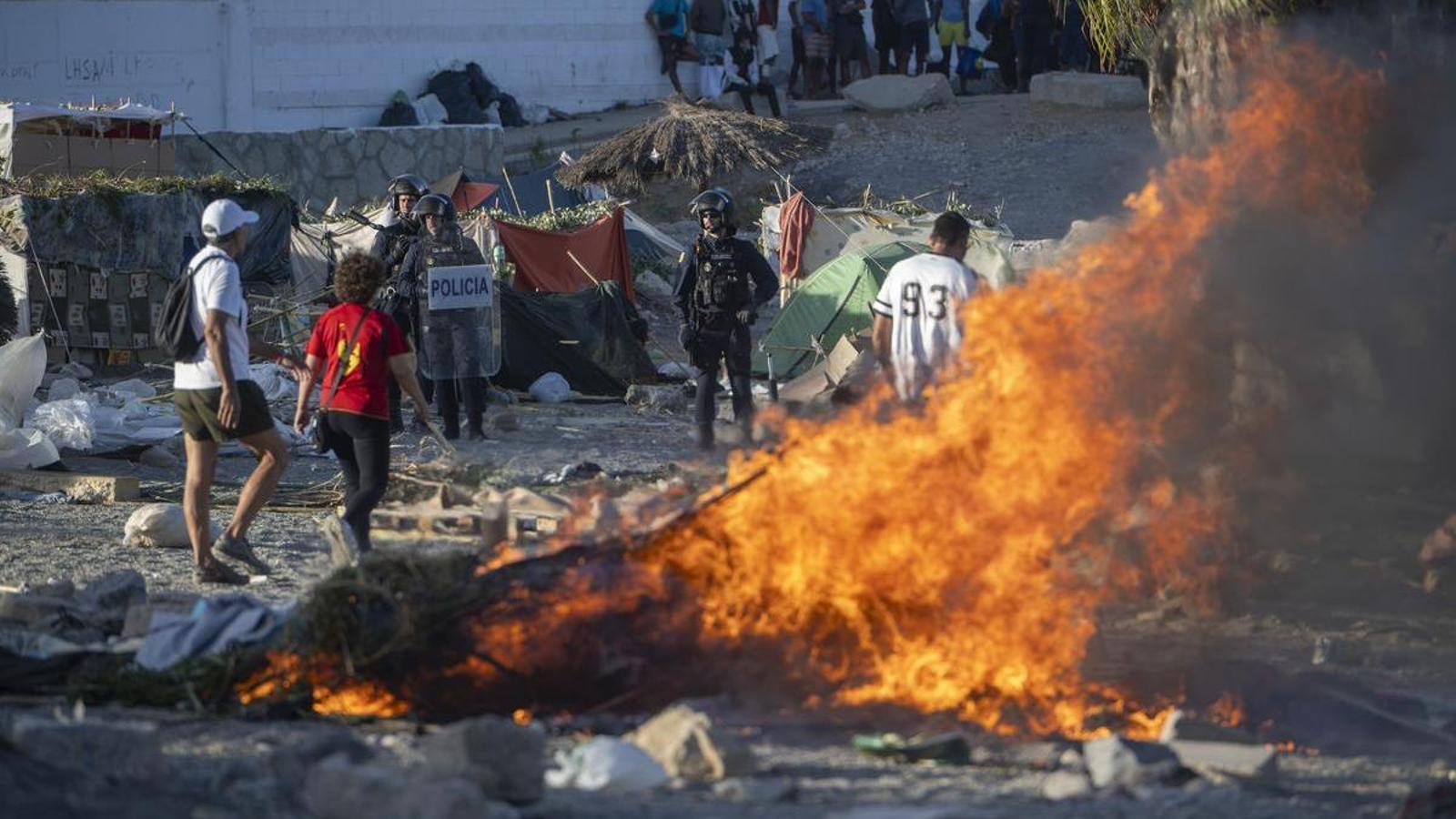
They assault and set fire to the migrant camp in Ceuta
Tension escalates in the autonomous city: neighbors prevent food from entering Trampolín beach for more than two hours
-
CAT -
CAST
Madrid / BarcelonaThe worst migratory crisis in recent years, which has claimed at least 140 lives, is pushing Ceuta to its limit. This Thursday, hundreds of people blocked the access of a Red Cross truck to Trampolín beach for more than two hours, where the organization distributes food to the immigrants who have remained there since their arrival on July 30. Afterwards, the demonstrators, many of them carrying Spanish flags, sticks, and stones, broke the police cordon on Benítez beach, stormed the camp where these people have been sleeping for almost a month, and set fire to two straw parasols that had become improvised shelters for the migrants to protect themselves from the sun.
Before storming the beach, the demonstrators chanted slogans such as "Ceuta is not for sale, Ceuta is defended" or "I am Spanish" and expressed their discontent with the prolongation of a situation that, as they denounced, is conditioning the daily lives of the residents and generating a growing sense of insecurity. During the rally, criticism was also heard against the Red Cross and calls not to buy their coupons, in protest of the attention they give to immigrants settled in different parts of the city, according to Efe. The demonstrators stormed the camp with a large Spanish flag.
This is a trend that has already been seen in previous rallies in the city. "Tension is growing in Ceuta. Demonstrations with very undesirable slogans and a very hostile attitude towards the social entities that are on the ground are being activated, and this concerns us greatly. It is uncomfortable to walk in the street and it is important that it be stopped. We are very concerned about the climate of tension, which is enormous and there are those who fuel the tension with irresponsible discourse," explains the general director of the Sur Acoge Federation, José Miguel Morales, in a telephone conversation with ARA. This organization with a presence in Ceuta is the one that is responsible on the ground for the reception and support of a large number of girls and women.
Thus, while a part of the Ceuta citizenry continues to provide a humanitarian response to the migrant population, others are radicalizing their discourse and some have even resorted to violence this Thursday with the storming of the camp. Halima, from the NGO Luna Blanca, explains to ARA that until now there was tension, but these days after the demonstrations there is a "witch hunt against the migrant population" and the city "is a powder keg".
On the other hand, the participants have argued that their mobilization aims to claim the right of Ceuta residents to regain normality and have questioned that, almost a month after the massive entry, solutions are still not being specified that would allow the city to be decongested and provide a response to the people who remain there. The concentration occurs 28 days after the entry of tens of thousands of people from Morocco, a migratory crisis – and at the same time the deadliest tragedy at the southern border since records began – which has generated strong social tension in Ceuta and has led to repeated citizen demands for administrations to adopt measures that allow normality to be restored in the city.
Hate speech
This Thursday, the Minister of Territorial Policy, Ángel Víctor Torres, called for “non-violence” and warned that it cannot be that Red Cross workers from Ceuta feel “amenaced” for giving food to migrants. The Minister of Justice, Félix Bolaños, asked for “calm” and “confidence” from the increasingly tense citizens of Ceuta. “We will return to normality,” he promised, and he downplayed the insecurity denounced by the opposition. He admitted that there has been a spike in crime – 4.2% – in Ceuta, but believes that the figures do not align with the situation depicted by the right.
In the same way that politicians ask for responsibility from the city's residents, they ask it from those most responsible for managing the crisis. Morales, from Sur Acoge, regrets that there has been a lack of agility in the humanitarian response: "We need responsible political discourse, and to say and affirm that everyone must and will be able to return is not a responsible discourse, it is an antidemocratic discourse. Furthermore, it is impossible by law, it will not be like that."
While migrants continue to be on the streets, the social entities attending to them warn that the use of words like “invasion” is what fuels hate speech towards the migrant population. This is an expression that the PP and Vox have used on repeated occasions, finding in this crisis a vein for hardening anti-immigration discourse and, consequently, to push for stricter border control. In fact, the organization secretary of the PSOE, Rebeca Torró, has accused both parties of “the climate of hatred” that has settled in Ceuta and has linked Thursday's assault to the visit of former Spanish president José María Aznar.
