Up to 50 fires in one day in Catalonia: "We have to consider that not all of them will be able to be extinguished"
The main risk of fifth-generation fires is that there are no resources to face them all at once

-
CAT -
CAST
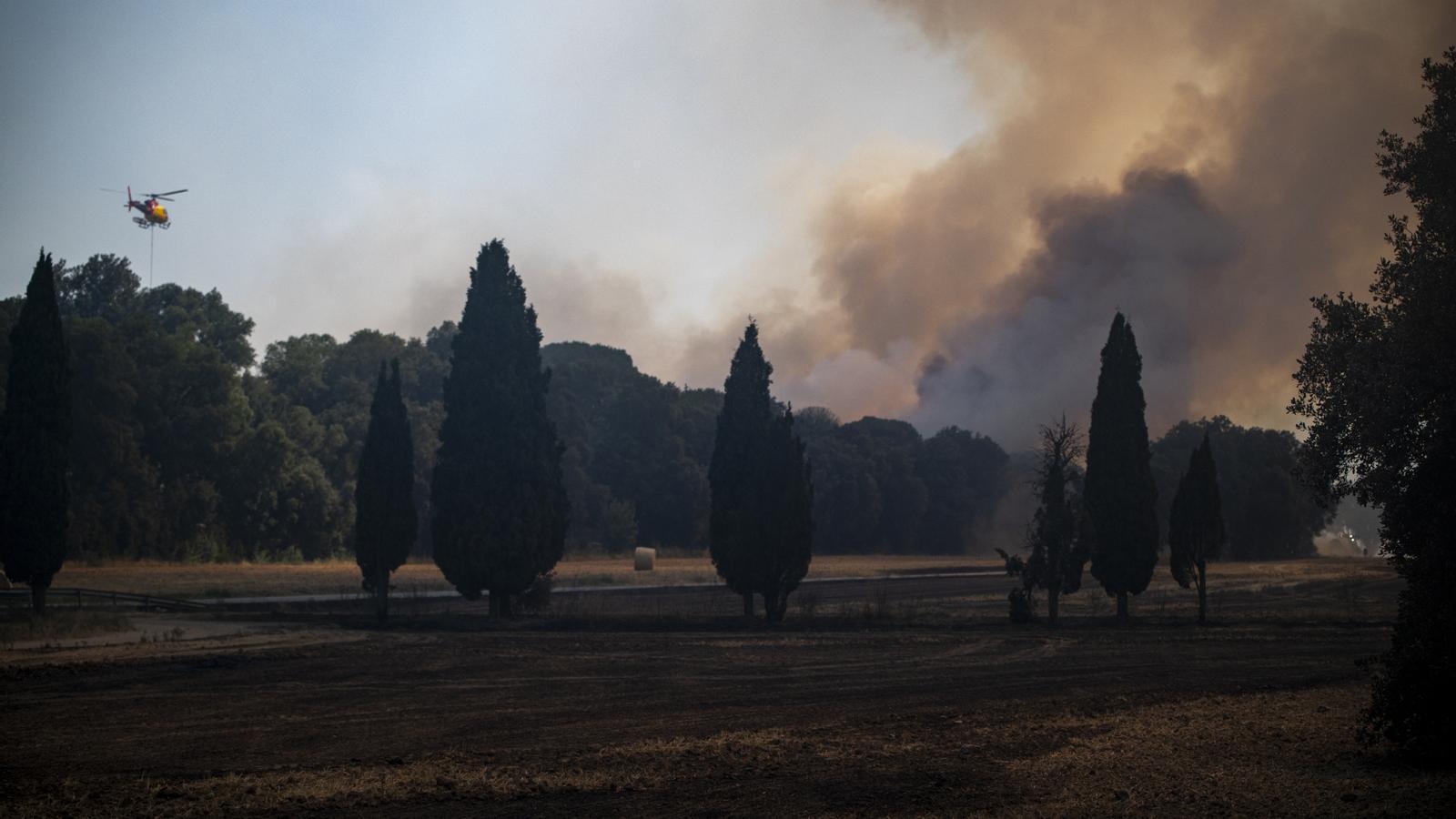
BarcelonaThe Generalitat Firefighters have long have a web page where all the fires they are working on can be consulted live. This Monday afternoon, no less than fifty simultaneous fires were active. Some stabilized after very tough hours – and little rest for the staff – like the one in Bisbal d'Empordà, and others active and worrying, like the one in Sentmenat or Anoia. The scenario of simultaneous fires is always one that causes firefighters the most anguish, as they face the possibility, however distant it may be, that they may not reach all the fires or may not be able to allocate the necessary resources to all of them.
To define the fires that occur in our country, the Firefighters talk about generations. Lately, there has been a lot of talk about sixth-generation fires, which burn at unprecedented speeds, affect large areas, and create large pyrocumulus clouds. Fifth-generation fires, however, are those that occur simultaneously, as explained by Anna Badia, a professor of human geography at the UAB. They tend to be smaller, but more widespread.
Núria Prat Guitart, head of knowledge and applied science at the Pau Costa Foundation and doctor in forest fires, adds that the trend of simultaneous fires has been detected, especially in the last decade and it evidences a reality: that the vast majority of the country's forest masses are "very available", that they ignite with any spark or accident. At the extreme is the possibility that "there is no capacity to respond to all fires". "We have very developed firefighters, but they are who they are," she comments. Right now, in this summer campaign, there are 2,883 professional firefighters available and 1,395 volunteers.
The risk is evident and it is that the Firefighters, in a scenario of simultaneity, cannot reach everything. "The Mediterranean forest is ecologically prepared to burn. As a society we will have to consider that in summer there are fires and that we will not be able to put them all out. And we have to think about how we protect ourselves as much as possible. Perhaps the Firefighters will not be able to attend to the fire around your house or will not be able to dedicate all the necessary resources to it," warns Prat.
Fire as a tool
The two forest fire experts are particularly concerned about this campaign. "It rained a lot in the spring and the grass grew. Now, however, the undergrowth is dry," describes Badia. Climate change has played an important role, but so has the abandonment of rural areas. "Fires reflect how we organize ourselves and relate to the territory. Fire is part of our lives. For millennia we have learned to control it. We must know that it is part of nature," explains the UAB professor, who defends prescribed burns and criticizes that there are currently many administrative obstacles in Catalonia to carry them out. "We must get used to fire being a tool for forest management," she insists. In fact, she points out a paradox: "Since we have data, the number of fires is decreasing, the area also, but we are so efficient at putting out fires that fuel is accumulating for new fires. Small fires control vegetation," she points out. That is, before the danger was lower, because a fire burned an entire area and it was difficult for it to reignite. Now, the speed of extinction leaves areas vulnerable to flames.
Facing the scenario ahead, of "fires we won't be able to stop", Badia insists on shared responsibility, on not leaving everything in the hands of the Firefighters, on being aware of where we live. "Let's consume locally, from local farmers, who are the ones who manage the territory for us", he reflects. "As a society, we must be aware that we have to invest in caring for the landscape", Prat adds.
The two experts also insist on the need for education, also for those who live in isolated houses and must be aware of how to isolate them from fire. Even for children in schools. In fact, the Pau Costa foundation participated in the creation of a tool which allows you to measure your home's vulnerabilities to forest fires. The reflection is not far from what Civil Protection often communicates with messages such as the kit emergency: that in times of changing climate like the ones we are experiencing, self-protection is key, that the administration will not always be able to reach everywhere.
That the scenario is complex does not mean that solutions are not being sought. The two experts agree that the Firefighters are one of the most developed extinction corps in the world. And that "a lot of progress is being made", in Prat's words, in public and private initiatives that work on prevention. "The solutions are on the table, now it's about seeing how we implement them," she explains. One of the problems to address is wheat fields, which burn quickly with any spark and the fire spreads easily through a forest where there are no firebreaks. Badia speaks of the need to care for the roads, which can slow down fires and facilitate the passage of firefighters to attack them. And to create strips, such as vineyards and cultivated fields, the famous mosaic landscape that has been requested for decades but has not arrived.
