A third of Spaniards believe that homosexuals are still in the work closet
24% of the population states to have had sexual relations with between five and ten people throughout their lives
-
CAT -
CAST
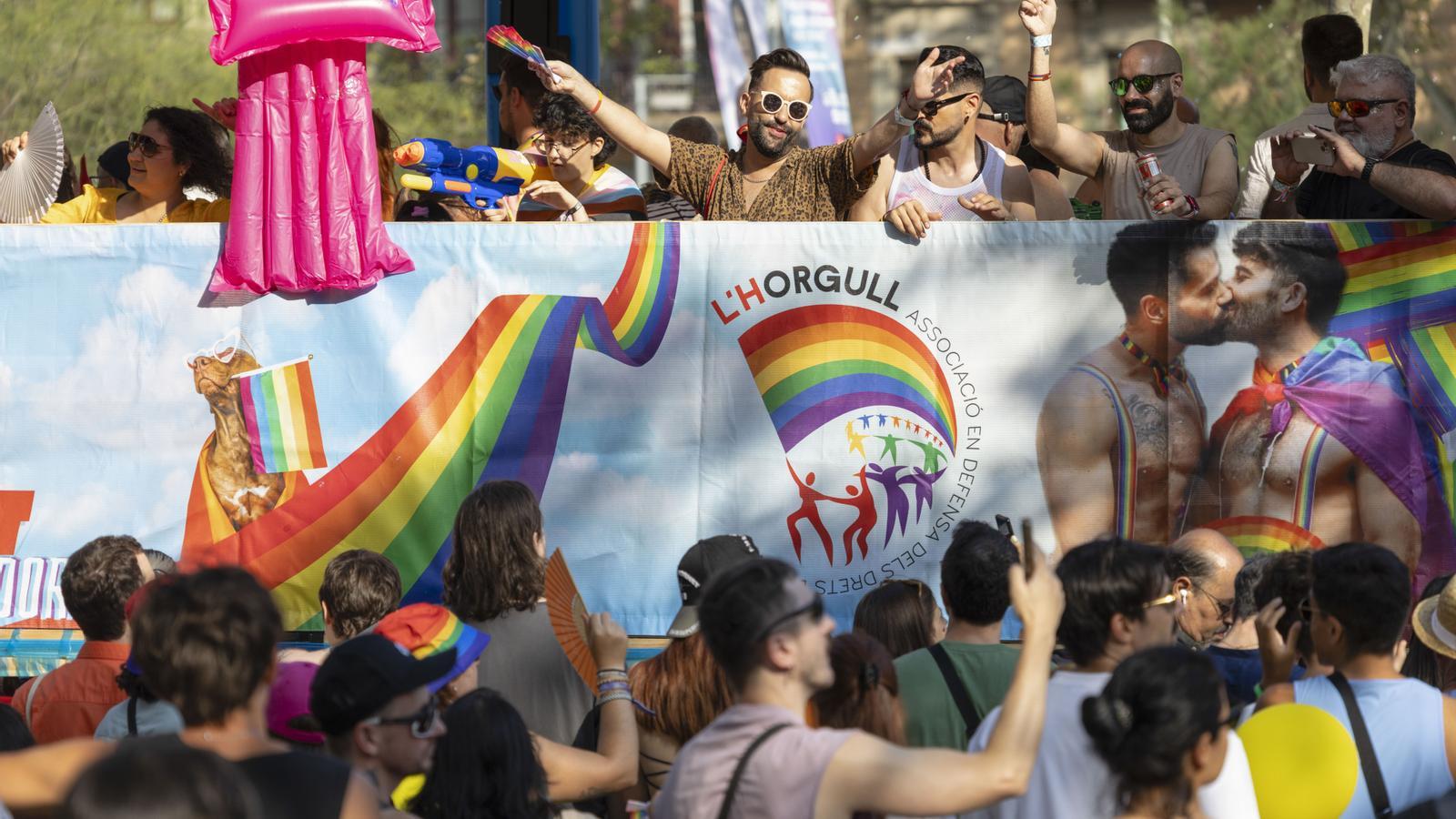
BarcelonaOn paper, Spain has won the game against homophobia, but today it is still difficult to come out of the closet in some areas. While almost three-quarters of Spaniards (72%) share the importance of recognizing the LGTBIQ+ rights, at the same time, around a third believe that gay, lesbian and bisexual people cannot speak naturally in their workplaces. The percentage rises to half in the case of transsexual people. It is one of the conclusions of the survey on sexual diversity that the Sociological Research Center (CIS) published this Wednesday based on 5,005 interviews it conducted this June, coinciding with Pride demands.
The CIS also offers a snapshot of the affective and sexual habits of the Spanish population. According to this, 72% of respondents currently have a partner, while 25% do not. Only 2.8% state they have never had a partner. Regarding relationships throughout life, 31% claim to have had only one partner, 22.4% have had two, and 19% three. In contrast, nearly 11% admit to having had between five and nine partners. The survey also analyzes sexual experiences. 24% of the population states to have had sexual relations with between five and ten people throughout their lives, while another 11% claims to have had them with between eleven and twenty people.
The study reveals that, despite the advances made in rights, there are still closed closets. For example, at work 35% consider that gay and lesbian people do not feel comfortable talking about their orientation, compared to 33% of bisexuals and 48% of trans people. The workplace is the area with the most doors, followed by studies. According to the results, the community also speaks with a lot of more normality among friends than with family.
Despite this social acceptance of the community, there continue to be attacks against LGTBIQ+ people. Three out of four respondents say they have witnessed scenes where homosexuals or transsexuals were insulted (faggot, a baker, butterfly, transvestite, fig-eater, mockery, imitation of gestures and tone of voice), and one in four responds that they have even seen them physically assaulted, threatened, or isolated.
Presence of the flag
Another of the contradictions shown by the CIS survey is that more than half of the population does not see it well for the rainbow flag, which represents the collective, to be raised in a public building – they believe that only institutional ones should be there – even though 70% are in favor of shops displaying the symbol, many because they consider that its presence fosters respect and responsibility.
The CIS also asks about the application of laws and emphasizes that almost six out of ten people believe that having certain political ideas can be detrimental when applying the law. It points out that 72% believe that everyone is not treated the same and that there are differences "depending on who it is." For 66%, being poor is the characteristic that can reflect a greater difference in treatment before the law, followed by political ideas (56.3%), being Roma and of foreign origin (50 and 51.5%), and being a woman (45%). For four out of ten, it is also a penalty to be Muslim or of another religion, to be homosexual, transsexual, or to have a disability.
The survey also reveals how Spaniards are perceived: thus, the vast majority (almost nine out of ten) define themselves as heterosexual, while 4.8% express themselves as bisexual and the remaining 2.3% are distributed among other orientations and identities (gay, lesbian, non-binary, asexual or pansexual). When asked about the real attraction felt throughout life, one in ten people admits to having felt attraction to both sexes, not caring about the gender of the partner, or not having experienced attraction to anyone.

Finally, the CIS points out that 41% of the surveyed people consider that the PSOE is the party that best defends the rights of the LGTBIQ+ collective. Behind them are Podemos (28%) and Sumar (26%), while only 5.8% point to the PP.
